

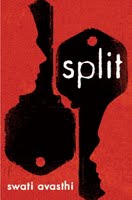
 Despite having just been released yesterday, Swati Avasthi's debut novel, SPLIT, has already garnered much praise and attention for its intense and realistic portrayal of a teenage victim of domestic violence, and his struggles to rebuild his life after escaping from his destructive home. Below, she traces the origins of the book to her personal experiences with families suffering from similar abuse, and describes how she was able to find hope and inspiration from their heartbreaking stories.
 And if you haven't already, be sure to check the book trailer for SPLIT, here.
My debut novel, SPLIT, is narrated by 16-year-old Jace Witherspoon, who has just fled 1300 miles after finally hitting his dad back. He hasn’t seen his brother, Christian, in five years. But he shows up on Christian’s doorstep with $3.84 in his pocket, bruises on his face, and a secret. He tries for a clean slate, but can’t really go on living with his secret, unless he deals with all he’s left behind: his mom (who is still trapped with his dad) and his girlfriend --- well, his ex-girlfriend --- Lauren, who just won’t stop emailing him.
Jace’s story grew out of the three years I coordinated a domestic violence legal clinic. I learned a lot of lessons about survival and courage. I was often asked how I could put up with so much sadness and misery, but to me, it was inspiring. Every day, I watched men and women seeking orders of protection bravely come into our office, facing down the devil they knew and opting for the devil they didn’t.
Once, a woman came in with her two kids. She was telling me about a harrowing incident when I stopped her and asked her if she’d like an intern to look after her kids. She wasn’t sure why and when I told her that it might be hard for them to hear about her experience, she told me that they had seen it. It was chilling to think that the two little kids in front of me witnessed this. I wondered who these kids would turn into when their primary role model for manhood was an abuser. The kids, the boy in particular, began to haunt me.
Additionally, I was disturbed by my own response to his mother. Underneath all my sympathy and genuine concern for her, there was a tinge of anger toward her. I wanted her to protect her children, to be a responsible mother. But I was blaming the wrong person. I needed to hold their father accountable.
Domestic violence is typically seen as a women’s issue, but to me, that seems strange. In most cases, the abusers are men. Abusers have the clearest line of sight to ending abuse, to breaking the cycle. Women can escape abuse (though it is very difficult and requires an impressive amount of courage) and go on to a better relationship. But abusers carry their hatred and anger to their next victim.
SPLIT is about what happens after the abuse is over. Jace, who terms himself a Scholar of Fightology, has a lot of Fightology Lessons to unlearn. He needs to find a better way, a way that is not just about survival, but about living.
-- Swati Avasthi

