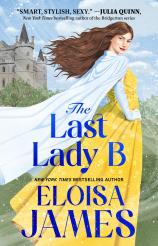
The Last Lady B
Review
The Last Lady B
Romances are romances, right? Not exactly, as Eloisa James proves so beautifully in her latest novel, THE LAST LADY B. It seems the antithesis of romance when Genevieve agrees to marry Lord Burnsby, whom her father describes on the first page as “a nasty old goat with three dead wives.” Her groom is older than her father, but unlike her father, he's extremely wealthy and willing to offer her sister Rosie a dowry, without which Rosie will not be able to marry a titled gentleman. While love is all well and good, without money it was nothing at that time and in their social class.
Genevieve's own father is a poor money manager, leaving them in financial straits. Their mother died, and the two sisters did the best they could. But as the oldest, it was Genevieve upon whom the responsibility of raising Rosie fell. Genevieve's outlook is pragmatic. She made it clear to Lord Burnsby that her expectations included no conjugal visits, and she would be Lady Burnsby in name only.
"THE LAST LADY B may be just under 400 pages, but they fly by. Readers will delight at Lady Burnsby's fortitude and marvel at the fantastic tale that uncovers more plot twists than snow on the ground during a Scottish Highland winter."
So when, after a few months of marital ennui, they travel to Burnsby's Highland estate in Scotland, Genevieve is shocked to find her husband's mistress ensconced in that remote, supposedly haunted, former abbey. Not only does his mistress reside there, so do a teenage daughter, Ophelia, whom he does not acknowledge, and someone he introduces as his sister, Mima, who was born on the wrong side of the blanket.
The three women who reside permanently at the remote abbey are unlike anyone Genevieve has ever met. Ophelia has grown up with no guidance or education. Anything she knows is from reading books from the library, many of which were quite inappropriate for a young girl. Her Aunt Mima is not cognitively able to hold conversations and cannot remember much of anything. And the mistress, Sophonisba, is an unbearable woman who delights in shoving her relationship with Lord Burnsby in Genevieve's face.
Also there for the Christmas holidays are Lord Burnsby's son and heir, Lancelot; Lancelot's French wife, Colette; and Lancelot's best friend from childhood, Godric, a barrister. Then there is Peony, the piglet who fell asleep on Genevieve's foot while she and her siblings were on their way to market as the Burnsbys were passing through on their own journey. Genevieve took pity on the sweet little pink creature; to Lord Burnsby’s disgust, she saved her from slaughter and took her as a pet.
Genevieve is excited to be at the abbey and thrilled that she might encounter a real ghost, as ghosts are rumored to appear there. Her husband has disappeared to spend time with his mistress, and she is rightly humiliated and furious about the situation in which she finds herself. And they have Christmas and Lord Burnsby's 70th birthday to celebrate.
What really makes this romance different from others is the style of the first-person narrative. As James explains in the note at the end of the novel, she styled it on NORTHANGER ABBEY, which she comments “is written in a wry, ironic voice that mocks literary pretensions...” She explains that Jane Austen created a “metafictional narrative, a way to talk to the reader and tell her story at once.” And that's what makes this narrative unique and very enjoyable. Genevieve is talking to us, and while the pretense is the advice to Rosie at the start of each chapter, the rest is really just Genevieve telling her story. Her voice is delightful and relatable.
There is, of course, romance. But there is also murder, bigamy, mistaken identities, and more causes for confusion that make the ending so complex and even a bit perplexing that some might be tempted to reread it. There may even be ghosts. But I love that James creates engaging, likable, intelligent and strong female characters who don't sit back and let society dictate to them. This novel, like her others, showcases her ability to write smart, clever dialogue and imagine smart, clever situations in which the characters' personalities and their strengths are amply displayed. (Other assets might be amply displayed as well.)
THE LAST LADY B may be just under 400 pages, but they fly by. Readers will delight at Lady Burnsby's fortitude and marvel at the fantastic tale that uncovers more plot twists than snow on the ground during a Scottish Highland winter. Read it for the romance, but also for the pleasure of enjoying a creative masterpiece of misdirection with a side of betrayal and secrets and a truly delightful villain (or two).
Reviewed by Pamela Kramer on June 12, 2026
The Last Lady B
- Publication Date: May 12, 2026
- Genres: Fiction, Gothic, Historical Fiction, Historical Romance, Romance
- Paperback: 384 pages
- Publisher: Gallery Books
- ISBN-10: 1668200058
- ISBN-13: 9781668200056