Interview: February 5, 2026
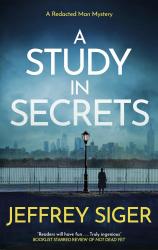
A retired gentleman with a complicated past. A missing priceless treasure. A young woman in trouble. A STUDY IN SECRETS kicks off Jeffrey Siger’s Redacted Man mystery series, which features a Sherlock Holmes-worthy sleuth. In this interview conducted by former publicity executive Michael Barson, Siger talks about his fascination with the world’s most famous fictional detective and why he made his protagonist a former intelligence agent; his decision to set the series in present-day New York City; and the biggest challenge he faced while writing this opening installment.
Question: How did your fascination with the character of Sherlock Holmes begin?
Jeffrey Siger: When I was about 12 and toying with the idea of becoming a writer, I received a compendium of Sir Arthur Conan Doyle’s four novels and 56 short stories as a birthday gift. But back then I never got deeply into the Holmes canon. Rather, I kept telling myself that one day I’d read them all when I had time.
That opportunity took almost 20 years to present itself. I had injured my back in a manner that laid me up for more than a month, and I took that opportunity to read all of Holmes. By the time I’d finished, I’d come to appreciate Conan Doyle’s gift for Victorian prose and his keen insights on the human condition --- so much so that often I was able to solve many of the mysteries before their denouement.
From that point on, I felt a strong kinship with Holmes --- even more so once I learned that Sherlock Holmes’ father’s name was Siger Holmes.
Q: Your protagonist in A STUDY IN SECRETS, Michael A, is a former intelligence agent. That’s quite a twist on Conan Doyle’s original premise. What inspired you to move in that direction?
JS: I’d always envisioned my protagonist to be a tall, lean, elderly gentleman who led a reclusive life passing his time reflecting on the lives of those he observed beneath the windows of his elegant park-side townhouse. In hindsight, I subconsciously might have been influenced by the opening scene to each televised episode of Jeremy Brett playing Holmes. It showed him staring out his window at the goings-on below his rooms.
But I’m not responsible for the decision to incorporate a military and intelligence background into Michael A’s character. That was done at the urging of Michael and his fellow characters. To them, that seemed the most credible way of creating a true-to-life character possessing Michael’s captivating skills. Who was I to argue?
Q: Your new Redacted Man series takes place in present-day New York City. Had you ever considered setting the series in any other historical framework instead?
JS: History plays a significant role in the series. In the opening scenes of A STUDY IN SECRETS, Michael A subtly offers his perspective on modern life and why he prefers a lifestyle reminiscent of elegant late-19th-century living. That dichotomy provides a framework for the storyline moving forward at an ever increasing, more complicated pace. As for other settings, yes, I considered several European cities as a prospective locale but settled upon New York because of how well I know the city and its secrets.
Q: In what ways did you have to alter the writing approach you have taken over the past 15 years with your acclaimed Chief Inspector Andreas Kaldis series, which now has 14 volumes in print?
JS: What immediately comes to mind is the instrumental roles that Greece’s grandiose settings and unique cultural ways play in the telling of my Kaldis stories. Those elements require a prodigious level of research unnecessary for the Redacted Man series because its stories are driven far more by its characters’ nuances and the intensity of their individual backstories.
In practical terms, it means that when working on a Redacted Man book, I have more time to dangle my toes in the Aegean Sea while contemplating what happens next.
Q: What was the single biggest challenge you ran into during the process of writing A STUDY IN SECRETS?
JS: My biggest challenge was something a bit embarrassing. I simply could not come up with a catchy book title grounded in the real world that was neither too quiet nor too cute. The book’s original working title was “The Narrator,” later changed to “Park of Dreams,” which was abandoned by submission time. That left me struggling through potential titles incorporating words like “Canemaster,” “The Watcher,” “Back in the Fight,” “A Time For Angels,” “Watchful Warrior,” and on and on through more than a hundred potential titles. None of them did anything for me.
So, rather than flipping a coin (make that many coins) to choose a winner, I abdicated my role in the selection process and deferred to my editor to make the choice. It was the wisest decision I could have made, as she came up with dynamite titles for both this debut novel and the overall series.
Q: With the benefit of hindsight, which three authors were most responsible for instilling in you the desire to write crime fiction?
JS: I can’t point to any writers who specifically inspired me to write the Kaldis series, though my work has kindly been compared to such masters of the “exotic” police procedural as Andrea Camilleri and Donna Leon. What does come to mind are the names of writers whose work continues to inspire elements of my books. For example, whenever I think of creating a villain, I think of Cormac McCarthy’s Judge Holden from BLOOD MERIDIAN; for the pace and meter of my dialogue, it’s the plays of August Wilson; and for aspects of Kaldis’ mentor, Tassos Stamatos, K.C. Constantine’s Mario Balzic continues to make me smile.