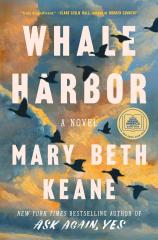
Whale Harbor
Review
Whale Harbor



WHALE HARBOR is a sweeping, multigenerational epic from Mary Beth Keane, the New York Times bestselling author of ASK AGAIN, YES and THE HALF MOON.
For years, Mary Joyce has claimed that “this baby will be the last.” But when we meet her and her family in Cuan an Mhíl Mhóir, their small fishing village in Connemara, Ireland, she is pregnant again, this time with her 11th son. Cathal, their patriarch, is stubborn as a mule and every bit as dogged. He supplements his government job as a postal worker by brewing and selling illegal poitín, which is Irish moonshine. The local priest bans the family from Mass following yet another of his transgressions: attending a Protestant funeral, the gravest of sins. Still, despite Cathal’s headstrong ways, the Joyce boys enjoy life in Cuan. Their mother is always too busy tending to the latest baby to care that they are scrapping with their peers or going on ill-advised adventures down the coast.
Accustomed to Cathal’s ways, Mary provides her sons with the affection and support they need at home, always doled out in sharp and logical but folksy arguments steeped in both myth and practicality. This is important to them as they all know what is eventually coming. One day, each of them will be sent away --- most likely to England --- to earn a living, send money back home, and ultimately arrange passage for the next Joyce.
This fate is being pondered most heavily by Macdara “Mac” Joyce, the eldest of the boys still living at home at 16. Whipsmart and responsible, Mac has taken to learning English well --- the family’s particular strain of Irish unspoken even in Ireland’s big cities --- and lately has become his younger brother Rian’s biggest role model, companion and father figure. Meanwhile, nine-year-old Rian is the roughest and toughest of all the boys, nearly feral in his disregard for rules and adamant about speaking in their native tongue. He knows that to abandon his language is to accept his fate: that one day, he likely will leave Cuan and never return.
"It is hard to say that there can or ever will be a 'best' Mary Beth Keane book, as talented and unstoppable as she is. But WHALE HARBOR is a strong contender, her most epic and exquisitely written novel yet."
But Mary, having birthed 11 children in only 17 years, does not survive her last. One day, while taking a rare seat as she prepares dinner, she keels over and dies. Her death was already foreshadowed by the exhaustion of labor and caregiving, but Mac and the other boys feel that it was hastened by Cathal’s abandonment. True to form, he disappears for weeks on end after every birth, this time for a whopping five weeks, returning only when the baby was finally named: Vincent, in honor of an anthropology professor who had taken a liking to Mac and followed him around the village to learn about their hardscrabble, homey ways.
The death of Mac’s mother ushers in a new layer of fears: What will happen to his brothers, especially Rian, when it is his turn to head to England? Will Cathal step up and rejoin the family as a stable, reliable entity? Facing impossible odds --- poverty, a lack of options, and his own mercurial ways --- Cathal instead sends away five of his sons, opening up their home to welcome his new wife, Nuala, a loving but snobby woman who takes quickly to the youngest Joyce brothers but never to difficult Rian.
Amid the rocky instability of his changing home, Mac has a chance to join his best friend in Montana, where he hears that the Irish are plentiful and the opportunities even more so. Though he promises to send for Rian as soon as he can, the devastation of their separation is abrupt. It is not long before Mac finds himself ensconced in Larkspur, Montana, torn from everything and everyone he knows and loves, not even one year removed from his mother’s passing.
Mac dives headfirst into the work awaiting him on a cattle ranch, but he remains tortured by memories of Rian, who he knows will have an even harder time as a teenager than he did. But his focus must remain on work and ensuring that his younger brothers can continue to join him, rebuilding the family piece by piece in a foreign land. Stoic and practical, Mac has attempted to bury the guilt he feels at abandoning Rian, shouldering a “crushing breathlessness” when he tries to face his shame. Only a few years later, though, he learns that Rian has run away. Though his younger brothers do indeed come to join him, leading the newly rebuilt family to New York in search of wives, the loss and ambiguity of Rian continue to torment Mac.
But New York presents a new challenge: the attempts of the collected Joyce brothers to maintain their memories, their heritage and their bonds to each other. Mac himself marries and welcomes a daughter, Mary, but the question of Rian’s whereabouts --- and the continued rumors of him being spotted across the world --- plague him deeply. He will need answers soon, and they lie only in Cuan. There, Mac revisits the day when a whale washed up on its shores, and how its arrival, decay and legacy mirror that of their fractured family.
Mary Beth Keane has long been a chronicler of Irish American families, but here she turns her keen, incisive gaze even farther back. She takes on not just the alienation and discomfort that immigrants face, but what it means to abandon one’s home and lifestyle. Exploring this through the eyes of wise-beyond-his-years, stoic Mac, Keane evokes a tender but exacting sentiment that carries each of Mary’s 11 sons through adolescence, immigration and beyond. She vividly constructs her settings, from the run-down fishing village of Cuan to big-skyed Montana, and finally to 1970s New York.
But what truly propels this fantastic, revelatory novel is Mac’s deep remorse and what it says about the bonds of family, and what we owe to those who come after us. Tracing generations and continents, Keane explores all of her familiar preoccupations here --- generational trauma, marital stress, cultural expectations, addiction and identity. But in expanding her cast to a whopping 11 sons (and plenty of memorable supporting characters, not to mention Mac’s daughter), Keane allows the tapestry of family to weave itself. The writing is so natural and unforced that it seems at times that she has access to the Joyces themselves.
Keane peppers her narrative with a deep understanding of ancestry and its roots, the power of blood connections, and the long arc of a family, especially one divided. It is hard to say that there can or ever will be a “best” Mary Beth Keane book, as talented and unstoppable as she is. But WHALE HARBOR is a strong contender, her most epic and exquisitely written novel yet.
Reviewed by Rebecca Munro on October 23, 2026


Whale Harbor
- Publication Date: October 20, 2026
- Genres: Fiction
- Hardcover: 352 pages
- Publisher: Scribner
- ISBN-10: 1668224631
- ISBN-13: 9781668224632