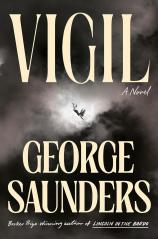
Vigil
Review
Vigil



After his protean first novel, LINCOLN IN THE BARDO, winner of the 2017 Booker Prize, one might conclude that George Saunders had said all he wanted to say about death and the afterlife. Happily for his readers, as he reveals in his brief, sweetly barbed parable, VIGIL, he wasn’t quite finished with the inexhaustible mysteries of that subject.
Asked about that apparent obsession in a recent New York Times interview, Saunders admitted that “I think about it a lot, but I find it a joyful thing, because it’s just a reality check.” For him, that reality is summed up in three essential truths: “You’re not permanent, you’re not the most important thing and you’re not separate,” so that death “is the moment when somebody comes and says: You know those three things that you’ve always thought of? They’re not true.”
And true to his fictional DNA, Saunders doesn’t smother our consideration of these truths under a heavy authorial hand. VIGIL is a gentle tale that focuses on two strongly contrasting characters as they wrestle with them in real time.
"VIGIL is a gentle tale that focuses on two strongly contrasting characters as they wrestle with [three essential truths] in real time.... All of this coheres to present a surprisingly complex picture in such a short novel..."
One is Jill “Doll” Blaine, an “elevated” being who’s made nearly 350 trips back to earth since her own death, serving as a companion for a human on the verge of leaving it. “To comfort whomever I could, in whatever way I might” is her mission. In this instance, her “charge” is a prominent figure --- 87-year-old oil company executive K. J. Boone --- who’s dying of cancer in his Dallas mansion.
But as Jill quickly discovers, Boone will turn out to be among her most problematic cases. She’s frequently reminded of that challenge by one of her “ilk” known only as the “Frenchman,” who acts as something of a devil’s advocate. “To comfort one who remains willfully ignorant of what he has done is to provide no comfort at all,” he reminds her. “If you truly wish to comfort him, bring him to admit his sin, then repent of it.”
From humble beginnings on a failing Wyoming farm, Boone eventually came to hold “more actual power than most kings of old.” But as Jill enters his consciousness, her presence supplemented by a parade of visitors from Boone’s long and consequential life, she reminds him --- sometimes gently, sometimes forcefully --- that he used that power to conceal the damage inflicted on the planet by fossil fuels.
To buttress her case, Jill conjures up scenes of dead birds, ravaged forests and drought-stricken lands, the last embodied in the appearance of Mr. Bhuti, one of its victims from India. Boone’s other visitors tug him between defiance and repentance as he assesses the impact of his career. But even in the face of these tragedies, he insists, “There’d been no sin involved in any of it, none at all.”
Saunders also subtly raises questions of free will and determinism in this story. They’re triggered by Jill’s recollections of a man named Paul Bowman, who was responsible for her own sudden, untimely death at age 22, only a year after she wed. Applying these insights to Boone’s life, she speculates if “[i]t had all unspooled just as it must. It did not seem strange to me, but inevitable. An inevitable occurrence on which it would be ludicrous to pass judgment.”
And yet, even as Jill tests that hypothesis, it’s not one that Saunders forces on the reader. That’s also true of her musings, perhaps inspired by Saunders’ longtime Buddhist practice, that “[t]he self is the culprit. With the self disavowed, what blame or glory can possibly affix to it?”
All of this coheres to present a surprisingly complex picture in such a short novel, as Saunders described in the New York Times interview. “Specificity negates judgment,” he noted. “So as I work harder and harder to know that guy, my sense of wanting to judge him seems juvenile. Anybody can judge. Let’s go deeper. I really cherish that feeling. Of course it doesn’t last beyond the page, and I’m sure if I met his real-life corollary, I’d be sneering at him. But what a blessing to, for a few minutes a day, ascend up out of your habit.”
As in all of Saunders’ fiction, whimsy often abuts poignancy. With concrete and water, Jill imaginatively dispatches a pair of climate change-denying scientists, both named Mel (“R.” and “G.”), a short time after she returns from a visit to her nondescript Indiana hometown, where she reunites with her beloved Grandma and pays a visit to her own grave. At times the novel brings to mind Charles Dickens’ A Christmas Carol and at others Thornton Wilder’s Our Town, but Saunders executes all of this with a light touch that is characteristically his own.
Whether in real life or literature, most of us will encounter a character like K. J. Boone, armed with firm ideas about whether or not the term “villain” should be attached to him for eternity. And it’s likely that many will leave his story with that assessment unchanged. The fact that Saunders may shake those perceptions a bit along the way is a tribute to the success of this modest but memorable novel.
Reviewed by Harvey Freedenberg on January 30, 2026


Vigil
- Publication Date: January 27, 2026
- Genres: Fiction
- Hardcover: 192 pages
- Publisher: Random House
- ISBN-10: 0525509623
- ISBN-13: 9780525509622