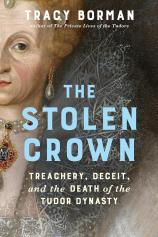
The Stolen Crown: Treachery, Deceit, and the Death of the Tudor Dynasty
Review
The Stolen Crown: Treachery, Deceit, and the Death of the Tudor Dynasty



In 1603, Queen Elizabeth I took her last breaths, signaling the end of her 45-year reign as monarch. Questions of who would ascend to the throne upon her death had been circling the kingdom for years, especially as Elizabeth had never married and allegedly remained a virgin. The frontrunners in the succession battle were cousins and noblemen, men and women. Yet shortly after Elizabeth’s passing, word came down from those nearest to the Queen that she had chosen her second cousin, James VI of Scotland, to be England’s new leader. The transition from the Tudor Dynasty to the Stuart Dynasty had begun.
The relationship between England and Scotland was turbulent as the two countries had been at loggerheads until the early 16th century. A peace deal struck in 1502 was sealed with the marriage of Margaret Tudor and James IV of Scotland. While the treaty was dubbed “The Treaty of Perpetual Peace,” there would emerge the occasional fractures in the tenuous peace. During the reign of King Henry VIII (1509-1547), the two countries were on a war footing after a potential union was dashed, and Henry VIII sent his military on raids into southern Scotland. In addition, his dictates regarding succession, particularly with respect to nominating a potential heir, set the stage for problems down the line.
"This well-researched work is enlightening and will turn more than a few heads when considering the impact of royal succession and the future of empires."
The flighty nature of Henry VIII nearly led to Elizabeth not ascending to the throne, as she was disinherited after the execution of her mother, Anne Boleyn, in 1536. Elizabeth was restored to the line of succession in 1543 and became Queen in 1558 after the brief reigns of her half-siblings. Concerns over Elizabeth’s legitimacy in inheriting the throne were raised by her cousin, Mary Stuart (Mary I) of Scotland. The heated rivalry factored into the formative years of Mary’s son, James, who became King of Scotland after Mary was forced to abdicate in 1567. As James was finding his place as Scotland’s sovereign, he maintained a steady correspondence with the English Queen that would last decades.
The relationship between Elizabeth I and James VI was equal parts teacher/student and mother/son, as Elizabeth offered advice to the burgeoning leader while also cautioning him against foolhardy behavior. The alliance between the two cousins was tested with the execution of Mary Stuart for her role in plotting to overthrow Elizabeth, but James reluctantly chose to accept Elizabeth’s excuse that it was carried out unbeknownst to her.
While Elizabeth had employed spymasters capable of unearthing plots against her, James had narrowly escaped attempts on his life, which called into question his strength as a leader. This, along with how he dealt with malcontents inside his kingdom, was concerning for Elizabeth as she considered him to be the next ruler of England. The reign of King James I stood in stark contrast to his predecessor. As leadership was delegated, there was less enthusiasm towards the arts and architecture, and relations with the Catholics in the kingdom were at an ebb.
THE STOLEN CROWN is a riveting account exploring how the usurpation of the English crown occurred and was obscured by centuries of historical revisionism. History is often written by the victors, and King James I endeavored to ensure that historian William Camden did exactly that when Camden told the story of his anointment. James’ machinations are just one of many royal plots revealed in this brilliant real-life drama, which contains more than a fair share of love affairs, scandals and treason.
Tracy Borman provides a well-written timeline covering the troubled history between England and Scotland, along with the problematic questions of succession, which began in the 1530s and lingered during Elizabeth’s reign. This well-researched work is enlightening and will turn more than a few heads when considering the impact of royal succession and the future of empires.
Reviewed by Philip Zozzaro on December 6, 2025


The Stolen Crown: Treachery, Deceit, and the Death of the Tudor Dynasty
- Publication Date: November 4, 2025
- Genres: History, Nonfiction
- Hardcover: 448 pages
- Publisher: Atlantic Monthly Press
- ISBN-10: 0802165907
- ISBN-13: 9780802165909