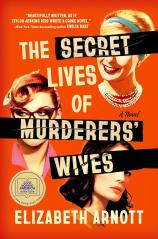
The Secret Lives of Murderers' Wives
Review
The Secret Lives of Murderers' Wives



Acclaimed writer Elizabeth Arnott pairs the glossy facade of “Mad Men” with the true-crime intrigue of “Mindhunter” in THE SECRET LIVES OF MURDERERS’ WIVES, a searing takedown of corruption, misogyny and victim-shaming.
By all appearances, there is little that unites preternaturally gorgeous Beverley Lightfoot, who is raised to submit to men and their needs, but is uncertain of her own strengths or desires; bookish Elsie Parker, a British expat whose frumpy appearance sets her apart from her glamorous California peers; and bold and brassy Margot Green, an unabashed social climber and party girl with a keen eye for reading men. But behind their exteriors, they are all members of an exclusive --- yet undesirable --- club. They are the wives of convicted killers, women who failed to notice the signs of their husbands' evildoings.
United by their spouses’ crimes (and their own unwarranted notoriety), Beverley, Elsie and Margot often get together to discuss their survivors’ guilt, their rage, and how they feel every bit as judged and persecuted as their husbands. To cope, each has turned to a different hobby. Beverley has become obsessed with tracking the murders of other women, scrapbooking newspaper and magazine clippings together in hopes of identifying a pattern and gaining control. Elsie has become ravenous for facts, devouring encyclopedias, road maps, phone books and puzzles with an insatiable desire to solve, eventually culminating in a job at a newspaper. And Margot, who was once assured of her ability to read and manipulate any man but was finally outdone by a master manipulator, vows never to let a man get too close again or to admit that she, too, can be read.
"THE SECRET LIVES OF MURDERERS’ WIVES [is] one of the most sharply written, heart-stoppingly exhilarating and surprisingly galvanizing works of suspense I have read in quite some time."
On the day we meet these women, it is 1966 in Berryview, California. The headlines are awash with reports of the sweltering heat, stories of planes bombing Hanoi, and images of protests against police brutality and racial profiling. But for Beverley, it is also the five-year anniversary of the capture of her husband, Henry --- the Heatwave Killer, who murdered seven women --- and she is set to speak at an LAPD gala honoring the brave detectives who caught him.
Beverley doesn’t enjoy revisiting the day she discovered her husband’s blood-covered shirt in a neighbor’s trash can, or the moment when the police and SWAT teams descended upon her home, urging her to collect her two young children and prepare for the most violating, invasive period of her life. But neither does she relish the voyeuristic stares of her neighbors, who once stood by her and decried the accusations leveled against Henry. They turned on her when he was sentenced, asking what she really knew and if she should be arrested as an accomplice. Beverley hopes that the speech will help to rehabilitate her image and allow her to move on from her identity as a killer's wife.
But then news of a murder hits the headlines. Cheryl Herrera, a college student and track star, has been strangled, stabbed through the eye with a pen and dressed in a blonde wig. The case is so absurd and unusual that the women quickly recognize the echoes of their husbands’ crimes, but the police lazily write off the death as gang-related because of Cheryl’s Latin heritage. The intrigue intensifies when the body of Emily Roswell, a cheerleader, is pulled from the lake of a golf course, stabbed multiple times, and tattooed with the words “Love” and “Hate” on her hands. This is followed by the murder of model Diane Howard Murray, who was strangled and dressed in designer duds, propped up as a mannequin waiting to be discovered.
Having pored over reports of women’s murders for years, Beverley, Elsie and Margot quickly identify a pattern: a woman-hating man who leaves absurd calling cards, likely a white individual in his 30s with a desire to control. They’re not detectives, but they’re something better: wives, women born and bred to read the smallest cues of their husbands’ moods and desires, as well as those of the men around them --- fathers, bosses, delivery men --- to keep themselves safe.
The women have other weapons up their sleeves, of course. Beverley has been having an affair with one of the detectives who arrested her husband, and there is no greater aphrodisiac for him than bragging. Elsie makes friends with a new female reporter at the newspaper where she works, granting her insider access to the things not printed in the papers. And Margot catches wind of a seedy movie director known for demanding sexual favors from young models and actresses attempting to make it big.
Between the three of them, they slowly begin to investigate the murders of Cheryl, Emily and Diane. They often gain greater access to the victims’ families and their stories than the police themselves, thanks to their willingness to listen to what the girls were really like, not just what makes the most appealing story. But more than that, as the women start to close in on their suspect, they must reckon with the ways that their own stories were written from the start, how each of their husbands --- unremarkable, unassuming men --- began to groom and manipulate them, and how identifying the killer wreaking havoc in their community may allow them to finally heal from their trauma.
What follows is a madcap suspense that skews the line between cozy mystery and gritty police procedural, with the friendship of the women providing a heartwarming foundation to what ultimately transforms into an incisive, often gory and surprisingly cerebral thriller. Readers will be immediately immersed by the 1960s setting, with all of its social mores rendered in full glory. But it’s the dazzling, resourceful murderers’ wives who will keep you turning pages. Elizabeth Arnott laudably pays very little attention to the husbands’ actual crimes. Instead, she zeroes in on the unsung victims, particularly those who, like Cheryl and Diana, come from marginalized communities often blamed for their own misfortunes. But her decision to focus on the families of murderers allows her to adopt a previously unseen viewpoint into the lives of killers.
This insight, paired with the women’s talks of trauma and dissociation, notoriety and shame, makes THE SECRET LIVES OF MURDERERS’ WIVES one of the most sharply written, heart-stoppingly exhilarating and surprisingly galvanizing works of suspense I have read in quite some time. In giving agency to the hidden victims of men’s crimes, Arnott rights a wrong left unchecked for far too long: the mythologizing of unremarkable men.
Reviewed by Rebecca Munro on March 6, 2026


The Secret Lives of Murderers' Wives
- Publication Date: March 3, 2026
- Genres: Fiction, Historical Fiction, Historical Mystery, Mystery
- Hardcover: 320 pages
- Publisher: Berkley
- ISBN-10: 0593952995
- ISBN-13: 9780593952993