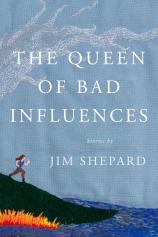
The Queen of Bad Influences: Stories
Review
The Queen of Bad Influences: Stories



Whether they are of the natural or human-caused variety, Jim Shepard is a connoisseur of disaster. From hurricanes to shipwrecks to wars, there are catastrophes aplenty in his sixth short story collection, THE QUEEN OF BAD INFLUENCES. What makes these 12 tales that seamlessly blend real and fictional characters more than voyeuristic glimpses of tragedy is Shepard's expert craftsmanship and his ability to shift his lens from wide-angle to close-up, bringing an intensely human dimension to the most dire circumstances.
In previous collections, such as LIKE YOU'D UNDERSTAND, ANYWAY and YOU THINK THAT'S BAD, Shepard has carved out a niche as a master of deeply researched, imaginatively recreated historical short fiction. Ranging around the globe and across more than three centuries, most of the stories in this collection --- three of which were chosen for Best American Short Stories and two for Pushcart Prizes --- are situated firmly in that genre.
"What makes these 12 tales that seamlessly blend real and fictional characters more than voyeuristic glimpses of tragedy is Shepard's expert craftsmanship and his ability to shift his lens from wide-angle to close-up, bringing an intensely human dimension to the most dire circumstances."
Shepard wastes no time ratcheting the drama up to Category Five with the opener, “Village of Islands.” In it, he brings to life the Labor Day 1935 Key West hurricane, one of the most intense Atlantic storms on record, with top winds believed to have approached 250 miles per hour and a death toll of more than 400. Shepard depicts the savage storm through the eyes of a handful of characters desperate to escape its fury. Most notable among them are newlyweds Rosalie and George Brady and Homer Dean, one of 50 World War I veterans brought to steamy South Florida to construct a camp to house 650 of their fellow soldiers assigned to a highway construction project and who become the subject of a dramatic rescue effort by rail. Shepard's depiction of the fates of the Bradys and Homer brings the story to a moving conclusion.
Among the most dramatic stories is “The Devil's Broom,” an account of the devastating wildfires in the Northern Rockies in August 1910. That conflagration is seen through the eyes of Edward Pulaski, an assistant ranger with the US Forest Service, whose real life heroism was instrumental in saving the lives of 43 of the “punks, stew bums, and pool hall boys” who made up much of his hastily recruited firefighting crew. “Privilege” vividly evokes the 1889 Johnstown Flood. A poorly maintained earthen dam built to create a massive lake for the enjoyment of plutocrats like Andrew Carnegie and Henry Frick collapsed, inundating the valley below. The most compelling of its shifting perspectives is that of John Parke, Jr., the dam's resident engineer, who is all too aware of its fatal but preventable weaknesses and who can only watch in horror as nature exacts its awful price.
The last of this trilogy of natural disasters is “Engineer of Safe Havens,” which imagines the nor'easter in November 1898 that capsized the paddle wheel steamer Portland on its way from Boston to Portland, Maine. It revolves around a trio of characters --- Alice Elinor Hays, whose father is a passenger on the vessel; Thomas Merrill, its first engineer; and Alonzo Ansel Crozier, a Black deckhand seeking to improve his lot through a life at sea. For all their many skillfully portrayed moments of high drama, in all three of these stories, Shepard persistently returns to the plight of these characters as they confront forces that overwhelm their ability to respond.
Two of the collection's stories --- both accounts of war --- rely on the epistolary format. In “Our Day of Grace,” two women exchange correspondence with their Confederate soldier husbands in Tennessee in November 1864 on the eve of the Battle of Franklin. The war is a “graveyard for virtues,” writes William, a former schoolteacher from North Carolina and a reluctant volunteer. He observes ruefully in the letter that concludes the story on the eve of battle, “Hope calculates its schemes for a long & durable life, & presses us forward to imaginary points of bliss, & grasps at impossibilities, & so ensnares us all.”
In “Where Are the Lads of New Zealand Tonight?” the second of the stories rooted in eloquent, revealing letter writing, Shepard tells the true story of William G. Malone, commander of a regiment of New Zealand soldiers embroiled in the disastrous 1915 Gallipoli Campaign. Consistently critical of their British commanders in his letter to his wife Ida, as his comrades' casualties mount, he laments how the “High Command sends us packing with a bagful of hallucinations. Were it not all so serious, it would be laughable.” In both of these stories, he effectively deprives war of its sheen of glamour.
Shepard is a versatile writer, and he occasionally departs from his affinity for tragic tales rooted in history. In the chilling “The Testament of Edward Hyde,” he revisits Robert Louis Stevenson's classic story from the viewpoint of the monstrous titular character. “The Mentally Ill Are Not Alone” reads like a slice of memoir, recounting the story of teenager John Shepard's battle with mental illness in the late 1960s from the point of view of his younger brother, Jim, a writer.
Each of the stories in THE QUEEN OF BAD INFLUENCES unfolds in a well-structured narrative over approximately 20 pages. Yet there's no sense of monotony, despite the absence of any flashy fictional devices or epiphanies. That's because of Shepard's impressive range and his ability to seize the reader's attention on the first page and hold it to the last with accounts of resilience in the face of forces beyond human control. Engrossing in the moment and memorable in hindsight, they're durable examples of the storyteller's art.
Reviewed by Harvey Freedenberg on October 9, 2026


The Queen of Bad Influences: Stories
- Publication Date: September 15, 2026
- Genres: Fiction, Short Stories
- Hardcover: 320 pages
- Publisher: Knopf
- ISBN-10: 0593804414
- ISBN-13: 9780593804414