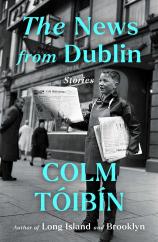
The News from Dublin: Stories
Review
The News from Dublin: Stories



On the strength of novels like THE MASTER and BROOKLYN, Colm Tóibín has long been recognized as one of Ireland’s finest contemporary writers. But even admirers of those works may not be aware that Tóibín also excels as an author of short fiction. THE NEWS FROM DUBLIN, his third story collection, is a showcase for his insightful, empathetic and disciplined writing and an excellent point of entry into the world of his short stories.
Though the settings of Tóibín's stories --- ranging from 1940s Ireland to contemporary California to Spain in the aftermath of the Civil War --- are diverse and fully realized, he's a writer who's preoccupied with the internal struggles of his carefully drawn, complex characters more than their external environment. It's necessary to focus only on a handful of his stories to understand that inclination and the characteristics they share that make them so rewarding for anyone who appreciates classical short fiction.
"A Free Man" opens with the introduction of a former mathematics teacher named Joseph, now living alone in Spain following his release from an Irish prison after serving a 10-year sentence for molesting several of his students. Joseph has moved to Barcelona at the urging of Denis Doran, once a fellow novitiate at the Irish seminary they both abandoned 40 years earlier, and now co-owner of a bar in the city.
"Toíbín's stories are old-fashioned in all the best senses of that word: well-formed, quiet, and calling for patience and attention to discover and appreciate their effects."
In the story, Toíbín shifts seamlessly between present and past to reveal the quotidian details of Joseph's life --- choosing a place to live, opening a bank account, deciding on the restaurant where he'll have dinner --- and his effort to come to terms with the implications of his crime. Joseph struggles to bridge the "unending gap between what others saw in him, in all its solidity, and what he believed about himself, in all its confusion." It's a dilemma that's made more challenging by his relationship with Doran and the complicated residue of their shared past. Whether it’s advancing the plot, revealing character or deepening the meaning of the story, each carefully crafted sentence subtly does its work in impressively unassuming fashion.
In the title story, Maurice, a teacher, travels from Enniscorthy (Toíbín's birthplace and the setting of several of his novels) to Dublin on a desperate mission to obtain the drug streptomycin (new and still experimental at the time of the story) for his younger brother, who is dying of tuberculosis. Through the intervention of a local politician, he manages to obtain a meeting with the minister of health, who once shared a prison cell with his father. In a story that's tinged with melancholy, Maurice makes his way around the capital city, unable to shake the feeling that "with each step he took that he was leaving a ghost trailing behind him, hovering in the darkening air, a solitary figure asking him if there was any news, if there was any hope."
The novella-length story that concludes the collection, "The Catalan Girls," follows the lives of three sisters --- Núria, Conxita and Montse (from whose point of view the story is told) --- who move to Argentina as adolescents with their widowed mother. Fifty years later, they learn they have inherited the house in a small village in the Pyrenees owned by their Aunt Julia, a place they visited as children and that Montse recalls with great affection. Toíbín's narrative is an astute investigation of the complex dynamics of sibling relationships, demonstrating how, though circumstances change, established patterns persist over the decades.
Stories like "A Sum of Money," a subtle exploration of social class that follows a poor Irish boy who parlays a talent for picking locks into a career as a petty criminal at his boarding school, and "Five Bridges," whose Irish protagonist considers himself the "oldest living illegal immigrant in America" after spending 30 years here on a tourist visa while working as an unlicensed plumber, are satisfying character studies. That's also true of "Summer of '38," the tale of Marta, a woman forced to revisit the memory of her relationship with one of Generalissimo Franco's generals during the Spanish Civil War long after the conflict's end.
Toíbín's stories are old-fashioned in all the best senses of that word: well-formed, quiet, and calling for patience and attention to discover and appreciate their effects. While those qualities may not have universal appeal in our age of quick takes and instant gratification, they're the ones that make Toíbín's work so memorable.
Reviewed by Harvey Freedenberg on April 3, 2026


The News from Dublin: Stories
- Publication Date: March 31, 2026
- Genres: Fiction, Historical Fiction, Short Stories
- Hardcover: 304 pages
- Publisher: Scribner
- ISBN-10: 1476785147
- ISBN-13: 9781476785141