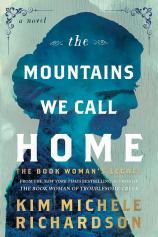
The Mountains We Call Home: The Book Woman's Legacy
Review
The Mountains We Call Home: The Book Woman's Legacy



Kim Michele Richardson revisits the inspiring story of packhorse librarian Cussy Lovett, the heroine of THE BOOK WOMAN OF TROUBLESOME CREEK, in her new stand-alone and companion novel.
Set in the mid-1950s, THE MOUNTAINS WE CALL HOME follows Cussy as she is jailed for violating Kentucky’s anti-miscegenation laws. (Cussy has methemoglobinemia, a blood disorder that turns her skin blue; her husband, Jackson, is white.) Separated from Jackson, who also has been imprisoned, and forced to leave behind her teenage daughter, Honey, Cussy struggles to adjust to life in prison. But as in the past, her love of books --- “a sanctuary for my heart” --- sees her through a challenging time.
"THE MOUNTAINS WE CALL HOME is a carefully researched exploration of mid-century Appalachian life... Richardson shines a light on marginalized communities fighting for dignity in a world that often wants to strip them of it."
Cussy lands a job as the prison librarian, and she promptly sets about doing what she can to help her fellow inmates. That includes teaching a death-row inmate to write so that she can send a letter to her estranged children and sharing books with mentally ill women in the prison’s forensic ward, who become calmer when given reading material. At the same time, she desperately tries to get information about Jackson, whom she’s been unable to contact since her arrest, as well as Honey, who is fighting to become an emancipated minor. (Honey’s parallel story unfolds in THE BOOK WOMAN’S DAUGHTER.)
Eventually, Cussy’s efforts in the prison library lead to a unique opportunity. She’s granted a week-long furlough to work at Louisville’s Western Colored Branch Library. (This real-life library was the first in the country built for and staffed entirely by African Americans.) Once there, she assists fellow librarian Effie Claxton in organizing night classes to teach locals to read and write while also getting her first taste of city life. At the same time, her personal situation has become increasingly precarious. As her time in Louisville draws to a close, she must decide what direction she wants her future to take.
Like the previous books in this series, THE MOUNTAINS WE CALL HOME is a carefully researched exploration of mid-century Appalachian life, touching on the challenges of poverty, the looming threat of urban renewal in cities like Louisville, and the migration of people from the rural south to the industrialized north. Richardson brings to life the dire conditions in the women’s prison (especially for the elderly and mentally ill inmates) while also highlighting surprising moments of grace and care. The trauma of family separation and incarceration is a theme throughout.
Unfortunately, when Cussy leaves prison, the story also leaves behind the women she befriended behind bars, even as it introduces a new cast of compelling supporting characters. But whether Cussy is in prison or working at the library in Louisville, the focus remains on the power of the written word and the impact that small, everyday acts of kindness can have on another person’s life. Throughout the book, Richardson shines a light on marginalized communities fighting for dignity in a world that often wants to strip them of it.
THE MOUNTAINS WE CALL HOME is a tribute to the hold that some places have over us, even when they don’t always love us back. Cussy’s world has expanded beyond the isolated Kentucky hollers where she grew up, a place that is a “puzzle” that she “could never quite fit into.” Nonetheless, her heart remains tied to the mountains of “ol’ Kaintuck,” where she was raised and will always call home.
Reviewed by Megan Elliott on April 24, 2026


The Mountains We Call Home: The Book Woman's Legacy
- Publication Date: April 21, 2026
- Genres: Fiction, Historical Fiction, Women's Fiction
- Paperback: 384 pages
- Publisher: Sourcebooks Landmark
- ISBN-10: 1464239339
- ISBN-13: 9781464239335