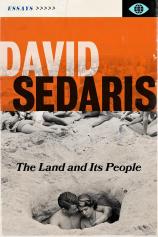
The Land and Its People: Essays
Review
The Land and Its People: Essays



In his latest book of essays, THE LAND AND ITS PEOPLE, David Sedaris returns to form after his bleak 2022 collection, HAPPY-GO-LUCKY. This perpetual “Stranger in a Strange Land” observes life post-COVID, both here and abroad, with his signature wit and wry humor.
Sedaris longs for the days of civility in travel and bristles at his role of caregiver after his partner’s surgery. He and his close friend, Dawn, discuss how they would endeavor to eat an entire car tire if they had to. (Her clever take involves grinding it up and ingesting it in pill form). He addresses the automation boom, railing against the ubiquitous self-checkout lines we encounter daily: “It seems we’re all doing someone else’s job right now. Workers have been replaced by machines but are still on the payroll. Their new job is to supervise you doing their old one.” He even touches on his own secret marriage to his longtime boyfriend, Hugh, a union that he feels slightly guilty about after forcing his sisters to sign a contract when they were tweens that they would never marry.
"David Sedaris returns to form after his bleak 2022 collection, HAPPY-GO-LUCKY. This perpetual 'Stranger in a Strange Land' observes life post-COVID, both here and abroad, with his signature wit and wry humor."
In one of his more indelible essays, “The Hem of His Garment,” Sedaris relates his 2024 visit to the Vatican to meet Pope Francis. The Catholic Church, along with Stephen Colbert, organized a special audience with the Pontiff and a number of comedians --- including Conan O’Brien, Chris Rock, Jimmy Fallon, Tig Notaro, Julia Louis-Dreyfus, Whoopi Goldberg, Stephen Merchant and Ramy Youssef --- to celebrate the importance of humor. Given that he is not a Catholic, Sedaris wondered why he was included in this esteemed company. He was fascinated by the pageantry of the clergy, which he thought seemed to skimp when it came to the Holy Father’s own attire. So taken with the vestments, he decided to buy a cassock for himself. It wasn’t for any religious reason, but because “I honestly just liked the robe. It takes ten pounds off!”
Aside from his razor-sharp observations of modern life, Sedaris facetiously dispenses advice. In “Punching Down,” after watching one too many ill-behaved child’s tantrums, he suggests, “You have a child or two and then send them off to be raised in Japan until they’re eighteen or so and have learned proper manners.” And if you fancy yourself important enough to merit a biography to be written about you, heed this advice from “In Lieu of My Biography: “[Y]ou might want to make your biography better by drinking more. I don’t mean going from one glass of Chardonnay to one and a half. I mean you need to put away buckets of hard liquor. Per day. And while you’re blacked out you should have sex with as many people --- both men and women --- as possible, preferably famous ones with good memories. Take drugs, too, and publicly, violently feud with your critics.”
Longtime fans of Sedaris will have noticed his recent embrace of technology, which is detailed in “Say It Like You Mean It.” It’s a concept that he used to fervently and famously reject as he lugged around a typewriter while on the road. These days, not only does he use a laptop, he’s also fond of his iPad, where he practices his language skills via Duolingo, and his Apple Watch, where he tracks his tens of thousands of daily steps. But in “Trophy Room,” he proudly states that while on safari in Africa, he didn’t take a single photograph.
And what’s a Sedaris essay collection without pondering death? He thinks about mortality in “Good Grief”: “Scrolling through my address book on a recent morning, I noticed how many of the people in it are no longer alive…. I suppose it’s partly a mortality exercise --- when the dead outnumber the living I should probably get my affairs in order….” As evidenced in most of his writing, he handles his grief with grim but affable humor. After purchasing an expensive cape for his sister to wear at her treatments for lung cancer, he learns “the cancer hadn’t spread to her lymph nodes, and was only in one lung, not two. A tiny speck. In the end, they cut it out, and she was fine after that. No radiation, no chemo. I was, of course, greatly relieved, but at the same time I thought, I want that cape back.”
Culturally, we were deprived of so much during the pandemic --- canceled family get-togethers, working from home instead of in a crowded office, no in-person plays, concerts or comedy shows. We also didn’t have David Sedaris touring, reading his hilarious observations to a live audience, being out there in the world, taking in everything he sees and filing it away for later.
“You don’t know what you’ve got till it’s gone,” sang Joni Mitchell. But thankfully, what was gone has returned, and once again we can read all about Sedaris’ mirthful experiences: “The world can be a savage place, but that’s not the lesson you want to carry home with you…. We’re all on a safari of one kind or another --- it’s just that some of us aren’t returning with two brilliant rectangles of Maasai plaid fabric and a bacterial infection.”
Reviewed by Bronwyn Miller on May 29, 2026


The Land and Its People: Essays
- Publication Date: May 26, 2026
- Genres: Essays, Nonfiction
- Hardcover: 272 pages
- Publisher: Little, Brown and Company
- ISBN-10: 0316264830
- ISBN-13: 9780316264839