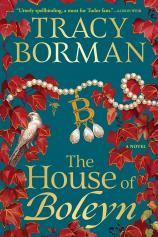
The House of Boleyn
Review
The House of Boleyn



“Downton Abbey,” make way for true-life venery, scandal, royalty and beheadings.
An excellent companion piece to Tracy Borman’s latest novel is her 2025 book, THE STOLEN CROWN, a work of nonfiction that details the life and turmoil of Queen Elizabeth I, Anne Boleyn’s only surviving child. “The Boleyns might have risen high at court but there was hardly a drop of noble blood in their veins.”
"Borman weaves a fact-based historical fiction tapestry as intricate as those by Peter Paul Rubens nine decades after the setting of this exquisite period piece."
Beginning at Anne’s childhood home, Hever Castle, readers of THE HOUSE OF BOLEYN learn that the Bullen crest is a “bull’s head, its horns like those of the devil,” and the familial name had morphed to patrician Boleyn. Thomas Boleyn sought to exalt political aspiration by availing himself of the king, perhaps virtually bartering his younger daughter as a means. Hever’s drawbridge, moat and fairytale-like setting almost make the castle a central character, especially with resilient servants whom history has slighted. Hever is truly the house of Boleyn, not only Anne’s muse.
The misogynistic norm for centuries is made manifest in this fascinatingly realistic fiction: “Daughters are but pieces on a chessboard. An educated woman is like a madman with a sword: a danger to himself and others.” A male character opines that “a case of adultery can only be brought against a wife.” Yet Henry’s divorce from Catherine was in May 1533, four months after he married Anne Boleyn.
Monarchs wrote their own historical fiction, which was stated as fact to authenticate their machinations. The second of Henry VIII’s six wives, Anne’s rise in the royal palace and fall from grace were as swift as the sword that beheaded her in 1536. When she was cast aside, her family members became pariahs. All castles, wealth and royal titles they held forfeited to the king.
Slightly massaging dates, Borman weaves plot threads into a Tudor tutorial. Despite harsh religious strictures during the 118-year turbulent Tudor dynasty, not a few engaged in non-marital venery, notably Henry VIII. His and Anne’s daughter, Elizabeth, was born in September 1533, less than eight months after the royal marriage in late January.
Pope Clement VII denied Henry VIII a divorce from Catherine of Aragon, which furthered the Protestant Reformation that began in 1517. It caused political and religious upheavals, a divisive culture in England.
As the 1536 New Year celebrations end, Catherine dies two weeks before the stillbirth of Anne’s son, and four months before she lost her head (May 19th), 11 days before the corpulent king married Jane Seymour.
The Chief Historian of Historic Royal Palaces, Borman weaves a fact-based historical fiction tapestry as intricate as those by Peter Paul Rubens nine decades after the setting of this exquisite period piece.
Reviewed by L. Dean Murphy on August 21, 2026


The House of Boleyn
- Publication Date: August 4, 2026
- Genres: Fiction, Historical Fiction
- Hardcover: 416 pages
- Publisher: Atlantic Monthly Press
- ISBN-10: 0802167853
- ISBN-13: 9780802167859