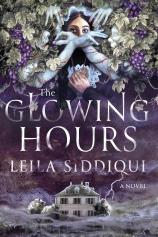
The Glowing Hours
Review
The Glowing Hours



“On with the dance! let joy be unconfin'd;
No sleep till morn, when Youth and Pleasure meet
To chase the Glowing Hours with Flying feet.”
This quote from Lord Byron’s poem, “Childe Harold’s Pilgrimage,” opens the action of the appropriately titled THE GLOWING HOURS by Leila Siddiqui. There have been many fictionalized works, from literature to film, that have attempted to document the infamous weekend at Lord Byron’s Lake Geneva cottage, where (among other things) Mary Shelley’s FRANKENSTEIN was born. However, none of them have taken as unique an angle as this novel.
"Through Mehr, everything that occurs here is heightened at a level that allows outsiders like us to feel like we are there as well. THE GLOWING HOURS is an eye-opening work that casts a spell over us and never lets go."
The insertion of a new and completely fictional story of Mary Shelley’s Indian housemaid, Mehrunissa Begum, provides a filter for the weekend that is unlike anything we have seen before. The prologue, which is set in 1858, shows a much older Mehr, who has been tracked down by Mary Shelley’s daughter. Jane shares with her the tragic deaths of her father, Percy Shelley, and Lord Byron. She also speaks to how her mother never married again.
This brief meeting takes Mehr and readers back to 1815, showing how she came to be in the service of the Shelleys and the part she played that weekend. Mehr travels to London by ship and is separated from her family before she is taken to her new residence as the Shelleys’ housekeeper. She recalls never being able to sleep a full night after being brought aboard.
The household is cast in disarray upon the arrival of Mary’s stepsister, Claire. All of them make their way to Geneva at the behest of Lord Byron for a weekend that will change everyone involved. Byron welcomes them and begins the surreal festivities with talk of the Diodati Demon, named after the chalet where they are staying, as well as other rumored hauntings within the property.
Mehr becomes both mesmerized and repelled by Lord Byron and his guests, particularly Dr. John Polidori, who in turn tempt and frighten her. She is treated as a fellow guest, not as a housemaid, and gets to fully participate in the fever dream of a weekend where everything appears to be both unbelievable and nightmarish. There is a brief reference to FRANKENSTEIN and how it resembled the tale of Prometheus, but the novel focuses more on the participants and the impact that this wild weekend has on each of them. In Mehr’s case, it is an indelible one.
Of course, as many legends have purported, accusations of Lord Byron being an actual vampire arise and are treated with mind-bending speculation. Through Mehr, everything that occurs here is heightened at a level that allows outsiders like us to feel like we are there as well. THE GLOWING HOURS is an eye-opening work that casts a spell over us and never lets go.
Reviewed by Ray Palen on April 10, 2026