Excerpt
Excerpt
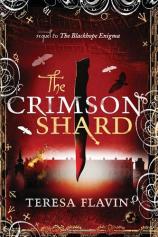
The Crimson Shard




Prologue
Taking care not to wake anyone, the traveler crept back into
the house, shielding his candle.
In the scullery, he rinsed the last traces of blood from his hands and dried them on a cloth. He felt for the leather sheath sewn into his tunic and slid out a fl at shard of red flint, smoothed and sharpened to a point at one end and carved into an animal’s head at the other.
He examined it closely. The crimson hue grew darker at its point. Every time the stone shard cut into fl esh, the tip’s red color became darker.
He picked up a piece of lye soap and a rough cloth and began to wipe clean the shard. As he worked, the face of the dead alchemist, Peregrin, edged into his mind. He scrubbed harder and cursed his associate for being so reckless with the lethal substances in his laboratory. If Peregrin had taken more care, he would still be alive and producing the miraculous elixir.
The traveler seethed, knowing he could no longer make unlimited use of the elixir’s astonishing powers; with so little left, there would not be many more crossings into other centuries. He must make the most of the few opportunities he had left to obtain the information he needed to track down Fausto Corvo.
When he was satisfied that the dark stain had faded, he returned the shard to the hiding place in his waistcoat and, stealthy as a cat, climbed upstairs to his study. He ran his eyes over the bookshelves, then glanced at the door in the far wall, its frame crowned with two carved faces.
Content that nothing had been disturbed in his sanctuary, he settled himself at his desk, dipped a pen in black ink, and, on the first page of a notebook bound in red morocco leather, scrawled two names:
SUNNIVA FORREST
BLAISE DORAN
They were only children, and twenty- first- century ones at that, but they had the knowledge he needed. And destiny had just brought them to London.
Whatever it takes, he thought, patting the shard through his waistcoat. Whatever it takes.
Chapter 1
Sunni raised her face to catch the sun and wished she were lying on the grass in Hyde Park instead of hanging around in Phoenix Square while her friend Blaise tried to decipher a map scrawled on a paper napkin.
A distant siren wailed, and something clicked in Sunni’s head.
“It’s so quiet here,” she said. “Like someone closed a window on the rest of the world.”
“Mmm,” Blaise mumbled, turning the napkin upside down. “Okay, I’ve got it now. It’s that house over there with the blue plaque on it.”
“So, you still want to see this place?” Sunni sighed as
Blaise stuffed the napkin in his pocket.
“No, I’ve made us come all this way for nothing.” He had that look of bright intent that he always got when his mind was set on something. “What’s the matter — don’t you want to see it?”
“I don’t know. Just because some weird beardy bloke in a café says it’s a cool place doesn’t mean it is.”
“It sounds cool to me,” Blaise said. “I thought you’d want to check it out, too.”
“It’s just that it’s bound to be full of sheeplike tourists, just like all the other museums in London,” she said.
“That’s what we are — tourists. And by the way, I am not sheeplike.”
“No, you’re more doglike, with a bone that you just won’t give up,” Sunni said. “I’m fed up with museums, Blaise. We’ve seen tons since we arrived. If I have to look at another china shepherdess or Roman mosaic, I will curl up and die.” She stopped walking. “Let’s hang out in a park for a change. We’ve only got a few hours till we meet your dad — and it’s our last day in London!”
“If you don’t want to come in, go sit in that park over there,” he said, nodding at the fenced-in scrap of grass and elm trees in the middle of the square. “I’ll meet you afterward.”
A jolt of irritation coursed through Sunni. “No, I’ll come
along,” she said. “Unless you want to go by yourself.”
“Of course I want you to come! Why are you making such a big deal about this?”
“I’m not making a big deal.”
“Yes, you are.” Blaise gave a gentle tug on her ponytail. “Hey. You look like a celebrity with those sunglasses on. Trying to hide from all your fans?”
“Yeah, right. Can we get this over with? Which house is it?”
“This one.” Blaise stopped in front of number 36. “And look, no lines of sheep trying to get in.”
“Except us. Baa!” Sunni bleated like a sheep, and Blaise laughed.
“Look,” he said. “We’ll go wherever you want after this. I just want to check it out.”
He stepped up to the red door, which had columns on each side and an arch above it. In the middle of the door was a bronze head with a ring- shaped doorknocker in its mouth.
“Now we’ll see if the guy in the café sent us on a wildgoose chase or not.” Blaise rapped the doorknocker.
“Yeah,” said Sunni. “I wouldn’t put it past —”
She stopped in mid- sentence as an outlandish figure pulled the heavy door part way open. The man wore breeches and a red silk vest, topped with a long dark overcoat. His extravagant cravat was as white as his powdered wig.
“Good afternoon,” said the man in a light but resonant voice with a slight foreign accent. He had languid, heavylidded eyes and a nose that had been broken at least once. But the uneven angles of his face did not diminish his handsomeness — they made him all the more striking.
“Is this Starling House?” asked Blaise.
“Yes. Have you an appointment?”
Blaise’s shoulders slumped. “Appointment? No, we didn’t know we needed one.”
“One usually makes an appointment to see the house.” The man consulted a leather- bound book on a side table. “But today it is not a problem. We will find the time for you.”
“Okay . . . thanks.”
The man swept the door fully open and ushered them into the hall.
They both stopped short, gaping. It was as if someone had peeled away the walls and ceilings to reveal an unspoiled landscape that had existed there before houses were ever built — a 360- degree panorama of rolling hills, trees, and pastures below a canopy of light blue sky.
“This is all painted, Blaise,” Sunni said, inspecting the wall. “You can hardly tell it’s not real.”
The man looked at them with polite amusement, as if he had heard comments like this a hundred times before. “Yes. It takes a few moments to remember you are in a house, not in the countryside.”
Even the staircase continued the illusion, decorated with painted sky, clouds, and flocks of birds all the way up the stairwell.
“Whoa!” said Blaise, teetering backward. He crouched down and touched a brightly colored spot on the fl oor. “I almost stepped on that, whatever it is. Wait, it’s a ladybug. Not a real one, a painted one.”
Sunni knelt down beside him. “Look, there’s another one over here.”
“Who made all this?” Blaise found a painted spiderweb almost hidden in a corner.
“I will explain in a moment,” said the man.
“Are you an actor?”
“An actor? No. This house was built in 1753, so we wear period costume to enrich the visitor’s experience.”
“Cool,” said Blaise.
“My name is Throgmorton. I conduct tours here.” The man slid an enameled watch from his vest and studied it. “We shall begin in a moment. Please wait here.”
Throgmorton closed his watchcase and disappeared down a staircase. He returned with two pairs of oversize felt slippers and handed them each a set.
“Put these on, please,” he said. “Over your footwear.”
Tittering under their breath, Sunni and Blaise slipped them over their sandals, the felt tickling their bare toes. Sunni was about to do a quick moonwalk when she caught Blaise staring at something behind her. The blissful look in his eyes alarmed her somehow, and she whirled around to see what he was looking at.
A girl stood motionless near the top of the stairs. It was as if she were floating in the blue expanse, held up by a few clouds.
She was dressed in a billowing silver gown, and her pale blond hair was pulled up into an elaborate arrangement of knots and twists. Without a word, she gathered up her skirts and glided down the stairs, like a goddess descending from the heavens to join the mere mortals on earth.
Chapter 2
The girl was smiling at him. At him! And she was
gorgeous.
Throgmorton was saying something, but Blaise was lost in her jade-and-ocean eyes.
The girl giggled.
“Blaise!” Sunni was trying to catch his attention. “Will you get a grip?”
“What? I’m listening.”
She glared at him. “At last.”
“Are you ready?” Throgmorton repeated.
“Sorry,” said Sunni. “We are ready. Really.”
“Then we shall begin. My daughter, Livia, and I will show you the house. No cameras or recording devices, please. Please do not touch the walls, and do not eat or drink while you are here.”
“Am I allowed to draw?” Blaise tapped his sketchbook, casting a sidelong glance at Livia to see if she was impressed.
A flicker of interest lit Throgmorton’s impassive face, and his daughter smiled her approval of this idea. “You may draw, yes, if it does not take too long. And we will be interested to see what you make.”
Blaise stuck his pencil behind one ear and opened his sketchbook to a fresh page.
“We’ll never get to the park now,” Sunni muttered.
Throgmorton bowed deeply. “Welcome to our tour of Starling House. This was the home and workshop of the artist Jeremiah Starling. He was born in 1723 and died in 1791, an eccentric who did not always fi t into the art establishment of his time. But today we recognize him as the genius he was. This house was his canvas. Every room is filled with surprises and little visual jokes, like the ladybugs on the floor.”
He herded them into the front room on the ground floor. “The dining room.”
A huge tiled fireplace and mantelpiece overlooked an oval table and wooden chairs. In alcoves on either side of the fireplace were sideboards laden with crockery and candlesticks. Tall cake stands of sweets and confectionery rose up into the alcoves like fruit trees ready for harvest. Portraits of gentlemen and ladies gazed from the walls. A birdcage in one corner contained a brightly plumed parrot, and in another corner a cat was curled up behind a chair draped with a Turkish carpet.
“As you can see,” said Throgmorton, with a knowing look, as if he were playing a familiar game, “this room contains only a table and chairs.”
Sunni peered at the alcoves and realized that not only were they painted, but so were all the fruits, plates, and candlesticks.
“It’s an illusion. This wall is completely flat,” she said. “There’s no recess here at all. It just looks like one.”
“And the portraits were done straight onto the wall. The
frames, too,” said Blaise, his pencil flying across his sketchbook. “And that birdcage.”
“This is what the French called trompe l’oeil,” said Throgmorton. “It means ‘fool the eye.’ Starling went out of his way to trick and entertain the viewer with his paintings.”
“Trump loy,” repeated Blaise, his best attempt at a French accent still sounding American. “I’ve heard of that before. . . .”
“Aw, Blaise, come look at the cat,” said Sunni, kneeling down to see the painted tabby close up.
But Blaise did not move. Livia was standing close behind him, her gown brushing against his leg.
“Your hand is so quick,” she said. She had a melodious
accent that was hard to place.
“Th-thank you,” he stammered. It was wonderful and yet awful, having her watch him draw. He dreaded making a mistake or smudging something.
“Where are you from?” asked the girl.
“A town called Braeside in Scotland. Well, Sunni’s from there — I’m not, I just live there.” Blaise was sure he was babbling, but he couldn’t stop. “I’m American. My dad is, too. He’s a professor and he had to go to a conference in London, so we came with him for the weekend — well, three days, actually, because we got Friday off from school —”
“Do you wear that same dress on every tour, Livia?” Sunni interrupted, still studying the cat. “You must be roasting hot in it.”
“I have many dresses.” Livia did not take her eyes off Blaise. “And I always feel fresh.”
“Really? Is it true people didn’t wash much in the olden days?”
Blaise stopped drawing. “We’re not in the olden days, Sunni.”
“I was just wondering, that’s all.” Sunni shrugged.
“Continue drawing, please,” Livia said. “It’s almost finished!”
Blaise made a few more marks on the sketch and held it out at arm’s length. Livia clapped her hands.
“Bravo!” said Throgmorton. “You are very composed under scrutiny. That is an admirable quality in a young man. Let us see how you do in the next room.”
Sunni came over to look at Blaise’s sketch.
“Let’s see it,” she said, her hand out, but Livia had already begun guiding Blaise toward the hall, murmuring, “I love artists.”
“I’m not an artist yet. But I want to be one,” Blaise said.
“What is your name?” she asked.
“Blaise.”
“Like the blaze of fire,” said Livia. “You have a very powerful name.”
Powerful! Blaise walked a bit taller.
“Watch out you don’t combust.” Sunni folded her sunglasses with a sharp snap and shoved them into her bag. “His name is spelled B-L-A-I-S-E, and it’s got nothing to do with fire.”
Livia stopped short, and Sunni tripped against her.
“I am sorry,” said Livia, turning to her with wide eyes.
“I did not notice you there.”
“No problem.”
“What is your name?”
“Sunni.”
“Ah, like the weather.” Livia tilted her head in a most
winsome way.
“No, it’s Sunniva, actually, after a Norwegian saint.”
Livia let out another “Ah,” and turned back to Blaise. “You will adore this,” she said, steering him toward a back room.
Sunni slid after them in her felt slippers, stone-faced.
Throgmorton was already in the room, holding a worn book in his hand. Sunlight filtered in from the solitary window onto walls lined from ceiling to floor with shelves, each tightly packed with books.
“The library,” said Throgmorton, closing his book. “Would you care to count the number of books in this
room?”
Sunni met his eye. “One,” she said. “It’s in your hand.”
“Correct,” he said with a smile. “You begin to understand. All the books are painted onto the walls, except for this one.”
“Didn’t Jeremiah Starling own any books?” asked Sunni. “Or any plates to eat from? Or real candlesticks?”
“Yes, but most of them are gone now.” Throgmorton flicked a dead fly from papers strewn on a desk. They did not rustle or shift, painted as they were on the wooden surface. “Sold or passed on.”
He raised his eyebrows at his daughter and beckoned toward Blaise, who was at work on a new sketch.
“Blaise,” breathed Livia, “may my father look at your sketchbook, please?” Before he had time to object, she drew it away from him.
“Uh, sure.” Blaise held his pencil in midair for a moment.
Throgmorton leafed through the sketchbook, his lips pursed. Livia hung on his arm, pointing out things she liked. A smile blossomed on Throgmorton’s face, growing as he moved on to the next page, and the next. He stopped at one drawing and tensed with concentration, but just as Blaise was wondering what had caught his attention, their guide gestured to him.
“You make beautiful drawings,” said Throgmorton, handing the sketchbook back. “And your hand is swift. I am very impressed.”
“Thank you.”
“And you take this sketchbook with you wherever you go?”
“Yes. I draw pretty much everywhere.”
“Everywhere,” Throgmorton repeated. “And everything.”
“And from memory,” said Blaise, watching Livia stroke a platinum curl into place. “When I have to.”
Out of the corner of his eye he caught Sunni frowning.What’s her problem now?
“To the second floor, please,” said Throgmorton. He led Blaise through the hall and up the staircase, high into the painted sky, followed by Livia, who hoisted her gown to climb and revealed delicate slippers with suede soles. Sunni was last.
Upstairs, the grand sitting room was decorated from fl oor to ceiling with ornate pillars, marble busts tucked away in arched recesses, and grinning cherubs, all painted to look three- dimensional. The fl oor was a complex grid of colored geometric tiles. There were a few good- quality chairs and a table set with a real china teapot and cups.
Livia glided over to the fireplace and gazed up at a cherub. “This is my favorite room.”
“I don’t like it as much as the others,” said Sunni.
Livia’s smile did not slip. “Why not?”
“It’s cold. As if no one is ever allowed in because they might leave a speck of dirt somewhere.”
“I do not see anything wrong in having a beautiful, clean room,” said Livia with a tinkling laugh. “You prefer a dirty one?”
“No, that’s not what I meant —”
Livia suddenly approached Blaise and tapped him playfully on the elbow. “I caught you! Father, look, Blaise is drawing me!”
“Well, you were standing still. . . .” Blaise blushed to the roots of his floppy dark hair, but it was just as much with pleasure as embarrassment.
Sunni’s lip curled as she watched Livia dance away with the sketchbook again and thrust it under her father’s nose. Throgmorton glanced at the sketch and said, “No one could do justice to my lovely Livia. But it is a good start. Shall we continue the tour?”
“I’ll put the sketchbook away if I’m going too slow,” said Blaise.
“No!” Livia hugged it to her chest. “I want Blaise to finish my portrait.”
“Now, now,” her father said. “We will see whether he has time. He may be obliged to hurry off somewhere else.”
“You’re not hurrying off, are you, Blaise?” Livia asked. “Do you have time to finish my portrait?”
“Sure. We’re not in a hurry.”
“We need to get to Tottenham Court Road,” Sunni said. “Your dad said he’d be finished early today.”
“But not yet,” said Blaise. “We’ve got tons of time.”
Throgmorton’s face brightened, as if an idea had just come to him. “In that case, perhaps you would be interested in . . .” His voice trailed off, and he shook his head. “Perhaps not.”
“What, Father?” Livia held Blaise’s sketchbook close. “What were you going to say?”
“Well, my dear, I was thinking of a visit to the Academy,” said Throgmorton.
“Yes, yes, Blaise must see it! He wants to be an artist, and he will love the Academy.”
Sunni jumped in to ask, “What is it?” but Livia ignored her.
“Father,” Livia said, “I think Blaise should stay to see the Academy and fi nish my portrait.”
“Should he?” Smiling, Throgmorton eased the sketchbook away from his daughter. “Then, of course, Blaise will stay.”
Chapter 3
If you wish to see the Academy, that is,” Throgmorton said to Blaise, almost as an afterthought, handing back the sketchbook.
“Uh, what’s the Academy?” Blaise fi nally found his voice.
“An art school — but only for the best, the most talented pupils. The Academy teaches young people the secrets of the Old Masters. It is so exclusive, students are admitted by personal recommendation only.”
“Really?”
Sunni could see a familiar alertness come over Blaise, like a hunter sensing he was near an elusive treasure.
“The Academy is not for everyone,” said Throgmorton. “It is only for those willing to work hard and learn from the Master.”
“I’d love to go to a school like that,” Blaise said.
“You are the sort of young man who would make an ideal student,” Throgmorton said. “The Master will be delighted to meet you.”
“Right,” said Blaise, his eyes wide.
“And we can discuss your drawings in depth,” Throgmorton said. “I have a number of thoughts about them, as will he.”
“That would be so amazing.” Blaise beamed.
Sunni waved her hand. “Hello? I’m here, too, you know, Blaise.”
“Aw, sorry, Sunni,” he said quickly. “Sunni wants to be an artist, too. She’s excellent at drawing.”
“Oh, yes?” said Throgmorton. “You have a sketchbook you can show us?”
Sunni shook her head. “I didn’t bring it today.”
“That is a pity.” Throgmorton shrugged and turned away.
At that moment, Sunni wasn’t sure what made her more angry: this tour guide and his daughter treating her like she was smaller than Jeremiah Starling’s ladybugs or seeing Blaise’s soppy grin whenever Livia hurled herself at him in her flashy gown. Watching the way his eyes now followed Livia, with all her shining hair and slender grace, Sunni couldn’t blame him. But deep down inside, her feelings were buzzing around and around like an outraged wasp caught under a glass.
As they left the grand sitting room, Sunni wanted to pull her slippers off and throw them. But she took a deep breath and said, “Mr. Throgmorton. Art means more to me than anything. I love to draw.”
“But I think you only love to draw sometimes.” Throgmorton smiled. “When there is nothing more interesting to do.”
“I know I don’t draw all the time, like Blaise does,” said Sunni, trying to keep her voice even. “He’s special that way. But it doesn’t mean I’m not good at it.”
“True,” Throgmorton said. “But why are you telling me this?”
“Because I’d like to see the Academy, too.”
Throgmorton glanced at Sunni and then at Blaise.
“Of course,” he said after a moment. “You are welcome to.”
He hurriedly guided them through the small sitting room and two bedrooms on the third floor. Blaise put away his sketchbook to save time and hunted for all the painted illusions in each room, like the combs on a dressing table and the rack of long- stemmed pipes on a mantelpiece.
They climbed up the last flight of stairs to the top of the house, winding around toward a small landing below a ceiling painted with blue sky and clouds. There were only two rooms on this floor. One was a small bedroom for servants, plainly decorated and of little interest.
Throgmorton swept them into the other, larger room. “The Cabinet of Curiosities,” he announced. “Jeremiah Starling’s workshop.”
Starling had made this room into an airy space with windows spilling light onto the wooden fl oors, neatly organized door, similar to the one they’d come through, that looked as if it connected to the servants’ bedroom next door. But when Sunni got closer to it, she smiled to herself. Jeremiah Starling had managed to fool her again — the door was another trompe l’oeil painted onto the wall.
The shelves and showcases that lined the workshop’s walls were fi lled with open drawers of artifacts and relics, leather albums and inlaid boxes. There were conch shells and cowries, pieces of amber, feathers and tiny skeletons. Stuffed birds stood on top of the cupboards, their glass eyes gazing into the distance.
On every bit of available wall space hung small framed paintings of landscapes, animals, and people at their everyday business.
Otherwise, the ceiling and walls were covered with neatly pinned animal specimens. Starfi sh, crabs, snakeskins, small sharks, dried scorpions, and lizards formed an orderly pattern over their heads. In the center, suspended upside down from the ceiling, was a large stuffed crocodile.
But none were real. They were all painted, every last one.
The only sunlight came from two small windows — the other four were illusions, delivering a bright sky that never changed, whatever the weather.
“Look how Jeremiah Starling painted those dragonfly wings, Sunni,” Blaise said, examining a case of insects. “How long do you think it took him to do all those little facets?”
“Hours and hours,” said Sunni. “I wonder which blue he used to get that blue- green.”
“Cobalt maybe? Did they use cobalt back then? We’ll have to ask Mr. Bell when we get back to Braeside,” Blaise said, mentioning their favorite art teacher. “Boy, he’d love this house. . . .”
“Blaise.” Livia seated herself on a chair and struck a demure attitude. “Work a bit more on my portrait.”
All Sunni could think was how much Livia looked like a sickly sweet china figurine from some stuffy museum collection.
Blaise whirled around. “That’s a great pose. How long can you hold it?”
“As long as you wish.” Livia’s eyes fl icked toward Sunni, who made a point of studying other painted specimens nearby while taking deep breaths to calm herself down.
Suddenly her phone let off a loud burst of drums and guitars. Sunni dragged it out of her bag and answered in a low voice. It was her stepmom, Rhona, worrying about something and wanting to know exactly when Sunni would be back in Braeside the next day.
Throgmorton loomed next to her. “Please take your device outdoors. This is a quiet house.” He guided her to the landing. “My apologies. I should have made that clear before.”
“I have to go all the way outside?”
“Yes, please.” Throgmorton rested both hands on the banister and waited there till she was downstairs.
“Who were you talking to?” Rhona’s voice buzzed in her ear.
“A tour guide in a museum. I have to go outside to talk on the phone.”
“I’ve never heard that rule before — what museum are you in?”
Sunni muttered, “You wouldn’t know it. And it doesn’t matter anyway because we’re leaving soon. If I can tear Blaise away, that is.”
“How is he?”
“Fine.”
“Is Mr. Doran with you?”
“No, we’re meeting him in a while.” Sunni kicked off the felt slippers, opened the big main door, and wedged one in it so she could get back inside. She felt better as soon as the summer air touched her skin.
“I don’t like you wandering around London alone,” said Rhona in a peevish voice.
“I’m not alone, and I’m absolutely fi ne. Honestly, Rhona, I am fifteen now, you know.” She glanced up at the top floor of Starling House and sighed. “Mr. Doran trusts us, unlike you.”
“That’s uncalled for, Sunni. You know very well why I’m concerned. After what happened in February . . .”
“I know, I know. Sorry.” Sunni walked back and forth in front of the house, half noticing the blue plaque on the wall commemorating its famous resident, Jeremiah Starling.
“Look, I need to go. How’s Dad?”
“He’s great and sends you hugs.”
“Okay, me too. And Dean?”
“Right where I can see him, playing his Skeeterbrain
game.”
“Typical.”
“I’ll tell him you said hello.”
“Yeah, okay. Bye, Rhona.”
Then Sunni called Blaise’s dad and left a message.“Hi, Mr. Doran, it’s Sunni. We got caught up at some old museum that Blaise wanted to see. We’ll be there as soon as we can.”
She turned off her phone, reentered Starling House, and shoved her feet back into the felt slippers.
Sunni padded upstairs and peeked around the door frame of the Cabinet of Curiosities. She was irritated to see Blaise still drawing Livia in his sketchbook. Neither of them noticed her there.
Suddenly Throgmorton moved into view and said, “Blaise, we must go now.”
“Go where?”
“To see the Academy.”
A pang of mistrust made Sunni hang back to hear more.
Blaise paused. “But Sunni’s still outside.”
“You are very considerate but, sadly, we cannot wait for her.”
Sunni was tempted to burst in and tell him what she thought of that, but something still kept her back.
“I’d feel pretty weird going without Sunni,” said Blaise, his brow furrowed. “Besides, she’ll be back any minute —”
“No, Blaise,” Throgmorton interrupted gently. “We can see the Academy now, at this moment, but not later. Visitors are invited in only at certain times.”
“I can’t leave Sunni.”
“You do not have to. The Academy is under this very roof. Through that door.”
Puzzled, Blaise swung himself around to look at the corner Throgmorton was pointing to. “But that’s a painted- on door. Isn’t it?”
Livia laughed and shook her head.
Sunni’s heart began thumping. Blaise was right; it was painted to look exactly like a brown- wood paneled door with a brass handle, just like the real door they had entered. What was going on?
“It is a real door,” smiled Throgmorton. “Come. I cannot wait to show you the Academy.” He led Livia toward the corner, out of Sunni’s view.
“But —”
“Only a short visit, Blaise. You will return here before your friend does.”
“I don’t know. . . .”
Sunni shook herself into action and entered the Cabinet of Curiosities as Livia’s tinkling voice chided, “Why do you look so worried, Blaise?”
His face lit up with that besotted grin. “I’m not worried, Livia. Everything’s okay now.” He threw Sunni a cool glance as he deposited his sketchbook in his messenger bag. “Finally. What took you so long?”
“Hold on,” Sunni spluttered. “I had to go all the way
outside, you know.”
But Blaise had already turned and walked toward Throgmorton and Livia, who gestured for him to leave his slippers behind.
Somehow while Blaise had turned to talk to Sunni, the painted door had opened. Blaise was following Livia through it, past Throgmorton’s outstretched arm. Sunni shed her slippers and hurried after them, still not quite believing they were walking through what she had thought was only paint on a wall.
Throgmorton’s arm twitched as she approached, but his face was expressionless. Sunni couldn’t help feeling the tour guide saw her as Blaise’s tiresome sidekick, tolerated but unwelcome.
She paused before the door, still suspicious of its solid timber and the brass handle. She peered through, half expecting to fi nd a walk- in cupboard or a hidden stairway, but she could see nothing beyond except golden flames flickering in darkness.
A razor- sharp twinge of misgiving made Sunni hesitate, even though Blaise had already gone through, but Throgmorton’s hands clamped onto her shoulders and propelled her over the threshold.


The Crimson Shard
- Genres: Adventure, Fantasy, Fiction, Young Adult 9+
- hardcover: 256 pages
- Publisher: Templar
- ISBN-10: 0763660930
- ISBN-13: 9780763660932