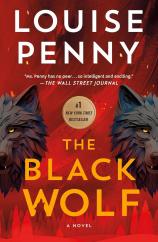
The Black Wolf
Review
The Black Wolf



While most of Louise Penny's fabulous Inspector Armand Gamache books can be read as stand-alone titles, THE BLACK WOLF is the second half of her previous effort, THE GREY WOLF. Unlike the others in the series, that one ended with the clear idea that the ultimate problem was not solved, that there was another issue that Gamache and his colleagues (who are also friends and family) must deal with.
It's a daunting task to try to review this brilliant novel. While it was written in 2024, before the ascendancy of the current US president, Penny seems to be almost clairvoyant in her ability to create a situation that occurred after she wrote the book. This gripping novel is both engrossing and frightening, as Penny takes us on a journey of "what could be."
In THE GREY WOLF, we learned the story of the grey wolf and the black wolf. A Cree chief has two wolves inside him, tearing him apart. The grey wolf is the one advocating for decency and compassion, but the black wolf tells him that he can't be weak, or else he'll be defeated and killed. Which wolf will win? The question in this novel is: Who is the Black Wolf? And can he (or she) be stopped?
Amoral politicians (both American and Canadian), greedy corporations and billionaires, and the utter stupidity of those who believe what is put out on social media combine to create a fiction that seems all too real. In fact, so much of what Penny writes is happening all around us. It's scary to realize how the truth can be twisted and made to seem crazy, how AI can make the crazy seem true, and how some people (maybe only in the pages of this novel) believe that Canadians are training geese to attack planes. And there are actually those who are convinced that tracking devices are somehow inserted into vaccines. As Penny demonstrates, there's no end to what the gullible will swallow.
"The writing is exquisite --- the staccato alternating action, violence, humor, evil, and then, finally, the peacefulness of the town of Three Pines, which all fans of this series long to visit or even move to."
So after Gamache; Beauvoir, his second-in-command and son-in-law; and Isabelle Lacoste, another deputy, save Montréal from a city-wide poisoning attempt in THE GREY WOLF, they now understand that there is an even more insidious plot --- but they don't know what it is. They are working from the same information they found thanks to Charles Langlois, a biologist, but there are no clear answers. There is a map with cryptic symbols; there are two notebooks, also with vague numbers and symbols; and somewhere there is Langlois' laptop.
The breadth of the story is stunning. The complexity of the plot is breathtaking, as is the beautiful description of the scenery of Canada's wilderness. What is the plot that Langlois had uncovered before he was murdered, dying literally in Gamache's arms? And, equally important, who can Gamache trust?
At the end of the last book, the Deputy Prime Minister was found guilty and imprisoned, but they know there are others who were complicit and not identified. And now, with new information they glean, they wonder if Marcus Lauzon, the Deputy Prime Minister, was not at fault. How high does the plot they finally uncover go?
Penny has the uncanny ability to narrate a scene, cut to another scene, and --- with every move to another character, another part of the action --- keep us hanging on the edge of our seats, dying to know what happens next. Like Gamache, we are unable to figure out until the very end who the Black Wolf is. The twists and turns are so sudden that we are at risk of whiplash.
Also throughout the novel is Penny's trademark humor. The butt of the humor is often poet Ruth Zardo, who travels with her duck, Rosa, another figure of fun. But alongside the humor is Penny’s brilliant commentaries on the human condition. Gamache and his family hate the Deputy Prime Minister with a passion, and rightfully so. At one point in the story, Gamache invites his enemy to dinner. He wonders if Lauzon will apologize for his malevolent behavior. Penny writes, "Part of him hoped he would, and that it would help sever the ties between them. Gamache knew, better than most, that hate bound a person to the one they hated."
Penny also has a perfect explanation for the harm that social media can do by sharing falsehoods, deepfakes, AI images and lies. Ruth explains in her blunt, no-nonsense, forthright manner: "There's crazy and then there's crazy. These people are crazy." And when asked why she reads it, she responds, "Because if you pile up enough sh** and leave it long enough, it has a way of combusting. And then you're in trouble." Penny delves into the power of words, the ones that ignite emotions and cause people to think of some as "others" and some as "us."
This echoes a stark reality that is frighteningly real today even if it wasn't when Penny wrote the words: "The ludicrous happens every day. The unthinkable is made real not through rational thought, but feelings. We'll follow a charismatic leader if they tell us that we have a legitimate grievance. That they'll give us back our dignity. Our threatened way of life. If we follow them, our enemies will be vanquished and we will be heroes."
Penny's heroes are not perfect people. They make mistakes and falter. But just as we forgive them, we see Gamache forgive others. At one point in the novel, Beauvoir repeats a quote from Gamache: "No one is as bad as the worst thing they've done." That's such a reassuring thought --- that we are better than our worst impulse, our biggest mistake.
The horrors of dealing with violence are real, and they don't disappear when the violence has ended. Penny's empathy for those who suffer is very apparent when she sneers at the term "post-traumatic stress" as she states that there's nothing "post" about it: "The trauma was still present, ever present. Evergreen. A perpetual, perennial horror, relived every day and through the night." How perceptive and accurate.
One piece of real estate that bridges Canada and America is the Haskell Opera House and the connected library. The building straddles the border, with a thick black line down the middle of the interior reflecting the border between the countries. Built in 1904 as a symbol of unity and friendship, it’s one of the only buildings in the world that connects two countries. It plays an important role in this story, as does the operetta that Gamache and his friend attend. Penny doesn't just build suspense; she creates poetry.
The writing is exquisite --- the staccato alternating action, violence, humor, evil, and then, finally, the peacefulness of the town of Three Pines, which all fans of this series long to visit or even move to. Described by Penny as a “state of mind,” it’s a place filled with decency and acceptance, integrity and courage. Despite the bitter winter cold, I'd move there in a heartbeat.
Reviewed by Pamela Kramer on October 31, 2025