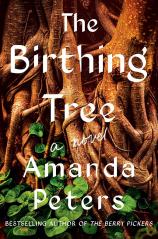
The Birthing Tree
Review
The Birthing Tree



Not surprisingly, given the title, Amanda Peters’ latest novel focuses on an ancient tree standing alongside a family homestead in a small Nova Scotia community. It is known as the birthing tree. Two prominent roots provide support and comfort for the pregnant women who travel there to give birth, and the blood and water that are spilled consecrate the ground.
Kiju is a Mi'kmaw midwife and herbalist who creates remedies from nature and prepares powerful recipes especially for the births. Aliet Paul is the narrator, and she describes life with Kiju, who is her grandmother, and the birthing tree. She introduces herself as the only daughter of an only daughter of an only daughter.
"Amanda Peters...adds to our understanding of how knowledge and life’s lessons pass from generation to generation --- through stories, memories and small recipe cards smelling of lavender wrapped in twine."
Aliet’s mother, Maggie, died while bringing her into the world under the birthing tree. Aliet has only two faded photographs of her --- one as an infant and one where she is turned away. She is told that she has her mother’s nose, but her light skin color and freckles give her a pass about acknowledging her Mi'kmaq heritage. This lack of honesty about her Indian blood, which she disingenuously explains away as something she did not really think about, will cause ultimate heartbreak.
The novel’s timeline moves from Aliet’s earliest memories, to the present time of repair, restoration and honesty, and then back to her life as a teenager and a young woman. The flashbacks connect us with her disappointments and small joys, deepening our understanding of her.
One of the novel’s most recognizable moments aligning with our contemporary life occurs at a hearing when Aliet is in high school. The town council wants to outlaw midwifery, and Kiju’s brief defense of her life’s work is timeless. A woman should be allowed to choose the way she gives birth. The first sound for a newborn's ears should be the mother’s voice. The pain of labor should translate into a powerful memory as the mother welcomes her child. She may tell the story as a passage to life, not as an experience blocked by drugs. The earth should surround and welcome the baby.
On her way out of the meeting, Kiju is stopped by a horrible town busybody who derides Kiju’s expertise and skill. She says Kiju did not even save her own daughter. Kiju’s solid slap across the woman’s face is both electrifying and satisfying. The council, though, passes a bylaw forbidding medical procedures that are not conducted by a qualified medical practitioner. Already diminished with the addition of new facilities and more rejections of the treasured tribal ways, Kiju’s life changes and saddens.
Years go by, and Aliet’s childhood home crumbles and falls into disrepair after she leaves to go to nursing school and then work in a nearby city. Her solitary life is simple, filled with broken bones and puncture wounds and the rush of overnight shifts at the hospital. Then Kiju dies, and Aliet returns to scatter her ashes under the birthing tree. While restoring Kiju's broken house, she is doing the same to her own life.
Kiju’s rich, significant life as a midwife and herbalist comes more clearly into focus, and Aliet listens to the voice of her grandmother heard in the rustle of cups and cooking pots, the rush of wind in the garden, and the earthy fragrance of mosses in the deep forest. Her steadfast friends continue to nourish her with herbal teas, laughter and good advice.
THE BIRTHING TREE may well serve as a metaphor for the life of the Mi’kmaq as it, too, changes yet endures. Amanda Peters vividly shows us the lives of Aliet and her grandmother, and she adds to our understanding of how knowledge and life’s lessons pass from generation to generation --- through stories, memories and small recipe cards smelling of lavender wrapped in twine.
Reviewed by Jane T. Krebs on September 11, 2026


The Birthing Tree
- Publication Date: September 1, 2026
- Genres: Fiction
- Hardcover: 304 pages
- Publisher: Catapult
- ISBN-10: 1646223691
- ISBN-13: 9781646223695