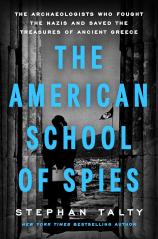
The American School of Spies: The Archaeologists Who Fought the Nazis and Saved the Treasures of Ancient Greece
Review
The American School of Spies: The Archaeologists Who Fought the Nazis and Saved the Treasures of Ancient Greece



It has been nearly 90 years since World War II commenced with Germany’s invasion of Poland. But it continues as a fertile area for historical research and writing by contemporary authors and scholars.
THE AMERICAN SCHOOL OF SPIES by New York Times reporter Stephan Talty is an engrossing and entertaining book about a group of men and women who initially were neither spies nor military operatives. Many were trained archaeologists who volunteered along with Greek Americans and other citizens of Nazi-occupied Greece to save the history and humanity of the Greek nation. It sometimes reads like a spy novel, with equal parts of James Bond and Indiana Jones. But the story is real, and the courageous behavior of its subjects is a skillfully told account of WWII heroism.
"As THE AMERICAN SCHOOL OF SPIES tells its compelling story, the intersection of wartime resistance with archaeology and intelligence gathering makes for an extraordinarily rich historical account."
Even before the United States entered the war, the FDR administration was preparing to engage Germany and Japan. The President asked former Wall Street attorney General William “Wild Bill” Donovan to create intelligence operations in Europe and the Balkans. Donovan visited overseas nations to evaluate the needs and resources in areas invaded by Germany. He spoke with political leaders, as well as kings and military figures, and was impressed by them. He also met an American, Rodney Young, who was driving a Red Cross vehicle. Young and Donovan shared Ivy League educations, as did many others who eventually would serve in the OSS. Donovan asked Young if he would help put a team of spies together to operate in Greece. He quickly agreed to it.
Young’s background is precisely the result of building a spy from scratch. He was born in 1907 and was part of the East Coast upper class. His father was an attorney, and his mother was an heiress. He was a third-generation Princeton man who obtained a PhD from Columbia in classics and archaeology. In 1933, he joined the American School of Classical Studies at Athens, pursuing the digging and discovery of antiquities. As the invasion of Greece by the Nazis became imminent and many western Europeans started leaving the country, Young stayed as a volunteer to begin salvaging and protecting ancient artifacts. He was involved in this work when he was recruited by the OSS.
For a clandestine organization, Donovan cast a wide net for potential operators in Greece. He enlisted the aid of Archbishop Athenagoras, the leader of Greek parishioners in America. They were looking for males of military age with language skills and military experience. The archbishop even sent a letter to every Greek Orthodox parish in the US telling parishioners that he was “full of Pride and Happiness” at being asked to join a secret project. The OSS wanted mechanics, medics, radio operators, safecrackers and commandos. The result of the recruiting was thousands of applications.
Greece was important not just for its geographical location in central Europe. It also had historical significance for Germany and the US. Hitler believed that Ancient Greece had Aryan roots, while the US saw the country as the birthplace of democracy. In part, the mission to save Greece also became a mission to save artifacts and archaeology.
As THE AMERICAN SCHOOL OF SPIES tells its compelling story, the intersection of wartime resistance with archaeology and intelligence gathering makes for an extraordinarily rich historical account.
Reviewed by Stuart Shiffman on June 12, 2026


The American School of Spies: The Archaeologists Who Fought the Nazis and Saved the Treasures of Ancient Greece
- Publication Date: June 9, 2026
- Genres: History, Nonfiction
- Hardcover: 320 pages
- Publisher: Dutton
- ISBN-10: N/A
- ISBN-13: 9798217044719