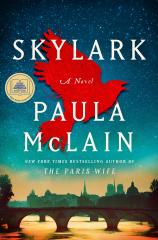
Skylark
Review
Skylark



It was only a few years ago when tragedy struck Paris’s famed Notre-Dame cathedral, with fire licking the church’s historic spires and erasing generations of legacy. But for Paula McLain, this was the start of a new story --- of a conservator digging through the rubble to discover an exquisite fragment of stained glass etched with a skylark. The find brings to mind her grandfather, who often told her stories of the tunnels and catacombs hidden beneath the streets of Paris, and where revolutionaries and refugees left carved symbols of birds to help guide others through the darkness and to freedom. This all comes to bright, shining life in SKYLARK.
In 1664, Paris’s streets are controlled by the famed Gobelin Tapestry Works, an elite guild that holds its dyers and other workers to rigid standards, with even so much as a whisper about methods or color schemes labeled treason and punished severely. For Alouette Voland, this is just one injustice of many, the main one being that women like her are relegated to the sidelines. Ever since her mother’s disappearance years earlier, an assumed suicide, Alouette has carried the weight of being not just a woman but the daughter of a mad woman. It is only her father’s reputation as a master dyer that keeps her family afloat.
But Alouette, long trained in her father’s trade, dreams of more: of becoming a dyer in her own right, and recreating the vivid blues and greens she saw every day in Marseille before he uprooted them to cold, dingy Paris. Not quite the famed City of Light in the 1600s, Alouette’s Paris is most easily identified by the Bièvre River, which is blackened by its filth and poison. Its darkness is mirrored by the high walls of the guild masters, who hoard knowledge and wealth while binding their workers to lives of labor and service to others. But it is not until Alouette attempts a dangerous, arsenic-dyed shade of blue that she sees just how risky it is to defy the guild.
"As sweeping and soaring as the lark it is named after, SKYLARK is a beautiful, surprisingly timely portrait of the human need to survive, and the incredible actions of the few who ensure that it is possible for all of us."
The Paris of 1939 bears little resemblance to that of 1664. For one, the Bièvre has been canalized under slabs and disappeared under the streets of Paris, along with its other ruins and catacombs. But the prejudice and hatred that once plagued its most marginalized citizens remain alive and well, now bolstered by the German takeover of Europe. It is at this point that we meet Kristof Larson, a Dutch medical student just beginning his psychiatry residency at Hôpital Sainte-Anne. Quiet and studious, Kristof mostly keeps to himself, though he enjoys the occasional night out at the cabaret.
It is here where he meets Alesander Extebarria, a Basque student of architecture at the École des Beaux-Arts. While Kristof tends to patients during the day, some of them nearly catatonic from mental illness, at night he and Alesander begin to explore the city’s famed catacombs. By chance, he also develops a friendship with his neighbors, the Brodskys, a Jewish family who fled from Warsaw after witnessing the beginnings of Hitler’s rise to power. Their precocious daughter, Sasha, provides a bright, shining levity here, with her devotion to memorization and unlocking the powers of her own mind. Unaware of the happenings in Europe, her dedication to her studies seems like a throughline of hope, proof that Kristof and everyone he knows will continue...and survive. After all, what is the alternative?
Of course, anyone who has studied even the barest of world history can guess at the alternative. In SKYLARK, McLain dives deep into the worst that humanity can offer. In Alouette’s timeline, a misstep on her father’s part lands both father and daughter in prison, but not before Alouette falls in love with Étienne Duchamp, a mason working on expanding the catacombs. In a last-ditch effort to preserve their connection as Alouette is sentenced to the notorious Salpêtrière asylum, Étienne carves his beloved a tiny stone lark, a symbol of hope. The treatments prescribed at Salpêtrière range from every form of violence imaginable, all administered under the guise of “saving” or “protecting” the mad women held within. Most of them are imprisoned not for actual insanity, but for speaking out of turn, loving the wrong man or refusing to suffer in silence. Crazy, right?
Meanwhile, in 1939, Paris kneels to Hitler, welcoming him with open arms in an effort to protect their historic buildings, art and other items of national pride. This may be well and good for Paris’s wealthiest, and especially the non-Jewish, but Kristof can see early on the dangers that he and his neighbors are facing. First, the hospital begins to cast out its patients, some of them nonverbal or barely functioning, explaining that they will be safer on the streets. The truth, as Kristof can see it, is that they are making room for the Germans to take over. Then come the papers and labels, along with the Star of David patches. It all culminates in the arrest of Mr. Brodsky, and the shock and horror as his wife and three children begin to reckon with the idea that he may never return home.
Weaving these plotlines together, Paula McLain paints a portrait of a city at odds. Once emblazoned with art, light and talent, it is equally weighed down by its history of hatred and bigotry, and the evil it has allowed to thrive at various points. In 1664, Alouette discovers a quiet rebellion taking place within the walls of Salpêtrière, led by the women deemed the craziest, the revolutionaries with nothing left to lose. In 1939, Kristof watches as his work as a doctor is jeopardized and finds purpose in the Brodskys --- once strangers, now condemned Jews, but family to him nonetheless. Through it all, the catacombs provide an underground refuge for these oppressed peoples, their history being carved on its buried walls one symbol at a time, with the lark standing for transcendent hope.
Though there is little to initially connect the stories of Alouette and Kristof, it is McLain’s sumptuous, glimmering talent that expertly juxtaposes their tales of courage and resilience. While hate may always creep in, insidiously taking hold of a person, a people or a city, there are always brave, unflinching heroes willing to risk it all for their freedom and the freedom of others. As sweeping and soaring as the lark it is named after, SKYLARK is a beautiful, surprisingly timely portrait of the human need to survive, and the incredible actions of the few who ensure that it is possible for all of us.
Reviewed by Rebecca Munro on January 9, 2026


Skylark
- Publication Date: January 6, 2026
- Genres: Fiction, Historical Fiction, Women's Fiction
- Hardcover: 464 pages
- Publisher: Atria Books
- ISBN-10: 1668028158
- ISBN-13: 9781668028155