Ruins
Review
Ruins



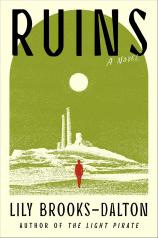
Lily Brooks-Dalton, the bestselling and critically acclaimed author of THE LIGHT PIRATE, once again turns her keen, compassionate eye to cli-fi drama. Her second novel, RUINS, is set far in the future after a devastating climate disaster called the Crisis has taken America and the world we know today.
Nestled off a glittering fjord near the North Pole, the Commonwealth is a world that looks like ours but with some marked differences. Despite its northern location, snow is rare. Although futuristic in some regards, the city runs entirely on hydroelectric power. Technology has devolved to the point that there are no phones, computers or even air travel. Perhaps most perplexing of all, there is no mention of America or any of the countries we recognize and expect to endure. Minus these differences, the Commonwealth is strikingly familiar, even down to the discontents of its inhabitants.
A once-promising archaeologist, Ember Agni has seen her life’s work derailed by bureaucratic red tape, the mundanities of life and her own abrasive nature. Though she has not been on a dig in nearly a decade, she was once at the forefront of the archaeology movement, and her own discovery of a mysterious tablet down in the Continent earned her some serious acclaim, as well as her position as a professor at a local university.
Since then, however, Ember’s progress has been stalled by the Commonwealth’s staunch observation of borders. No one is allowed passage past the wild, sea-bordered edges of the Commonwealth’s rule to the Continent, and all the ruins of the civilization that came before them are strictly off-limits. Ostensibly this is due to fears of the Continent’s scalding temperatures, dangerous water journeys and latent diseases. But savvy readers will notice an ulterior motive: control.
"Deeply captivating, bracingly sobering, and somehow still hopeful and galvanizing, RUINS is the best of Lily Brooks-Dalton, a startling talent whose forward-facing bravery and compassionate gaze make clear the value of knowledge and the risks we all must be prepared to take to preserve it."
This is where we meet Ember the professional: bored, beleaguered, and staring down an increasingly dull and unfulfilling future. And then there is her personal life. Her marriage to her husband, Jerome, may be irreparably fractured by her professional tunnel vision, but also by a grave misstep two years prior: a relationship with a graduate student that, while never sexual, blurred the lines between professor and student and put her career as an educator at risk. Beyond that, she is proudly prickly, largely friendless and mostly unliked at work.
Unbeknownst to Jerome and the few colleagues who can actually tolerate her, Ember secured illegal passage to the Continent two years ago. When her journey was derailed by a personal event, her once-burned student, Ish, took her place. And now he tells her, in a salt-seared, water-stained missive, that he has discovered the artifact that will change everything. This item will prove incontrovertibly that the people of the Continent were not illiterate, bumbling neanderthals, but an impressive, high-tech community. It was a nation united not by survival, but by boundless growth, advanced communications, and that most dangerous advancement of all: human folly.
Simply put, the Continent was America: bolstered by sophisticated smartphones and information warehouses, but at odds with the damage their conceit was doing to the very world tasked with supporting them. There’s just one major problem. Because it was secured illegally and its provenance cannot be confirmed or denied --- never mind that Ish did not survive the journey to bring it to her --- Ember cannot gift or donate the artifact to a museum, nor can she use it to support her grant proposals. This means that she has no grounds to encourage the Commonwealth’s leaders to open the borders and allow for travel and exploration, which she believes not only will prove her theories about the Continent correct, but also will prevent her own Commonwealth from meeting the same fate.
A trial ensues that pits Ember against her university peers, government representatives and, most shockingly, the Commonwealth’s origins. But when an opportunity arises for her to take a crew of 12 to the Continent to determine where the artifact came from and explore the ruins that kept it hidden for centuries, Ember finally feels like every miserable step of her life has been worth it. But alone on the water, then in the wild, untouched forests of the Continent, she must reckon with a very different set of ruins: those of her own life and what they expose not just about herself, but also about the Commonwealth, the passage of time, and what it means to control the narrative of history.
Readers of THE LIGHT PIRATE already will be familiar with Brooks-Dalton’s keen, cunning ability to demonstrate the future effects of our ecological warfare on the planet --- not just climate change, but also record-keeping, identities and personal survival. In RUINS, though, she takes this exploration a step further, asking what it might look like if America doesn’t survive the next climate disaster and what the ruins of our hubristic empire will look like to future generations. It’s not a new question, but Brooks-Dalton pens her latest with a clever, almost paleontological construction.
The world the characters inhabit is so divorced from our own that the novel unfolds a bit like a puzzle, with readers never quite certain if the world they’ve been dropped into precedes or succeeds our own. Slow-burn clues and reveals make obvious the timeline, but Brooks-Dalton plays her hand masterfully here. She explores our world as an archaeologist, someone tasked with studying the artifacts, structures and formations of a thing to figure out where it came from and how it was used. Looking through this lens is sobering, at times almost alienating, but she grounds this solemn perspective with a razor-sharp character study of her protagonist.
Ember is a remarkable antihero whom you hate to follow but also can’t resist. Juxtaposing her single-minded investigation against her woefully ignorant perspective of her life, Brooks-Dalton crafts one of the most fascinating, complex and multilayered characters I have ever read. The book’s title reflects the ruins that Ember so longs to explore, but also the wreckage of her own life, resulting in a work that explores humanity at large and on a micro scale. It unveils the hidden truths buried within every empire and political movement, but also the more cutting ones that hide in small moments: the touch of a colleague’s hand, the making of a favorite meal.
Deeply captivating, bracingly sobering, and somehow still hopeful and galvanizing, RUINS is the best of Lily Brooks-Dalton, a startling talent whose forward-facing bravery and compassionate gaze make clear the value of knowledge and the risks we all must be prepared to take to preserve it.
Reviewed by Rebecca Munro on April 3, 2026


Ruins
- Publication Date: March 31, 2026
- Genres: Fiction, Women's Fiction
- Hardcover: 400 pages
- Publisher: Grand Central Publishing
- ISBN-10: 1538770520
- ISBN-13: 9781538770528