Excerpt
Excerpt
Replica
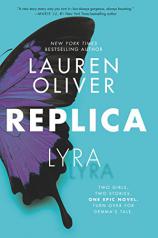




Lyra
one
On very still nights sometimes we can hear them chanting, calling for us to die. We can see them, too, or at least make out the halo of light cast up from the shores of Barrel Key, where they must be gathered, staring back across the black expanse of water toward the fence and the angular white face of the Haven Institute. From that distance it must look like a long green jaw set with miniature teeth.
Monsters, they call us. Demons.
Sometimes, on sleepless nights, we wonder if they’re right.
Lyra woke up in the middle of the night with the feeling that someone was sitting on her chest. Then she realized it was just the heat—swampy and thick, like the pressure of somebody’s hand. The power had gone down.
Something was wrong. People were shouting. Doors slammed. Footsteps echoed in the halls. Through the windows, she saw the zigzag pattern of flashlights cutting across the courtyard, illuminating silvery specks of rain and the stark-white statue of a man, reaching down toward the ground, as though to pluck something from the earth. The other replicas came awake simultaneously. The dorm was suddenly full of voices, thick with sleep. At night it was easier to speak. There were fewer nurses to shush them.
“What’s wrong?”
“What’s happened?”
“Be quiet.” That was Cassiopeia. “I’m listening.”
The door from the hall swung open, so hard it cracked against the wall. Lyra was dazzled by a sudden sweep of light.
“They all here?” It sounded like Dr. Coffee Breath.
“I think so.” Nurse Don’t-Even-Think-About-It’s voice was high and terrified. Her face was invisible behind the flashlight beam. Lyra could make out just the long hem of her nightgown and her bare feet.
“Well, count them.”
“We’re all here,” Cassiopeia responded. One of them gasped. But Cassiopeia was never afraid to speak up. “What’s going on?”
“It must be one of the males,” Dr. Coffee Breath said to Nurse Don’t-Even-Think-About-It, who was really named Maxine. “Who’s checking the males?”
“What’s wrong?” Cassiopeia repeated. Lyra found herself touching the windowsill, the pillow, the headboard of bed number 24. Her things. Her world.
At that moment, the answer came to them: voices, shrill, calling to one another. Code Black. Code Black. Code Black.
Almost at the same time, the backup generator kicked on. The lights came up, and with them, the alarms. Sirens wailed. Lights flashed in every room. Everyone squinted in the sudden brightness. Nurse Don’t-Even-Think-About-It
stumbled backward, raising an arm as though to shield herself from view.
“Stay here,” Dr. Coffee Breath said. Lyra wasn’t sure whether he was speaking to Nurse Don’t-Even-Think-About-It or to the replicas. Either way, there wasn’t much choice. Dr. Coffee Breath had to let himself into the hall with a code. Nurse Don’t-Even-Think-About-It stayed for only a moment, shivering, her back to the door, as if she expected that at any second the girls might make a rush at her. Her flashlight, now subsumed by the overheads, cast a milk-white ring on the tile floor.
“Ungrateful,” she said, before she, too, let herself out. Even then they could see her through the windows overlooking the hall, moving back and forth, occasionally touching her cross.
“What’s Code Black?” Rose asked, hugging her knees to her chest. They’d run out of stars ever since Dr. O’Donnell, the only staff member Lyra had never nicknamed, had stopped giving them lessons. Instead the replicas selected names for themselves from the collection of words they knew, words that struck them as pretty or interesting. There was Rose, Palmolive, and Private. Lilac Springs and Tide. There was even a Fork.
As usual, only Cassiopeia—number 6, one of the oldest replicas besides Lyra—knew.
“Code Black means security’s down,” she said. “Code Black means someone’s escaped.”
Gemma
ONE
Escape: that was what Gemma dreamed of, especially on nights like this one, when the moon was so big and bright it looked like it was a set piece in a movie, hooked outside her window on a curtain of dark night sky.
In movies, teenagers were always sneaking out. They’d wait until their parents went to bed, ease out from under their blankets already dressed in miniskirts and tank tops, slide down the stairs and unlatch the lock and pop! They’d burst out into the night, like balloons squeezing through a narrow space only to explode.
Other teenagers, Gemma guessed, didn’t have Rufus: a seventy-five-pound retriever who seemed to consist entirely of fur, tongue, and vocal cords.
“Shhh,” Gemma hissed, as Rufus greeted her at the bottom of the stairs, wiggling so hard she was surprised he didn’t fall over.
“Are you all right?”
She’d been awake for only a minute. But already her mother was at the top of the stairs, squinting because she didn’t have her contacts in, dressed in an old Harvard T-shirt and sweatpants.
“I’m fine, Mom.” Gemma grabbed a glass from the cabinet. She would never sneak out. Not that she had anywhere to sneak out to, or anyone to sneak out with, since April’s parents kept her just as leashed up as Gemma’s did.
Still, she imagined for a second that she was halfway to the door, dressed in tight jeans and a shirt that showed off her boobs, the only part of her body she actually liked, on her way to hop in her boyfriend’s car, instead of standing in a darkened kitchen in her pajamas at eleven p.m. on a Wednesday night while Rufus treated her ankles to one of his signature lick-jobs. “Just needed some water.”
“Are you dehydrated?” Her mom said dehydrated as if it meant dying.
“I’m fine.” Gemma rattled the ice in her glass as she returned up the stairs, deliberately avoiding her mom’s eyes. “Go back to bed, okay?”
Her mom, Kristina, hesitated. “Let me know if you need anything, okay?”
“Uh-huh.” Gemma shut her bedroom door in Rufus’s face, not caring that he immediately began to whine. She set the water on her bedside table and flopped back onto the bed. The moon made squares on her bare legs, cutting her skin into portions of light and dark. She briefly let herself imagine what Chloe DeWitt and Aubrey Connelly were doing at that very second. She’d always been told she had a vivid imagination, but she just couldn’t picture it. What was it like to be so totally, fundamentally, ruthlessly normal? What did they think about? What were their problems? Did they have any problems?
Rufus was still whining. Gemma got out of bed and let him in, sighing as he bounded immediately onto the bed and settled down exactly in the center of her pillow. She wasn’t tired yet, anyway. She sat down instead at the vanity that had once belonged to her mother, an ornate Victorian antique she’d loved as a child and hadn’t been able to tell Kristina she’d outgrown. She’d never been able to tell her parents much of anything.
The moon made hollows of her eyes in the mirror, turned her skin practically translucent. She wondered if this was how her parents always saw her: a half ghost, hovering somewhere between this life and the next.
But she wasn’t sick anymore. She hadn’t been sick in years, not since she was a little kid. Still, they treated her as if she might suddenly blow away, like a human house of cards, disturbed by the lightest touch.
She herself could barely remember all those years of sickness—the hospital, the operations, the treatments. Coping, her therapist said. An adaptive defense.
She did remember a garden—and a statue, too. A kneeling god, she thought, but she couldn’t be sure, with one arm raised to the sky, and the other reaching toward the ground, as though to draw something magic from the earth.
Lyra
TWO
H-U-M-A-N. The first word was hu-man.
There were two kinds of humans: natural-born humans, people, women and men, girls and boys, like the doctors and staff, the researchers, the guards, and the Suits who came sometimes to survey the island and its inhabitants.
Then there were human models, males and females, made in the laboratory and transferred to the surrogate birthers, who lived in the barracks and never spoke English. The clones, people occasionally still called them, though Lyra knew this was a bad word, a hurtful word, even though she didn’t know why. At Haven they were called replicas.
The second word was M-O-D-E-L. She spelled it, breathing the sounds lightly between her teeth, the way that Dr. O’Donnell had taught her. Then: the number 24. So the report was about her.
“How are you feeling today?” Nurse Swineherd asked. Lyra had named her only last month. She didn’t know what a swineherd was but had heard Nurse Rachel say, Some days I’d rather be a swineherd, and had liked the sound of it. “Lots of excitement last night, huh?” As always, she didn’t wait for a response, and instead forced Lyra down onto the examination table, so she no longer had a view of the file.
Lyra felt a quick flash of anger, like a temporary burst in her brain. It wasn’t that she was curious about the report. She had no desire in particular to know about herself, to find out why she was sick and whether she could be cured. She understood, in general terms, from things insinuated or overheard, that there were still glitches in the process. The replicas were born genetically identical to the source material but soon presented with various medical problems, organs that didn’t function properly, blood cells that didn’t regenerate, lungs that collapsed. As they got older, they lost their balance, forgot words and place names, became easily confused, and cried more. Or they simply failed to thrivein the first place. They stayed skinny and stunted. They smashed their heads on the floor, and when the Suits came, screamed to be picked up. (In the past few years God had mandated that the newest generational crops be picked up, bounced, or engaged in play for at least two hours every day. Research suggested that human contact would keep them healthier for longer. Lyra and the other older replicas took turns with them, tickling their fat little feet, trying to make them smile.)
Lyra had fallen in love with reading during the brief, ecstatic period of time when Dr. O’Donnell had been at Haven, which she now thought of as the best months of her life. When Lyra read, it was as if a series of small windows opened in the back of her mind, flooding her with light and fresh air and visions of other places, other lives, other, period. The only books at Haven were books about science and the body, and these were difficult and full of words she couldn’t sound out. But she read charts when they were left unattended on countertops. She read the magazines the nurses left behind in their break room.
Nurse Swineherd kept talking while she took Lyra’s blood pressure with Squeezeme and stuck Thermoscan under her tongue. Lyra liked Squeezeme and Thermo-
scan. She liked the way Squeezeme tightened around her upper arm, like a hand holding on to lead her somewhere. She liked Thermoscan’s reassuring beeps, and afterward when Nurse Swineherd said, “Perfectly normal.”
She added, “Don’t know what it was thinking, running that way. Breathe deeply, okay? Good. Now exhale. Good. It’ll drown before it gets past the breaks. Did you hear the surf last night? Like thunder! I’m surprised the body hasn’t turned up already, actually.”
Lyra knew she wasn’t expected to reply. The one time she had, in response to Nurse Swineherd’s cheerful question, “How are we today?” Nurse Swineherd had startled, dropping one of the syringes—Lyra hated the syringes, refused to name them—and had to start over. But she wondered what it would be like to come across the dead body on the beach. She wasn’t afraid of dead bodies. She had seen hundreds of replicas get sick and die. All the Yellows had died, none of them older than twelve months. A fluke, the doctors said: a fever. Lyra had seen the bodies wrapped and prepared for shipping.
A Purple from the seventh crop, number 333, had simply stopped eating. By the time they put her on a tube, it was too late. Number 501 swallowed twenty-four small white Sleepers after Nurse Em, who used to help shave her head and was always gentlest with the razor, went away. Number 421 had gone suddenly, in her sleep. It was Lyra who’d touched her arm to wake her and known, from the strange plastic coldness of her body, that she was dead. Strange that in an instant all the life just evaporated, went away, leaving only the skin and bones, a pile of flesh.
But that’s what they were: bodies. Human and yet not people. She hadn’t so far been able to figure out why. She looked, she thought, like a normal person. So did the other female replicas. They’d been made from normal people, and even birthed from them.
But themaking of them marked them. That’s what everybody said. Except for Dr. O’Donnell.
She wouldn’t mind seeing a male up close—the male and female replicas were kept separate, even the dead ones that went off the island in tarps. She was curious about the males, had studied the anatomical charts in the medical textbooks she couldn’t otherwise read. She had looked especially closely at diagrams of the female and male reproductive organs, which seemed, she thought, to mark the primary difference between them, but she couldn’t imagine what a male’s would look like in real life. The only men she saw were doctors, nurses, security, and other members of the staff.
“All right. Almost done. Come here and stand on the scale now, okay?”
Lyra stood up, hoping to catch a glimpse once again of the chart, and its beautiful, symmetrical lettering, which marched like soldiers across the page. But Nurse Swineherd had snatched the clipboard and was writing in Lyra’s newest results. Without releasing her grip on the clipboard, she adjusted the scale expertly with one hand, waiting until it balanced correctly.
“Hmmm.” She frowned, so that the lines between her eyebrows deepened and converged. Once, when Lyra was really little, she had announced that she had found out the difference between people and replicas: people were old, replicas were young. The nurse who was bathing her at the time, a nurse who hadn’t stayed long, and whose name Lyra could no longer remember, had burst out laughing. The story had quickly made the rounds among the nurses and doctors.
“You’ve lost weight,” Nurse Swineherd said, still frowning. “How’s your appetite?”
Several seconds went by before Lyra realized this was a question she was meant to answer. “Fine.”
“No nausea? Cramping? Vomiting?”
Lyra shook her head.
“Vision problems? Confusion?”
Lyra shook her head because she wasn’t very practiced at lying. Two weeks ago she’d vomited so intensely her ribs had ached the following day. Yesterday she’d thrown up in a pillowcase, hoping it would help muffle the sound. Fortunately she’d been able to sneak it in with the rest of the trash, which went off on boats on Sundays, to be burned or dumped into the sea or otherwise disposed of. Given the storm, and the security breach, and the now-probably-dead male, she was confident no one would notice the missing pillowcase.
But the worst thing was that she had gotten lost yesterday, on her way back to the dorms. It didn’t make any sense. She knew every inch of D-Wing, from Natal Intensive to Neural Observation, to the cavernous dorms that housed one hundred female replicas each, to the bathrooms with dozens of showerheads tacked to a wall, a trench-like sink, and ten toilets. But she must have turned right instead of left coming out of the bathroom and had somehow ended up at the locked door that led into C-Wing, blinking confusedly, until a guard had called out to her and startled her into awareness.
But she wouldn’t say so. She couldn’t go to the Box. That’s what everyone called G-Wing. The Box, or the Funeral Home, because half the replicas that went in never came out.
“All right, off you go,” Nurse Swineherd said. “You let me know if you start feeling sick, okay?”
This time, she knew she wasn’t expected to answer. She wouldn’t have to tell anyone she kept throwing up. That was what the Glass Eyes mounted in the ceiling were for. (She wasn’t sure whether she liked the Glass Eyes or not. Sometimes she did, when the chanting from Barrel Key was especially loud and she thought the cameras were keeping her safe. Sometimes, when she wanted to hide that she felt sick, she hated them, those lashless lenses recording her every move. That was the problem: she never knew which side the Glass Eyes were on.)
But she nodded anyway. Lyra had a plan, and the plan required her to be good, at least for a little while.
Gemma
TWO
Gemma must have been the only overweight sixteen-year-old girl in the entire history of the United States who actually wished she could participate in gym. It would be one thing if she were excused to go to study hall or free period. But due to “scheduling limitations” (the stated reason)—or, as Gemma suspected, the innate sadism of Ms. Vicke, the vice principal—instead Gemma was forced to go to gym and sit in the bleachers, pretending to work, while the rest of her classmates zigzagged across the gym, their sneakers squeaking, or flew across the mulchy, wet soccer fields, running drills.
In the bleachers, there was nowhere to hide. She might as well be a blinking Does Not Belong sign. Even worse: Mrs. Coralee, the gym teacher (also a sadist—the school was full of them), insisted that Gemma change into the puckered nylon shorts and matching tank tops the whole class was forced to wear, which on Gemma only served to further underscore how little she belonged—like wearing full-on ski gear to the beach.
“You are so lucky.” April Ruiz, Gemma’s best friend, swiped a lock of dark hair out of her eyes, as the girls filed back into the locker room. “I’m pretty sure dodgeball was invented by the same people who thought up rectal thermometers and wool tights.”
“Move it, Frankenstein.” Chloe DeWitt jabbed an elbow, hard, in the space where Gemma’s waist should have been, if she had a waist instead of a roll of flab. Gemma probably had forty pounds on Chloe, but the girl was all sharp corners and she knew how to use them to her advantage. Her elbows felt like whittled blades. “Not all of us get to spend the whole period snacking.”
Gemma blushed. She had never, ever eaten in class. She had hardly ever eaten in the cafeteria, precisely so that Chloe, and girls like her, would never get the opportunity to make fun of her for it. But it didn’t matter. From the time Gemma was little, Chloe had made it her mission to ensure that Gemma never forgot that she was a freak. In third grade, she’d hit on the name Frankenstein, after Gemma’s second heart surgery had left her with a thick scar from her chest to her navel. After that, Gemma had never changed except in a bathroom stall—but no one at school besides April and her teachers ever called her anything else.
What Gemma couldn’t understand was why—if she were so delicate, like her parents were saying (you’re delicate, Gemma, that’s why we have to be so careful; no roller coasters, Gemma, your heart is delicate)—she couldn’t look delicate, like one of the small crystal animal figurines that her mom collected and kept enclosed in the corner cabinet, with legs as thin as toothpicks. Like Chloe, with a tan that appeared permanently shellacked to the contours of her body, as finely chiseled and well-tuned as an instrument. Like she had been formed by a god with an eye for detail, whereas Gemma had been slapped together haphazardly by a drunk.
“Yeah,” she muttered, as Chloe and her friends converged on the sinks, laughing. “Lucky.”
“Don’t let Cruella get to you,” April said in a low voice. April always took Gemma’s side. Years ago, they had decided that either they were two aliens in a school of humans or possibly the only two humans in a school of aliens. “Someone forgot to shoot her with her morning dose of tranquilizer.”
April and Gemma waited until Chloe and the pack of wolves—a fitting nickname for more than metaphoric reasons, since Gemma was fairly sure that Aubrey Connelly had had her incisors filed into points, and wouldn’t have been surprised at all to learn that she liked the taste of human flesh—had changed before they stripped. They would both be late for study hall and would have to endure another lecture from Mr. Rotem. But anything was better than changing with the pack of wolves.
“Good news,” April said, when the rest of the locker room had cleared out. “Mom finally caved on the Green Giant. I told her it wasn’t safe to drive sixty miles in that beast, much less six hundred. How’s that for strategy? I used her own psychology against her.”
“And so the hunted becomes the hunter,” Gemma said, in her best movie-announcer voice. Sometimes she thought her favorite part of the week was sitting on the wooden bench just outside the shower stalls, which hadn’t been used in twenty years, talking with April while she washed her face and reapplied her makeup painstakingly, even though the result always made it look like she wasn’t wearing any. Like they were in their own protected world. But not a world her parents had made for her. A world she’d chosen.
“Something like that. Anyway, we’ll be cruising down to Florida in our very own Lexus. Can you believe it? My brother’s so pissed.”
Apart from Gemma’s, April’s parents were the most protective people Gemma knew. Neither Gemma nor April was allowed to date—not that it mattered, since nobody wanted to date them. The list of other things they weren’t allowed to do included, but was not limited to: (1) stay up past ten o’clock; (2) attend any school events or dances unless they were in a large group of females only, which precluded them from going, since they had no other friends; (3) go to Raleigh unless April’s brother, a senior, chaperoned; (4) be on Instagram.
Gemma was sure that even if she were five-eleven and a supermodel look-alike, her parents’ absurd beliefs about social media (It rots the brain! It’s bad for self-esteem!) would have ensured she stayed on the bottom of the social food chain. She was also sure that when her mom and April’s got together, all they did was brainstorm elaborate and ever more absurd ways to make sure that both April and Gemma stayed safe, friendless except for each other, and totally miserable.
When half the junior girls decided to spend spring break in Miami, Gemma hadn’t even bothered petitioning her parents to be allowed to go. She knew she had just about as much chance of being named the first female president of the United States . . . at age sixteen. Besides, she had no desire to spend her vacation bumping into the same predators she spent all her time deliberately avoiding at school.
But April—who was not only prettier, smarter, and far more optimistic than Gemma, so much so that had they not been absolute, sworn lifelong best friends, co-aliens, outcasts together, Gemma would have despised her—hadn’t given in so easily. She’d begged her parents. She’d cried. She had thrown a tantrum—a risky proposition, since her mother, Angela Ruiz, a renowned prosecutor for the state, had been known to frighten grown men into confessions at their first meeting. (And her other mother, Diana, was a computer programmer who had won several kickboxing competitions in her early twenties.)
Then the miraculous had happened. April hit on the magic word: sexism.
It was sexism, April claimed, that her older brother, Ryan, got to go on spring break with his friends. It was sexism that he got to drive a Lexus while she was stuck with the Green Giant, an ancient chartreuse station wagon. And even though Ryan was two years older, and the Lexus had been a congratulations gift for getting into Harvard early action, suddenly April’s moms had generated a counteroffer: April and Gemma could take the car and drive down to Bowling Springs, Florida, for a week, where April’s grandparents lived.
Even better, they had convinced Gemma’s parents that it was a good idea.
And, yeah, sure, maybe hanging out in a community known for its 65+ dating scene and competitive weekly badminton tournament wasn’t exactly the spring break of every girl’s dream. But it was better than nothing. They could stay for a whole nine days, paddle around the pool, walk down to the community tennis courts, and take their car to the beach. They could drink virgin piña coladas and sample fried gator at the local restaurants. Still better, they would have the house to themselves for three full days while April’s grandparents were off attending some weird Positive Visualization Health Retreat that involved a lot of yoga and deep breathing—a minor detail Gemma had managed to avoid in all of her conversations with her parents.
Discussing spring break plans with her best friend made Gemma feel all-American, beauty-magazine, country-song normal. So much so that she wasn’t sure she actually wanted to go, just so she could keep talking about it.
April had to hop, haul, and wiggle to get into her jeans. Her preferred fit, she always said, was human sushi roll. Gemma’s was airy trash bag. “I’ll pick you up Saturday at eight a.m., got it?”
“Got it,” Gemma said. They’d agreed on Saturday, March 19, eight a.m. weeks ago, but reconfirmed almost every day. Why not? This was the first adventurous thing either of them had ever done in their lives, unless you counted microwaving Peeps at Easter to watch them explode.
Gemma wished she only felt excited. She wished, more than anything, that her parents’ words and warnings hadn’t over time worked their way like a virus into her cells, replicating there.
She wished she wasn’t also just the littlest, tiniest bit scared.
But she told herself nothing would happen. After all, nothing ever did.


Replica
- Genres: Fiction
- paperback: 560 pages
- Publisher: HarperCollins
- ISBN-10: 0062394177
- ISBN-13: 9780062394170