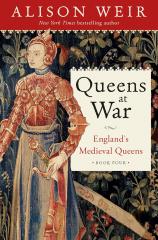
Queens at War: England's Medieval Queens, Book Four
Review
Queens at War: England's Medieval Queens, Book Four



I recall reading in several reputable sources that Alison Weir’s QUEENS OF THE AGE OF CHIVALRY, the third volume in her groundbreaking series about England’s medieval queens, would conclude a series that began with QUEENS OF THE CONQUEST and was followed by QUEENS OF THE CRUSADES.
Fortunately, in a very welcome fourth volume, Weir takes the story to a brilliant and logical conclusion. QUEENS AT WAR closes the medieval period with an uneasy but permanent joining of rival royal houses, York and Lancaster. Their on-again off-again Wars of the Roses lasted for nearly half of the 15th century (1455–1487) and erupted almost immediately after the equally infamous Hundred Years’ War between England and France (1337–1453).
During more than 80 years of political and economic instability covered in this book, five royal women found themselves almost daily in the thick of courtly intrigue, international espionage, cross-Channel diplomacy, clandestine dealmaking, marital infidelity, ruling for absent or weak kings, plotting stratagems of advancement and revenge, taking military command, and even being complicit in plots of sorcery and murder. Their activities may have ranged from noble to sordid, but the common thread connecting their overlapping lives was the survival of family lines.
Joan of Navarre (c. 1368–1437, Queen of Henry IV), Katherine of Valois (1401–1437, Queen of Henry V), Margaret of Anjou (1430–1482, Queen of Henry VI), Elizabeth Widville (c. 1437–1492, Queen of Edward IV) and Anne Neville (1456–1485, Queen of Richard III) all lived relatively short lifespans by modern standards, ranging from a tragically typical 29 (Anne) to a venerable 69 (Joan). Weir reveals in astonishing detail their under-appreciated individual and collective influence on history.
"Weir brilliantly demonstrates in this weighty but compelling conclusion to her series that the tapestry of English royal history is often most interesting and grounded when the torn, frayed and bloodstained places become an integral part of the story."
For all of them, joined in politically and religiously arranged marriages, the first and foremost duty was to supply their royal husbands with at least one male child to inherit the throne. But in a time of high infant and maternal mortality, success could take years, and the pressure to produce was relentless. Among surviving children, daughters seemed to predominate, but their only useful future was as bargaining pieces for advantageous diplomatic marriages. Strong sons were rare and always under threat by rivals.
As just one example, Elizabeth Widville bore Edward IV 10 children, seven girls and three boys. Three daughters and two sons survived childhood, but all were declared illegitimate at Edward’s death in 1483. When rival Richard III took the throne, both her sons were imprisoned in the Tower of London and later murdered, likely on Richard’s orders. Anne’s children, living and dead, were relegitimized in 1485 when Henry VII became the first Tudor king.
Weir begins QUEENS AT WAR with Joan of Navarre, who became Henry IV’s second wife in 1403 at the age of 35. Already past ideal childbearing age, she was unable to produce any living offspring. But like most of Weir’s resourceful queens, Joan was extremely well-connected across the Channel and actively participated in numerous marriage negotiations and behind-the-scenes diplomacy between England and France. Her fortunes varied in the extreme; she became the only English queen ever charged with witchcraft, even being imprisoned for treason.
At the more typical (but still “old”) age of 19, Katherine of Valois married Henry V in 1420 as a direct condition of a peace treaty (one of many made and broken) between England and France. She was only 21 when Henry died and scandalized royal society by maintaining a secret love-liaison with Welsh commoner Owen Tudor. Through him, she became the grandmother of Henry VII, England’s first Tudor monarch.
Margaret of Anjou played the most significant political and military role in the Wars of the Roses. In 1445, at the age of 15, she was married to the pious and scholarly, but indecisive, Henry VI. She quickly replaced him as a formidable defender of the Lancastrian cause. Her ability to create swift, effective and powerful armed alliances made her an adversary more feared and respected than many male military strategists of her day. She also suffered numerous defeats, losses and setbacks, yet almost single-handedly changed the course and dynamics of a long and very bloody war.
Elizabeth Widville’s marriage to Edward IV was criticized not only because of her widowhood (as were Joan of Navarre and Anne Neville) and commoner background, but also for her English birth. At a time when arranged foreign marriages were considered essential for political stability, Edward broke with tradition by choosing a commoner widow, and one of rival Lancastrian parentage. Weir details vividly how Elizabeth came into her power by exercising every opportunity to position her own family members in important royal posts. Her overriding ambition made her increasingly unpopular at court and beyond.
Although not as politically active as her precursors, Anne Neville’s marriages bridged a pivotal gulf, first as the teenage wife of Edward, the last Lancastrian heir to the throne (married c. 1470), then as consort to Richard III, the last Yorkist ruler (married in 1472 when she was barely 16).
Throughout QUEENS AT WAR, Weir paints strikingly vivid pictures of life in an era unprecedented for a level of political and economic uncertainty that affected every social class. The sheer amount of travel involved as the court moved from place to place, or as rivals fled one another up and down the country, or armies gathered and pursued one another in battles on both sides of the Channel, is mind-boggling for a time when the fastest land transport was horseback, and ships had little technology to navigate bad weather. Even the vast proliferation of messages back and forth seems unbelievable in a pre-postal, semi-literate society.
Weir brilliantly demonstrates in this weighty but compelling conclusion to her series that the tapestry of English royal history is often most interesting and grounded when the torn, frayed and bloodstained places become an integral part of the story. QUEENS AT WAR is a challenging read in places but is highly recommended.
Reviewed by Pauline Finch on January 16, 2026


Queens at War: England's Medieval Queens, Book Four
- Publication Date: December 2, 2025
- Genres: Biography, History, Nonfiction
- Hardcover: 576 pages
- Publisher: Ballantine Books
- ISBN-10: 1101966750
- ISBN-13: 9781101966754