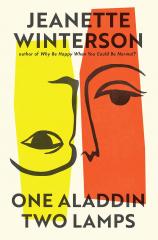
One Aladdin Two Lamps
Review
One Aladdin Two Lamps



Given that Jeanette Winterson has previously written creative reimaginings of Shakespeare's THE WINTER’S TALE (in THE GAP OF TIME) and Shelley's FRANKENSTEIN (in FRANKISSSTEIN), I picked up ONE ALADDIN TWO LAMPS with the expectation that it would be a retelling of the story of Aladdin (known to me mostly from its Disney adaptations) or its framing story, ONE THOUSAND AND ONE NIGHTS. And, to a certain extent, it is that. But it's also much more, incorporating elements of memoir, literary criticism, and political and social analysis into a surprising, satisfying whole.
The fact that this new book becomes far more than a simple retelling is, in Winterson's work, not that surprising. As she writes early on, "Stories have a way of escaping. Recombining. Defying neatness." She notes that for Shahrazad --- the storyteller who spins these stories nightly in order to try to escape the executioner's axe the following morning --- having the stories overflow their boundaries, intersect, overlap and diverge from one another was a necessity, spinning the stories out so that they never truly end.
"Winterson consistently spirals out from ONE THOUSAND AND ONE NIGHTS to include references to other works --- such as those of Shakespeare, Brontë, Ted Hughes, Yeats, and even song lyrics by Paul Simon --- to discuss how literature works and why reading is important, even essential."
Winterson pulls back throughout, outlining how each story serves the one that precedes and follows it. She pauses with the reader to discuss how these stories work, how they play with and defy the conventions of storytelling, and analyze the different ways in which they examine systems of power and reward, both within the stories themselves and in connection with those who tell and hear the stories.
Winterson consistently spirals out from ONE THOUSAND AND ONE NIGHTS to include references to other works --- such as those of Shakespeare, Brontë, Ted Hughes, Yeats, and even song lyrics by Paul Simon --- in order to discuss how literature works and why reading is important, even essential. She continually revisits her own personal history as a writer and, first, as a reader --- one who, as a girl growing up in a strict religious household, encountered the world's possibilities through the pages of books. Given our current political climate, she also speculates about what we have already lost and continue to lose as a literacy crisis converges with the ascendance of authoritarian systems of power.
In recent years, Winterson has grown increasingly fascinated with artificial intelligence, and she returns to this theme near the end of ONE ALADDIN TWO LAMPS. She might be more optimistic about our digital future than some readers are likely to be. But she does ask provocative questions about what will endure from our current existence if, as some futurists predict, consciousness eventually will no longer need to be tied to biological reality.
What is most important to preserve is "the enduring spirit of what it is that allows both love and language to come forward, to be heard, to create, to recreate. The spirit --- not contained in any bottle --- that makes forgiveness possible." In short, imagination. Some may be skeptical of this vision, but perhaps if we all have even a fraction of Winterson's own imagination, there's hope for us yet.
Reviewed by Norah Piehl on January 23, 2026


One Aladdin Two Lamps
- Publication Date: January 20, 2026
- Genres: Literary Criticism, Memoir, Nonfiction
- Hardcover: 240 pages
- Publisher: Grove Press
- ISBN-10: 080216711X
- ISBN-13: 9780802167118