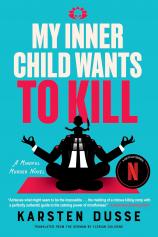
My Inner Child Wants to Kill: A Mindful Murder Novel
Review
My Inner Child Wants to Kill: A Mindful Murder Novel



Karsten Dusse's new novel, MY INNER CHILD WANTS TO KILL, is a worthy sequel to his extremely successful work, MURDER MINDFULLY. Both books feature protagonist Björn Diemel, a lawyer to men of questionable honesty and character; his wise and clever therapist, Joschka Breitner; several of Björn’s gangster clients; and his estranged wife, Katharina, and their beloved child, Emily.
Björn had committed two murders in the first novel. Both victims murdered mindfully, mind you, and were necessarily eliminated. If he had let them live, they certainly would have killed him. He also has managed to capture another killer and keep him in a cell in his basement. It’s better than taking the life of a third person, we suppose. In any case, he has promised himself never to kill again.
In MURDER MINDFULLY, Björn had absorbed all of his therapist's information about mindfulness, the basic pretext of which is not to think about relatively unimportant issues and to concentrate only on the thoughts and behaviors that immediately will serve your present needs. It seems like a wonderful and useful idea. But Björn had twisted those ideals into a strong belief supporting his contention that a couple of murders were inarguably his “present needs.”
The structure of both of these very clever, lighthearted novels is that the introduction to each chapter consists of words of wisdom from Breitner, followed by the story of Björn's adventures as he puts to use Breitner's specific gems of advice.
"[I]f you love mysteries with surprising and extraordinarily humorous twists, or even if you just enjoy exceedingly creative lighthearted literature, then take the advice of my son, my grandson and me, and read Karsten Dusse's wonderful books."
Björn's problems in MY INNER CHILD WANTS TO KILL begin with his very childish action during a visit to the Alps with Katharina and Emily, the same trip he had taken with his parents when he was a child. When the family sits down to have a meal, it soon becomes clear that their young waiter is an arrogant jerk who enjoys ignoring Björn's requests for service. As his unpleasant attitude becomes increasingly obvious and annoying, Björn's anger starts to sizzle. So he sets up a little trap for the waiter, who ends up falling off the nearby ledge and into the ravine, breaking his neck. Björn has killed him --- unintentionally --- but it is definitely the result of his uncontrollable anger. Everyone thinks that the tragedy was just an accident, but Björn knows better. He is responsible for a death. Again.
Björn visits Breitner to learn how to deal with his anger. But the therapist theorizes that the adult Björn is not the problem. The real issue is his very angry inner child. When he went with his abusive parents on the Alps vacation, they had made it abundantly clear that his needs did not matter. So they taught him, in essence, that he should just learn to live with the fact that he doesn't matter at all. And when the waiter acted the way he did with the adult Björn, he WAS those disgusting parents one more time. So his inner child reacted the way that an abused child would react --- with the need for revenge. Breitner urges Björn to begin an ongoing dialogue with his inner child in order to convince the child that he is loved and can depend on “his” adult to learn how to control his anger.
Björn accepts that responsibility, and for the rest of the novel, his inner child becomes another character in the book. “Discussions” between the two Björns become as real as discussions between Björn and anyone else. He tries to settle down his younger self, and his inner child attempts to realize fully that he should trust his elder self, to take the advice the adult offers, and to overcome his need for revolt and revenge. These conversations are cleverly constructed and often extremely funny, an absolutely unique method of talking to oneself.
But the togetherness of the two Björns doesn't even begin to resolve Björn's multitude of problems. His gangster prisoner, Boris, at first seems to have escaped and disappeared from his basement cell. When it turns out that he hasn't really escaped, the situation becomes even more dangerous and puzzling. Someone with access to Boris wants to punish him but not kill him yet. Björn then decides to help out the brother of Laura, a young and lovely mother of one of the students in the preschool class to which Emily belongs. Bjorn owns the preschool and the building in which it is housed. He also has an apartment and a business office there --- as well as the prison cell in the basement.
The building is attacked by a mystery person. It becomes apparent that the assailant is the one who temporarily freed Boris and has information about Björn's previous misdeeds. The protagonist is now facing trouble from all sides, and it could be deadly. Anyone who knows and hates Boris is either a gangster and probably a killer, or someone who carries deep grudges and hatreds. So the suspense and the mystery become more complicated, far more disturbing and potentially deadly.
But as the danger grows, so does the novel's humor. As the owner of the preschool, Bjorn must communicate openly with the parents of the children, and they are a fascinating lot. He develops a crush on Laura, who is Max's mother, and the kid insists that he has heard strange and scary sounds coming from the basement. Uh-oh. Has he heard the man in the cell? Or the individual who temporarily freed him? The sound of stuff being moved around down there? All of that?
Björn also must deal with the goofiness of the substitute teacher who tells the kids that if they eat or drink from squeezy pouches, they are contributing to the destruction of the environment. Both Emily and Max love their squeezy pouches, so Björn must make the educator look foolish. But the majority of the parents agree with the sub, and the ensuing arguments are truly hilarious.
The later long section of humorous events is even sillier, more creative, more laugh-out-loud funny, and certainly more daring. As Björn and Laura consummate their affair, and as Björn experiences and narrates the happy get-together step-by-step, he also pictures and narrates the parallel event of his employee entering and “implanting” the equipment to set a building on fire. Björn's ecstasy and excitement about both dreams coming true culminate in a stunning climax, a veritable explosion and fiery finish. I've never before read such an exquisite and crazy description of two parallel constructions occurring at the same time. And I'm quite sure I never will again. Talk about uniquely hot creativity!
When I've just finished and reviewed a novel that I deeply appreciate, I often check other reviewers’ opinions about it to see if they agree with my positive assessment. They usually do. But in this case, my supporting opinions came not from other critics, but from my own family. I hadn't realized that my 38-year-old son, a smart guy and terrific reader, was reading Dusse's first novel at the same time I was reviewing this one. He said, out of the blue, “I'm reading a really good mystery called MURDER MINDFULLY.” My “second opinion” had arrived surprisingly quickly.
Then, while I was taking a nap, my 10-year-old grandson, an extremely bright and precocious kid, had grabbed MY INNER CHILD WANTS TO KILL and started reading it. I woke up when he was on page 20. He said, “Boy, this is a great book, Papa.” I said I agreed, but I grabbed it back and told him it would be appropriate for him in about 10 years. He was insulted and even a little angry. I momentarily thought, I wonder if this angry child is actually my own long-lost angry inner child reborn. That thought lasted only about two-and-a-half seconds, but it did reflect how deeply my brain had been embraced by Dusse's unusual novels.
So if you love mysteries with surprising and extraordinarily humorous twists, or even if you just enjoy exceedingly creative lighthearted literature, then take the advice of my son, my grandson and me, and read Karsten Dusse's wonderful books.
Reviewed by Jack Kramer on August 14, 2026