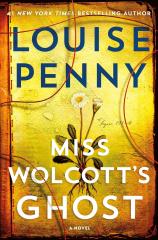
Miss Wolcott's Ghost
Review
Miss Wolcott's Ghost



Welcome back to Three Pines, that charming, peaceful village (minus the occasional murder) nestled in the mountains of Québec.
Louise Penny's prior books, THE GREY WOLF and THE BLACK WOLF, took us into a far-reaching conspiracy that spoke of world politics and evil intentions. While our beloved Armand Gamache was still intrepid in his determination to protect people from dastardly plots and despicable deeds, we didn't get to spend much time in Three Pines. But even though MISS WOLCOTT’S GHOST returns us to that idyllic locale, there is still so much going on, so many threads to the plot, that trying to do justice to them all is a Sisyphean task.
One of the best parts of Penny's novels, and almost a character in its own right, is Three Pines. It's a magical place that doesn't appear on any map or GPS, and it's difficult to find, but the “right” sort of people end up there --- those who need to be there. And I daresay that most readers, certainly moi, long to move there as well. Gabriel “Gabri” Dubeau and Olivier Brulé are the charming couple who run the bistro, which serves mugs of café au lait and sandwiches with ham, brie and apples. Ruth Zardo is a well-known poet whose favorite word rhymes with her pet duck, Rosa. Myrna Landers owns the local bookstore, and Clara Morrow is the now world-famous artist. And Inspector Gamache and his wife, Reine-Marie, live in a cottage with a wide veranda and a lovely garden.
"Along the way in this free-rambling mystery, we are treated to Penny's brilliant writing and wry commentary on the history of women.... One of the reasons that this series is so delightful and beloved is the sense of belonging, community, friendship and family as we read about Three Pines and its residents."
The story begins with a phone call in the middle of the night. Someone wakes up Gamache with information that there's a body in Lost Nation. The call is disconnected, and Gamache is flummoxed. He doesn't know who it was, and he has no idea where or what Lost Nation is. Muddling the matter even more, the call originated from a burner phone registered to Clara, who claims to know nothing about it. He and Reine-Marie ask their friends about Lost Nation and try to research it, but to no avail. Ruth mentions that perhaps the couple at Buzz, the bistro in nearby Knowlton, might know about it. They do, and it turns out that it's a real bistro (which I'm guessing will be getting a lot more traffic from fans of the series who flock to Knowlton, where Penny lives).
Lost Nation is a place that is uninhabited in the novel. The cemetery contains tombstones on which the dates stop in the late 1880s. And yes, when Gamache is led there by the bistro's chef and owner, there is indeed a body on top of one of the graves. But the tombstone has no name, just a date. It is made of a different material and faces in a different direction than the other markers. Growing out of and through the body is a strange plant --- one that turns out to be named Miss Wolcott's Ghost.
Penny brings to our attention historical events that otherwise might have passed us by. For example, in another novel, we learn about the shooting of the Canadian engineering students at the École Polytechnique. It led to the passing of gun control laws, and there is a national day of remembrance. Penny continues that tradition here by detailing a tragedy that I'm not going to name in this review as it needs to be discovered during the reading. But it's yet another obscure event that should be known.
In the Acknowledgments, which Penny (and I) advise you not to read until you have finished the book, Penny shares that Miss Daisy Wolcott is based on a very real, brilliant woman.
So this mystery wanders from the wealthy and eccentric Miss Wolcott and her roundabout connection to the tragic event, to the killings of two women over half a century ago, and the current murder that Gamache is investigating.
In this novel are tales of greed and unbridled avarice. But perhaps the most touching element is that Miss Wolcott, who exemplified the difference between male and female explorers, didn't explore simply to find riches. Rather she listened to indigenous people. She noted their stories and thought they were important. There is more that can't be shared, but she truly is one of Penny's most notable characters.
Along the way in this free-rambling mystery, we are treated to Penny's brilliant writing and wry commentary on the history of women. At one point she describes Clara, Ruth and Myrna as they arrive at the cemetery at Lost Nation after an arduous climb: “They looked for all the world like something Mother Nature had birthed. Like the three tall pines. Or the witches from Macbeth. Or the Three Graces. It came to the same thing, Isabelle knew. Witches. Graces. Same women. Just different interpretations.”
Penny mentions the perceived threats from history that certain governments feel and that they sometimes try to erase due to “toxic nationalism and unpleasant truths.” She also spends time studying opposites: bravery and cowardice. It's one thing for an officer to know what is expected in a planned raid, but she points out that we don't know how we'd behave in a crisis. Would we sacrifice our lives to help others escape, or would we succumb to that basic desire to run and live to see another day? She says that bravery isn't a lack of fear; it's how we deal with that fear. Do we run away? Do we face it?
One of the reasons that this series is so delightful and beloved is the sense of belonging, community, friendship and family as we read about Three Pines and its residents. Where one woman goes, the others show up. And after just a bit, Gabri appears with libations and treats. Lemonade and ginger cookies in the summer. Mugs of coffee and tea with hearty soups and sandwiches dripping with melted cheeses in the winter. Sitting in front of fireplaces enjoying the crackle of the logs burning, or sitting outside the bistro and taking in the sunny day, depending on the season. Three Pines is at the heart of these stories. The warm feelings and Inspector Gamache's kind, intelligent and understanding demeanor envelop us inside a sensation of protection. We know he'll keep us safe.
And then we have to close the book and step back into the real world. But at least for several hours or days, we get to live in Louise Penny's world, a better place (except for the murders, of course) and most definitely a more delicious experience through and through.
Reviewed by Pamela Kramer on October 23, 2026