
Excerpt
Excerpt
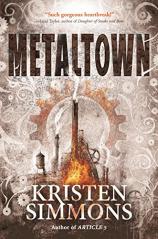
Metaltown




1
COLIN
“Go halves with me—you want pigeon or rat?”
Ty swiped at her nose with the back of her hand, making the threadbare, fingerless glove bunch around her wrist. The cold had drawn bright blotches to the exposed skin between her hat and tattered scarf, and as the line to Hayak’s corner cart shortened and pulled them beneath the yellow glow of the streetlight, Colin could make out the hooked scar on her chin, and a fading brown bruise on her jaw.
“What’s the difference?” They all looked the same to Colin: charred fists of meat. He stamped his feet and shrugged deeper into his wool coat. It was too big—big enough to fit another sweater in- side if he’d had one, which he didn’t. The bitter predawn wind clawed right up his stomach and back, freezeburning his skin.
Ty’s thick, straight brows lifted, but refused to arch. “One flies, Prep School. Surprised you didn’t know that.” She snorted, revealing a crooked front tooth.
Colin frowned. He hadn’t been to school since he was thirteen, more than four years ago. That life was in the past.
“Rat,” he said, because it was her less favorite of the two. “And I call the nose.”
“Course you do.” She spat on the ground, then rubbed it into thecracked sidewalk with the heel of her boot. “You talk. Hayak likes you better.”
“That’s ’cause I’m likable, Ty.” He grinned now, and she rolled her eyes.
Another customer served, and they moved to the front of the line.
Hayak, a greasy man three times their age with a shock of white hair and a peppered beard, looked up from his rotisserie and grimaced.
“No,” he said. “No, not you two. Not today. Hayak cannot feed you today. You go away.”
Colin flashed his best smile and pulled off his hat in an attempt to look less shifty. “Come on, Hayak. You said we could pay at the end of the week—”
“No.” He shook his finger at them sternly. “No, you say you pay at the end of the week. Hayak say you can pay now.”
Colin looked over his shoulder and winced at the grumbling line behind him. Stepping off to the side, he cuffed the man’s burly shoulder. “You know I’m good for it, Hayak. You know I wouldn’t lie.”
He hid a smirk as Ty eased up beside the cart behind him and stashed a handful of fry scraps up her coat sleeve. If he could just turn Hayak a little more, she could reach the black spit and the hunk of charred meat pierced on the end.
The man directly behind her was crowding up in line, making a quick circle with his hand for Ty to pass him some. She raised a silent fist, like she might punch him, and he fell back a step.
“Hayak, you’re right, I should have given you money last week. Only I didn’t get paid, okay? So it wasn’t my fault.” That much was true. Hampton Industries was fat on green. So fat, it didn’t get off its lazy ass to pay its workers half the time.
As Hayak shouted back, his face turned progressively redder and his eyes began to bulge. It was just a matter of time before he went for the tongs to beat Colin upside the head. Colin pulled his hatback down over his ears, taking the lecture with a feigned look of shame. Shifting left drew the cart man’s gaze further away from Ty. She was just about to make a grab for the prize when motion behind her caught Colin’s eye.
A man approached, wearing clean trousers and a coat swollen with enough stuffing to make Colin shiver at his own lack of protection from the cold. He had that yellowed, sunless skin, pockmarked at the tops of his cheekbones, and long hair, greased nice, and pulled into a tail at the back of his skull.
Jed Schultz. The People’s Man. The voice of the Brotherhood—the people who represented the workers’ rights at the steel mill where Colin’s ma was employed. He was flanked by a man twice his size but half as bright. A hammer, hired to watch Jed’s back so the greenback bosses couldn’t stick a knife in it. Colin thought his name was Imon, and had heard he’d come from somewhere in the mountains, north of the Tri-City. A place so cold your breath turned to ice before it left your mouth.
Colin coughed once, and Ty abandoned her mission without so much as a glance up.
“Morning, Hayak,” said Jed. He walked straight to the front of the line. Those who’d been waiting didn’t mind— Jed did right by the poor folks, so Jed got whatever he wanted in Metaltown.
“Mr. Schultz, good morning. Yes,” Hayak recovered, keeping Colin in his sight.
“How’s the bird?” Jed asked.
“Good, good. I give you my best one. Here.” Hayak stepped back behind the center of his cart, and rotated the rotisserie once over the flames to warm the round carcass Colin had been eyeing. His stomach grumbled. Saliva filled his mouth. He’d eaten yesterday, but it felt like longer.
He swallowed as Hayak wrapped the bird in paper and handed it to the People’s Man. Jed nodded, just slightly, cuing Imon to step forward and withdraw a wallet from the breast pocket of his coat. There was a stack of bills in the fold, and as he unfurled one afteranother, Colin’s eyes grew wide as dinner plates. Jed was flush as a greenback. There was a bite of jealousy, then a swell of admiration. He wondered what it would be like, just once, to walk up to Hayak’s cart and buy whatever he wanted.
“Your money’s no good here, Mr. Schultz,” said Hayak, a huge smile plastered across his face. Colin couldn’t help gagging, to which Hayak responded with a glare.
“Good man,” said Jed. Imon put his money away. Jed turned to Colin. “You like pigeon, Mr. Walter?”
Colin’s eyes went wide. He wiped his hands off on the front of his coat, aware of ten pairs of eyes that swung his way. They were surprised, Colin knew, that Jed knew his name. He was surprised himself.
“Yes, sir.” Colin’s mouth gaped like a fish when Jed handed him the steaming, charred meat. White bubbles of fat had already begun to congeal against the puckered skin in the cold; a good sign the bird was thick, not hollow. “Whoa. Thank you, Mr. Schultz.”
“How’s Cherish, Colin?” His eyes were dark and piercing. Powerful, Colin thought. He wondered if he was capable of such a commanding stare himself. Jed and Imon had stepped in front of Ty, and she was slowly backing into the line opposite them, head down, hat pulled over her ears. Colin gave her a puzzled look—it wasn’t like Ty to back away from anyone, famous or not.
“She’s okay. The money you sent helped, thank you, sir. The doc said she needs clean water for drinking. That’s what we bought.” Colin had stiffened at the mention of family but tried to play it cool. Jed didn’t need to be bothered with all the details.
“Good boy,” said Jed, nodding with interest. Colin relaxed. “So Colin, Hayden was supposed to meet me this morning. He say anything to you about it?” Jed reached for another hunk of meat—rat or pigeon, Colin couldn’t tell—and returned Hayak’s smile.
Colin tensed again. His brother had grown unpredictable these last few years. Hayden was three years older than Colin, but had never adjusted to Metaltown the way Colin had. Ma said it wasbecause he’d gotten his heart broken when they’d pulled him out of school. She didn’t know the half of it.
Colin’s fingers were beginning to thaw beneath the crinkling paper holding the bird. Dawn was coming, turning the darkness to the chronic steely haze that burned off the chem plant across the bridge in thick, white plumes. The air had a sweet, heady odor that would only grow stronger as the day plowed on.
“He’s been sick,” said Colin. “He did say he was going to meet you, but I guess he fell behind. He was up puking all night.” Which was probably true, wherever he was. Colin hadn’t seen him in two days. Ty’s chin lifted in surprise before digging back into her scarf.
Jed scowled. “Not the flu, I hope.”
“No sir, just ate something rotten.” He was going to punch Hayden square in the face when he surfaced.
“Well, that’s okay then,” said Jed. “Since he’s indisposed, maybe you can do me a favor.” Jed leaned against the cart, tearing a hunk out of the meat in his grip with his chew-stained teeth.
Colin took Jed’s lead, and bit straight into the wing. It was tough and gamey, but warm. He felt Ty’s glare from behind Jed.
“Yeah. Sure, okay,” said Colin.
“A friend of mine lost his girl to the corn flu a few weeks past. He’s been missing work, and I’d hate to see them lose their place over it.”
Colin nodded. Jed did this kind of stuff a lot. Just two weeks prior, Colin’s ma hadn’t made her quota at the mill and the foreman had refused to pay her. Their cupboards were already bare, and just before the heat was shut off, Hayden came home with a wad of cash, courtesy of the People’s Man. It had been enough to keep their lights on, and put food in their bellies for days.
Jed stepped away from the cart, and the people in line tentatively resumed their shuffle.
“They live in Bakerstown, by the Cat’s Tale, you know where that is?”
“Sure,” said Colin, taking another bite. He used to live in Bakerstown before he’d left school.
Imon removed the wallet again, this time taking out a stash of green bills half an inch thick. Colin had to remind himself to keep chewing. Just one of those bills could fill six jugs with clean drinking water. Another could pay the power at his apartment through the next month. One more could mean food, real food—bread and beans and salted pork—for dinner, not just broth like they had every night.
“Can you take this down to him this morning? One-fourteen Fifth Street.”
Colin waffled, glancing at Ty. She was shaking her head no, but when Jed followed his gaze she immediately fixed her eyes on a hole in her shirtsleeve.
He faced Colin again. “I can count on you, right Colin?”
“Yeah. Of course, Mr. Schultz. It’s just that I’ve got work in an hour, and the Cat’s Tale is way up Fifth Street. I mean, I’ll do it, it’s just . . . You know how the foreman gets if you’re late.” Colin couldn’t afford to push his luck with Minnick. The man had fired two workers just last week for getting sick on the job—something that happened a lot on account of the hazardous materials they dealt with. But he didn’t want to get on Jed’s bad side either, not after how good Jed had been to his family.
Jed smiled. “I’ll talk to your foreman. You’re in Small Parts labor, right?”
“Yes, sir,” said Colin. “Good. Go ahead and take your pal.” He stuck a thumb behind him in Ty’s direction.
“Okay.”
The concern that had come into Jed’s face while he’d been talking about the family dissipated. He slung a hand around the back of Colin’s neck and gave a companionable squeeze. “You’re a good kid, aren’t you? Remind me of me when I was your age. Man of the house.”
Colin grinned, and felt his ears grow warm under his hat. Tech- nically, Hayden was the man of the house, but Hayden wasn’t here, was he? Colin wasn’t so irritated that his brother had blown off Jed anymore. In fact, Hayden could go right ahead and stay gone as long as he liked.
Imon handed him the stack of money, and Colin, fighting the urge to count it, folded it into the front pocket of his trousers.
“Say hello to Cherish for me.” Jed turned back the way he’d come, disappearing into the gray smog.
Colin felt ten feet tall. Breakfast, a personal hello from the biggest man in Metaltown, and the morning off work? It couldn’t get much better than that.
“Wipe that grin off your ugly face.” Ty snatched the remainder of the bird from his loose grasp. He pulled his hat back, smoothed one gloved hand over his buzzed head, and winked at her.
“Ugly,” Ty repeated. Then they turned the opposite way, toward Bakerstown and the rising sun.
2
TY
Ty bit down on something that crunched, and pulled a white shard of pigeon bone from her cheek. It was thin as a needle, and she used it to pick at the food stuck in the gaps between her teeth. She may not have liked where the feast had come from, but she wasn’t about to turn it down. Pride didn’t fill your belly like a roasted pigeon.
“Smells good out here,” Colin said from beside her. She glanced over, but he wasn’t smiling like he had been for the last mile—he was biting his pinky nail. She felt her own brows draw together in response.
The air did smell cleaner; anywhere outside the grasp of the factory district did. But though the sun didn’t have to cut through a filter of smog, it wasn’t like the place was perfect. The poor ran thick here, crowding the street beside them, begging at each red brick shop front for food and work.
Funny how they didn’t come to Metaltown to beg for work.
“Don’t lie. You know you love the smell of nitro in the morning,” she said, glad to see his hand lower from his mouth and his grin return.
The crumbling sidewalk they walked down ran beside an iron fence that twisted and spiraled like the ivy that clung to it. It would have been posh had the park within not grown over like a jungle.It was even stocked with wild animals: dopers and sellers and the kind of people who knew how to get anything you wanted—for the right price. At least half of them were in the earliest stages of the corn flu.
She felt the switchblade lodged into her boot, and another knife in her waistband. Always ready, just in case.
“How much did Jed’s man give you?” she asked, changing the subject. She would have suggested pocketing a few bills for them- selves, but she knew better. Nothing was free in Metaltown. She’d bet a week’s pay that Imon’s muscle work wasn’t limited to greenback thugs.
“I don’t know, but it’s burning a hole through my leg.” Colin was thinking of lifting it too, she knew he was. They were two like minds. Had been since she’d taken him under her wing four years ago, fresh out of prep school.
She glanced his way, noticing the changes in him. Metaltown had made him hard. His sky blue eyes had turned to steel, and his dark, shaggy hair had been shorn close to the skull to cut the heat inside the plant. Hands used to writing facts and figures had grown strong and calloused, and he had muscles, too, beneath those baggy clothes.
She’d been eleven and he’d been thirteen when they’d met, but their ages might as well have been reversed. He’d known nothing about work, and for some unknown reason she’d taken pity on him and called a safety. According to street rules that made her responsible until he could stand on his own two feet. Now he was a leech. She couldn’t shake him if she tried.
“Let’s count it,” she said, feeling a different, greedy kind of hunger take over. Even if they couldn’t lift it, she could feel the paper in her hands and imagine what it’d be like to buy whatever she wanted.
“Yeah right,” he said, and his shoulders pulled forward again. “We passed the beltway. We’re on McNulty’s turf now. One sniff of green and they’ll be on us like flies on rot.”
“Let ’em come then,” she said, tapping the handle of the knife she kept in her waistband. “I’m not scared of any Bakerstown pansies.”
His barked-out laugh had her cheeks suddenly warm. “Just like you were going to take Jed and his man, right?”
She fought the urge to sock him between the eyes. “I could take ’em.”
“Course you could’ve,” he said. “Imon only outweighs you by a hundred and fifty pounds.”
She tossed the bird carcass into the trash-filled gutter. “I’ll take you in a second.”
“Such a tease.” He shoved her off the sidewalk.
She pushed him back, maybe a little too hard, irritated that all the layers of clothes she wore suddenly made her too hot. He bounced off the iron fence, laughing.
The clang of a doorbell from one of the shops across the street drew their attention to a couple exiting a deli. They were flush, that much was obvious. Smart clothes—a black peacoat and slick leather shoes on the man, a swanky black dress on the woman—and clean, brown skin. The woman’s small brimmed hat with its fishnet veil had Ty wondering what purpose such ridiculous clothes could possibly serve.
The couple waited for the doorman to clear a path through the beggars, then headed down the sidewalk around the corner, making no attempt to hide the shiny handheld defusers they each wore on their waistbands. The crowd cleared around them; one shock from those things and a person would be out for hours.
“Must be hard being so damn rich,” said Ty. “Wading through all this muck. It’s disgusting really.”
She hiccupped a laugh, pleased with herself, but Colin didn’t find her funny. His eyes were round as he watched them go. What was wrong with him? He was standing taller. And smoothing down the front of his shirt. He’d been acting strange all morning, ever since they’d run into Jed and Imon.
She shifted her weight from one side to the other. They shouldn’t have left Metaltown. Jed was trouble— she refused to trust a rich man she’d never seen work. He probably wasn’t even going to keephis word and tell the foreman. Then they’d be sacked and she’d be no better than these bums here, begging for a job.
Colin had begun walking again.
“If I was flush,” he said, “I’d buy a separate sidewalk so me and my greenback friends didn’t have to get our shoes dirty.”
Ty’s shoulders loosened, and she fell into step beside him.
“If I was flush, I wouldn’t walk at all. I’d make scraps like you pull me around in a cart.”
He smirked. “If I was flush, I wouldn’t even need a cart. I’d make scraps like you go get me everything I need.”
“Anything for you, Great One,” she said. But her laughter failed when he lapsed into silence. Most of the time the quiet didn’t bother her. She preferred it actually; there was nothing more annoying to her than mindless chatter. But here, so close to a home she knew he still missed, she felt a strange pressure to keep him talking.
“Where is Hayden, anyway?” she asked, thinking back to the whole reason they were on this venture. “And why’s he working for slick Jed Schultz?”
Colin scowled. “He’s not slick. He’s all right.”
Ty took this answer to mean that he didn’t know where his brother had landed. He was all doe-eyed again, thinking about Jed, and she didn’t like that one bit.
A couple stiffs in black uniforms walked by, and Ty pulled Colin down off the sidewalk so they could pass. Bakerstown police were as crooked as they came. Word was their chief was owned by big boss Hampton himself, who could use them as his own private army if the mood struck. They wouldn’t take kindly to a couple Metalhead kids with pockets full of cash.
“Here’s Fifth,” she said when they reached a corner. A bike messenger swept by them, nearly clipping Ty’s arm. She swore and gave him the finger.
Old rusty cars were parked on the curb, relics from a time when gas wasn’t just for the rich, before the war between the feds. Most people used them now for shelter, though half of them had been dismantledfor parts. A parking garage entrance came up on their left, and though their pace didn’t quicken, both of them kept their eyes sharp. A lot of shadows in there. A lot of places for someone to hide.
Two guys were sitting on the concrete exit ramp and jumped up as Colin and Ty approached. They were both shorter than Colin, and well fed, dressed in hand- me- down wool slacks—nice ones, but not new—and shirts tucked into their waistbands. Their belts were painted green, flaking around the buckles. Muscle, hired by McNulty. Ty thought they looked soft and out of practice.
Colin sighed beside her, which made her lips quirk into a small grin. But when a girl about their age sauntered out of the shadows with her shirt tied in a tight knot behind her lower back, the scowl returned to Ty’s face.
“Well hello,” said Colin, eyes traveling from her darkly painted eyes and thick brown curls down her curvy form. She smirked and pushed her chest out, hand resting on one cocked hip. Ty made a noise of disgust.
“Let’s see,” said the first guy, a dark-skinned boy with dreadlocks. “Holes in their boots, eyes dumb as a dead pig, and the stink of acid. Must be Metalheads.” His friend laughed into his fist.
Colin smirked, then wiped his grin away with the back of his hand. “Was that an insult, Ty? I . . . just . . . can’t . . . seem . . . to . . . catch . . . on.” He scratched his head.
“I think so.” She shrugged. The other two looked at each other and laughed, but the lines around the first boy’s eyes had gone tight.
“Damn,” he said. “That’s a girl. Thought for sure she was a man.”
“That’s ’cause she’s twice the man you are,” Colin shot back. His hand on Ty’s arm stopped her from smacking those smirks right off their fat faces, even as her skin prickled with resentment. He’d meant it as a compliment, but it didn’t feel that way.
The girl giggled, maybe at them, maybe just to flirt with Colin. Girls were always losing their heads around him. He sent her a smile blocked immediately by the second boy, whose hair was curled so tightly against his skull it looked like it might break.
“Why’d you cross the lines, Metalhead? You know better.”
“Jed Schultz sent us to see a friend of his,” Colin told them, easy as he might’ve said nice weather today or say, you all have matching belts, how ’bout that.
Ty’s jaw locked. Why was he pulling the Schultz card? They could have handled this on their own. It took a second for her to figure out he prob ably didn’t want them finding out about the money in his pocket.
Jed Schultz had immunity in Bakerstown, which meant they had immunity in Bakerstown. She wasn’t used to that kind of protection. She wasn’t sure she liked it. A reputation like that came with a cost.
McNulty’s boys sighed and took a step back.
“Yeah, all right,” said the boy with dreads, the disappointment thick in his voice. “Why didn’t you say so? McNulty and Schultz go way back.”
“I’ll bet they do,” said Colin.
Jed was the white knight of the gray city, the middleman between the people and their wealthy employers at Hampton Industries. McNulty was the king of the underworld—a big Northerner who made his money from the wealth of Bakerstown through girls and gambling and dope. Word was, McNulty used to run Metaltown before Jed came along, but after Jed won the workers over, he booted McNulty across the beltway. There was a truce in place: as long as their interests didn’t clash, their people didn’t clash. But that didn’t mean they liked each other.
“Shouldn’t you Bakerstown pricks be in school?” Ty asked. “I think I hear your teacher calling.”
“School?” Dreads’ patronizing tone made her hands curl into fists. “Surprised you know what that is, she-man. Are they teaching factory workers to read now?” His friends laughed.
She laughed with them, despite the bite of annoyance. She could read. Kind of.
“We graduated early,” said the boy with the curly hair. “McNulty handpicked us to run his crew.”
“Least he got it right with one of you.” Colin leaned around them to grin at the girl.
She twirled her hair around one finger.
Ty’s eyes narrowed. “Look, interesting as this is, some of us actually got things to do.”
A long, hard stare passed between her and Dreads, kicking up her pulse. He was the first to back down, bringing a smirk to her face. When he turned away, Curly Hair balked, but followed. McNulty’s clan let them pass without further trouble, though Ty could hear them arguing with the girl all the way down the block.
“Still think he’s slick?” said Colin when they were out of earshot. “Jed’s even got Bakerstown showing some respect.”
Ty grunted. If McNulty was letting Jed do business in Bakerstown it could only mean one of two things—that McNulty didn’t see Jed as a threat, or that Jed was even worse than his Bakerstown rival. Either way, she would have rather they’d fought—better than hiding behind some slick’s back.
The intersection opened to reveal two twin stacks of apartments up ahead, cut down the center by the remainder of Fifth Street. The place was worn by the weather, and by the hodgepodge add-ons that folks had done over the years. Tattered sheets and clothing hung to dry outside the windows, some of which were covered by cardboard or trash bags. Half the place was marked by graffiti— most of it green for McNulty’s clan. Somewhere in the distance, a baby was crying.
It was good, somehow, to see that even Bakerstown— the middle ground between the empty pockets of Metaltown and the high society of the River District—was just as sorry as where they’d come from. She hoped Colin saw that too. Then he might stop thinking things were so much better across the beltway.
“We’re here.” Colin stopped before a bar with dark windows and a set of stairs that went down into the entrance. The sign protruding from the door front said “Cat’s Tale” in pale gold letters. Harsh words and harsher laughter filtered outside.
Beside the stairs was another set of steps, these leading up to an enclosed concrete landing. They climbed around the paper trash and a stray tabby that hissed at Ty, and stopped before the first door: 114 Fifth Street.
Colin took a deep breath, reminding Ty to breathe too. She registered the nerves in her belly then—they’d been brewing since she set foot out of her own territory this morning. They needed to get this over quickly and get back where they belonged.
Colin knocked twice and they waited. Stupid, Ty thought, for them to come now, in the middle of the day. But Jed had said this man hadn’t been to work in a while, so maybe he was home.
They didn’t wait long. From the inside came the sound of locks releasing, one at a time. Three clicks, and then the door pulled inward. A skinny boy about their age with yellow hair and dark rings around his swollen eyes answered the door. He was wearing a thermal shirt and pants that were too short, and his apartment stunk of boiled cabbage.
Ty heard Colin’s quick intake of breath and braced defensively, but he didn’t make a move. A second later the stranger’s eyes rounded with recognition.
“Colin?” the boy said. “What are you doing here?”
3
LENA
Lena set down her electronic reader and stared out the study window at the stone steps that led from the great room downstairs to the gardens, and then to the dock. The river was bright blue, as it always was after a recent color treatment. An illusion, of course; the water was filthy. The street people from the surrounding districts bathed and laundered in it—and, disgustingly enough, fished in it as well—leaving it even more sludgelike than the sticky black oil water of the Whitewater Sea.
“Is there a problem, Miss Hampton?” asked her tutor, an angular, birdlike woman with a hooked nose. Her dark hair had become speckled with gray over the last year, and she wore it in a short cap around her skull.
“I’m tired of this, Darcy,” said Lena. She rubbed her eyes, the satin fingers of her gloves making the perfect blue water dis appear behind her fine lids. “If I have to read one more word of this nonsense I’ll be forced to throw you in the river.”
Darcy flattened any expression she might have had, and adjusted her simple black dress.
“Now Miss Hampton, there’s no need to be hostile.”
“Not according to the Advocates,” she argued, pleased to haveelicited a sigh from her tightly strung tutor. “Hostility seems to be working quite well for them.”
Just last week she’d read that the Advocates—Eastern Federation radicals, desperate for food— had taken out a supply train headed toward the southern border. The contents, not rations but Hamp- ton Industries weapons, had all been stolen, a large painted A marking the side of the empty boxcar. For a group who claimed they wanted peace, they seemed to have no problem killing Northern Federation soldiers to get it.
She glared down at her reader again. Poetry was useless, especially poetry in a foreign tongue. If the purpose was to make her worldly, she’d rather learn about the war, and what news there was from the front lines. She certainly wasn’t getting any information about it from her father and brother, who rarely included her in business discussions.
“The Advocates are misguided,” said Darcy, looking out the window now as well. “Hunger makes people dangerous.”
Hungry or not, they were ignorant if they thought there was enough food and clean water for everyone to share. Resources were thin. Just last week the Hamptons’ cook had run out of bread for her morning toast. A flour shortage, he claimed. The effects of the crisis were felt even in the River District.
“Well, crates of military-grade weapons make people dangerous too,” said Lena. “Maybe they should try eating them if they’re so hungry.”
Sometimes her father liked to say that it wasn’t a war about resources, but a war about entitlement. People fighting for what they thought they deserved, rather than what they actually needed. Even the North, who claimed defeating the Eastern Federation’s military would enable them to offer aid to the poor starving citizens there, really just wanted their enemy’s land. She wasn’t naïve. More than once she’d heard her whispers during her father’s parties at the house of what Hampton Industries could do if they expanded their factories into the Eastern territories.
“You’ve been doing some extra reading, I see.” Darcy’s thin brows pulled inward. There was a fine line between geography and politics, and her father’s orders were that Lena only study the first.
“I read that their leader—Akeelah something— wants a seat on the Assembly,” Lena pressed. The article about the supply train at- tack had mentioned as much. Apparently he’d lived on the streets, and worked in the cornfields. There were no pictures of him. Perhaps he was hiding, just like his Advocates.
She could hardly imagine a laborer from the East serving on a board entirely composed of Northern citizens. Her father had served his elected, six-year term alongside military commanders, police chiefs, and other businessmen and women when she was a child. Every other month they’d met to discuss Northern Federation issues, to govern the North. Including anyone from the East- ern Federation, much less the leader of a rebel group, would have been like inviting a traitor over for dinner.
“Perhaps he just wants their voice heard,” said Darcy.
“Then perhaps he should tell his people to stop stealing our weapons and ambushing Northern troops.”
“Sometimes people feel opposition is the only way to get attention.” A vein appeared on Darcy’s forehead. She appeared as if she might say more, but her mouth snapped shut at the creaking of foot- steps in the foyer. They both turned toward the front of the house, but the noise had stopped. It was probably a maid, dusting the hallway paintings.
“Let’s return to task,” Darcy said quickly. “Did you encounter a problem with the poem?”
“I just want to know—”
“The poem,” she said firmly, ending their previous talk.
“Yes,” said Lena. She leaned forward in her desk chair; the bolts of fabric tightened around her waist and made it difficult to breathe. “The problem is it’s pointless to learn the ancient languages when they serve absolutely no practical purpose in the real world.”
“And what would you know of the real world, my dear?”
Lena stood sharply at the sound of her father’s voice from the study door. Josef Hampton was statuesque as always, his face clean-shaven, smooth as bronze, his black hair neatly combed. The gray suit he wore had been pressed to crisp lines. Its gray vest was open at the front, an indication that he’d just finished his morning meeting. She hadn’t expected him home so soon; he normally kept to his office, a separate cottage on their estate, until the evening.
Lena smoothed down her hair, tucking a flyaway into the tight knot at the back of her neck. She cleared her throat, noting the way Darcy’s hands had folded in front of her hips and her head had fallen forward in respect for her employer.
“Good morning, Father,” said Lena, unsure yet if his cool smile meant he was pleased to see her. She hoped he hadn’t overheard too much.
“Good morning, Lena. Please, continue,” he said. “You were just telling the tutor about the faults in your curriculum.”
Lena’s neck warmed. She lifted a gloved hand and waved off the comment. “I was just trying to lighten the mood.” She laughed. She couldn’t hear Darcy breathing. Lena hoped she didn’t plan on passing out.
“I only meant,” continued Lena, “that I wish I could study something more useful. The old languages get their best use as party tricks these days. Everything now is in the common tongue.”
Josef’s face did not change. “And what if I told you an education in the arts is one of the few things that separate us from the working class?”
Lena turned back toward the window, wondering how it was possible that her father, the most brilliant man in the Northern Fed, could be so impractical. “Then I would say that Hampton Industries rests on the backs of the workers, not the back of the arts. And that there are a great many other things that separate us beside that. Circumstance, for instance.”
“Circumstance?” chided her father. “Is that what children are calling money these days?”
She wouldn’t know. She rarely socialized with others outside of committee parties, and her father didn’t approve of her mingling with the families of their subordinates. The Hamptons remained untouchable, leading the Northern Federation’s Tri-City area— the River District, Bakerstown, and the factory district—in revenue. But they hadn’t always been so fortunate. Her great- grand father had worked his way up from poor means, living in a space smaller than her bathroom while he built the foundation of their empire. She often imagined him alone, tinkering with various forms of ammunition in his tiny shop while the people who would one day make him rich squabbled outside on the streets.
Because of his diligence, her family had a legacy, one that thrived on a bloody violence they would never see up close. Their various factories manufactured military supplies— bombs, guns, all grades of weapons and ammunition. A necessary business, according to her father. The survival of the Federation depended on it.
“Miss Hampton,” piped Darcy. “Perhaps we should study outside today? It’s quite lovely.”
Lena chewed the inside of her cheek, unable to turn around and face her father for fear of the disappointment in his eyes. She didn’t know why her mouth ran away with her sometimes.
But Josef had begun to laugh, a deep, honest sound of amusement. Lena faced him then, consciously holding back a smile.
“Such a sweet girl,” he said, dark eyes gleaming. “Darcy, perhaps you should be teaching Lena a trade of some kind. Welding perhaps. Or sewing. There are always open positions in the kitchen.”
Lena acknowledged the chill in the room and forced her chin to stay level.
“I meant no disrespect, Father.”
He smiled at her, and approached slowly, stopping a few feet away.
“I know,” he said. “It’s in your nature to question. I sometimeswonder, if you had a mother…” He trailed off, eyes focusing on the river outside.
Lena felt herself drawn forward, wanting to hear more. He rarely spoke of her mother apart from when he was acknowledging Lena’s faults. She felt an emptiness creep into her chest, a feeling of loss. But that was ridiculous, of course. The only mother she’d ever known had been her nanny, and even if as a child Lena had wished for more, the woman was no more bound to the Hamptons than the rest of the staff.
“What was she like?” Lena found herself asking.
“She was beautiful. Like you.” If he’d meant it to be a compliment, she couldn’t help feeling disappointed, like there was little else to her.
“I was thinking I could work,” Lena said. “Perhaps not in the kitchen, but somewhere else. Surely there’s something I can do for the factory? Otto can barely keep up the books for his division—”
“Your brother is still learning,” responded Josef. “He’s only been manager for a year. He’ll figure out what needs to be done.”
“He’ll run it into the ground,” Lena said under her breath. She’d heard her brother just last week telling the foreman to do whatever he wanted, just as long as the division’s output increased. If she had to guess, she’d say he hadn’t spent more than an hour in his factory in the past month. If her father knew Otto was drinking his days away at the Boat House, she doubted he’d have such confidence in his tone.
“But since you’re so eager, there is something you can do,” said Josef, either not hearing Lena or ignoring her. “We’ll have guests this afternoon. Clients, the kind with deep pockets. I’m sure you recognize the importance of fostering such relationships.”
“Yes, Father,” said Lena, sparking with hope.
“Clever girl,” he said. “You’ll sing for us, I hope. Let them see the Hamptons’ softer side.”
Lena’s shoulders fell. He didn’t want her to sit in on the meeting, to be a part of negotiations. Of course he didn’t. Otto was called infor wining and dining, and she, just a year his junior, would be the entertainment.
Her father faced her, waiting for her gaze to rise and meet his. When it did, he nodded once, and left the room.
* * *
Lena climbed the stairs to the third story, the heels of her shoes clicking with each contact against the cherrywood floor. In the hallway mirror she caught a glimpse of herself and paused, blowing out a controlled breath she hoped would dispel the flush that had climbed her neck and blossomed on her high cheeks.
Automatically, one hand went to smooth her black hair, though it hardly needed a touch-up. It was neat and flawless, as were her olive skin and the arches in her brows. Not alluring, not like the women who attended her father’s parties with their wealthy patrons, but polished. So like her father.
She sighed in frustration, removing one glove to fix her makeup. Leaning toward the mirror she could see her amber eyes clearly, and wondered as she had a thousand times if her mother’s eyes had been this strange lion’s color. Her father’s and Otto’s eyes were dark, nearly as dark as the black hair they all shared. Perhaps that was why he favored his son so much more than his daughter. Because he was a nearly perfect replica of the powerful, untouchable Josef Hampton. Quickly, she replaced the glove and continued past Otto’s bedroom to her own.
Her quarters were large, composed of a sitting area, walk-in closet, bathroom, and sleeping room. Antique furniture had been sparsely arranged by her family’s interior designer. Lena moved immediately to the window, before which hung a white decorative cage, half her height and shaped like the palaces across the sea. Inside was a bird, a brilliant yellow canary that trilled a happy greeting and hopped sideways along the wooden dowel.
“Good,” Lena said. “Why don’t you go downstairs and sing for Father and his colleagues if you love it so much.”
She poked one finger through the cage, frowning when the song- bird only tilted his head from side to side, but drew no closer. When he warbled again, Lena’s lips turned up into a small smile. He was extraordinary; she’d thought so since her father had brought him home three years earlier from a business trip. They’d set up the cage together, one of the few tasks not left to the servants, and he’d told her she must take care of him herself in order to learn the value of responsibility. Sometimes she wished her father would come upstairs to see what a good job she’d done, but he rarely came to this level unless to look for Otto.
“Pretty thing,” Lena murmured, longing to feel the soft downy feathers but only feeling the inside of her glove. Outside, the breeze rattled the gray limbs of the oak tree against her windowpane.
“How exciting,” said Darcy, stepping into the room in one jerky movement. “What will you sing, I wonder?” Her tone didn’t reflect her words; she was always on edge after a visit from Lena’s father.
Lena rose, already defeated, and walked to the table beside the tall bureau where she kept her clothes. “I don’t think it really matters, do you?”
In the center of the room, Darcy had already begun riffling through the sheet music on its intricate wire stand. “Something that shows your range, I think. Not that piece you performed at the last recital. Something classic. Your father will like that.”
Darcy wasn’t listening to her. She had a way of picking through a conversation and only extracting the things she wanted to hear. It was that way with all of Lena’s servants.
All but one.
Ignoring Darcy, Lena went to her sleeping room and closed the curtain separating the chamber. Her bed was neatly made, the plush gold comforter hanging nearly to the floor, a menagerie of decorative pillows scattered around the head. She kneeled beside the mattress, and shoved one hand beneath it until she came upon what she was seeking: a doll no larger than her fist, handmade from rope that had once belonged to a mop.
Smiling wistfully, Lena laid down the doll’s dress and removed her glove once again to feel the knotted rope that made up the head. Then, taking care, she placed it back in its hiding place, where the servants could never take it out with the garbage.


Metaltown
- Genres: Dystopian, Dystopian Fiction, Fiction, Science Fiction, Young Adult 13+
- paperback: 400 pages
- Publisher: Tor Teen
- ISBN-10: 0765336650
- ISBN-13: 9780765336651


