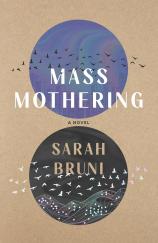
Mass Mothering
Review
Mass Mothering



Sarah Bruni's second novel, following THE NIGHT GWEN STACY DIED, is almost like two books in one.
The first is ostensibly lifted from an in-progress English translation of a book of nonfiction prose titled Field Notes by Tomas Petritus, published posthumously in his native language. That work, which reads almost like a combination of a diary with a first-person sociological observational study, takes place over the course of several months. Working in an unnamed Latin American country, Petritus comes to know a network of mothers whose sons have disappeared.
"MASS MOTHERING is both strange and elegant, puzzling and powerful. It's the kind of novel that feels almost abstract and yet --- since it's based on Bruni’s own field work and research in Uruguay and Colombia --- deeply grounded in reality."
Conspiracy theories about the young men's location and the circumstances of their vanishing abound, but in Petritus' telling, those details are less important (or at least less concrete) than the effects of their absence on their mothers. The sons' disappearance results in sadness and anger, but it also galvanizes the women --- many of whom have never been politically active before --- to band together and raise public awareness and outrage at the surprisingly widespread problem.
The other part of MASS MOTHERING is a first-person account of Petritus' English translator, a young woman known only as A. She's working in an unnamed American city (which bears a lot of resemblance to New York City) as a teacher of English as a second language. By night, she goes dancing at a variety of bars and nightclubs, where she often crosses paths with another avid dancer. N. is an immigrant from the country where Petritus did his work, and A. discovers Field Notes on a shelf in his apartment. She covertly steals it after an unwanted sexual encounter between them prompts her to break off their friendship.
A. is immediately drawn into Petritus' stories of the mothers and siblings these men left behind --- in no small part because, after a cancer diagnosis requiring a hysterectomy, she's having to come to terms with the knowledge that she will never bear a child herself. A.'s response to Petritus' writing is wound up in her feelings about motherhood, or the lack thereof, and she's drawn to find funding to travel to that unnamed Latin American country to tackle a translation into English. What she finds there reaffirms and deepens much of what she discovered in the pages of Field Notes but also changes her understanding of Petritus and even, surprisingly, N.
MASS MOTHERING is both strange and elegant, puzzling and powerful. It's the kind of novel that feels almost abstract and yet --- since it's based on Bruni’s own field work and research in Uruguay and Colombia --- deeply grounded in reality. In addition to its considerations of the ways in which pain is bound up in motherhood, and collective action and voice are intertwined, it's a thoughtful reflection on authorship, translation, and what it means to usher the words of another into the world.
Reviewed by Norah Piehl on February 6, 2026


Mass Mothering
- Publication Date: February 3, 2026
- Genres: Fiction, Women's Fiction
- Hardcover: 272 pages
- Publisher: Henry Holt and Co.
- ISBN-10: 1250392616
- ISBN-13: 9781250392619