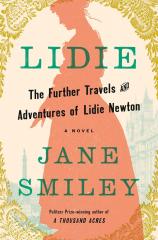
Lidie: The Further Travels and Adventures of Lidie Newton
Review
Lidie: The Further Travels and Adventures of Lidie Newton



Lidie Newton, a tall, curious, plainspoken and orphaned young woman facing life in the divided America of the 1850s, is made for adventure --- or perhaps misadventure. Now back home in Quincy, Illinois, in the forgiving but somewhat stultifying bosoms of her much older sisters, she struggles to forget the tragedies of the first book of her adventures --- the murder of her abolitionist husband, Thomas, and her beloved horse. (So if you haven’t read Jane Smiley's THE ALL-TRUE TRAVELS AND ADVENTURES OF LIDIE NEWTON, you get the gist.)
Lidie takes a new interest in her niece, Annie, who has caught the acting bug. Annie steals the show in a production of Dickens' A Christmas Carol and secures a benefactor, Mr. Mallory Cunningham. Seeing them together walking arm in arm around Quincy, Lidie wonders if he is a suitor, but it turns out he just wants to pay her way to England to act in the productions in which he invests.
"Lidie is a perceptive judge of human nature, and that’s one of the treasures of this novel... Lidie’s Liverpool adventures...are illuminating, filtered as they are through her fine and observant mind."
Naturally, a young and beautiful woman cannot travel on her own without a chaperone, and so begins Lidie’s next big adventure: stealing away from Quincy and sailing across the ocean to Liverpool, England. Here she adopts a new role as Annie’s ladies’ maid, as well as the name Helen Longbourn. As a ladies’ maid, she is expected to do errands for the family: pick up meat, fish, flowers and Mr. Cunningham’s new hat. But this is far from a burden for her, as she meets several simpatico humans in her wanderings around Liverpool --- and even falls in love.
The adventures are plentiful, but Lidie’s keen mind and judgments are equally good reasons to read LIDIE. The political similarities between 1855 and now are surprising. The “goose question,” which was a polite way of signaling how one felt about slavery (if you were sound on the goose question, you were pro-slavery), casts a heavy shadow over Quincy and indeed all of America at that time. Relating the different conceptions of sin in the various Quincy churches, she muses, “I wondered what would be the greatest sin: some folks were agitating for a conflict, desiring to kill one another for what they considered ‘conscience,’ while others, thinking of their bank accounts, were avoiding the conflict.”
Lidie is a perceptive judge of human nature, and that’s one of the treasures of this novel: “One thing I always thought interesting about the Border Ruffians was that, although many of them did not actually have the money to own slaves, they were outraged by the idea that they might be prevented by others from doing as they pleased.” While Lidie has never been a churchgoer, she is open to wondering about the ways God might be present in her world. Before she died, her mother had claimed that she saw Jesus, and Lidie spends a lot of time pondering this. Lying in bed in Liverpool, remembering a man who helped an old woman across the street that day, “I decided that he was Jesus, that one of his qualities was that he was everywhere, doing his errands, and he was too busy to be bothered about whether he went unseen.”
Lidie’s Liverpool adventures --- helping with the family’s wayward horse, attending the races with the Cunninghams’ butler, roaming the city and exploring her feelings upon seeing free Black people on the streets, watching Annie fulfill her promise as an actress --- are illuminating, filtered as they are through her fine and observant mind. We feel like we are there with her in busy Liverpool, taking in the parks, businesses and docks, hearing the accents and church bells. Will her budding relationship with her beau result in a settled Liverpool life? Or will a further adventure beckon? I am hoping for the latter.
Reviewed by Eileen Zimmerman Nicol on April 24, 2026


Lidie: The Further Travels and Adventures of Lidie Newton
- Publication Date: April 21, 2026
- Genres: Fiction, Historical Fiction, Women's Fiction
- Hardcover: 336 pages
- Publisher: Knopf
- ISBN-10: 0593802292
- ISBN-13: 9780593802298