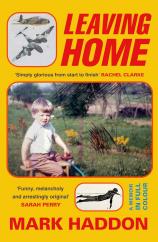
Leaving Home: A Memoir in Full Colour
Review
Leaving Home: A Memoir in Full Colour



In the course of my work as a reviewer, I’ve covered more than 150 memoirs. Without question, none of them resemble LEAVING HOME. Comprising 87 loosely connected segments, the book is an episodic exploration of Mark Haddon’s personal and professional life, filtered through his fertile and idiosyncratic mind. What makes it most distinctive is a format that intersperses photographs and drawings with his revelatory prose. He has created a unique sort of literary scrapbook that simultaneously excavates his past and charts the course of the artistic life he forged as he left it behind.
Haddon was born and grew up near Northampton, England, in the 1960s and ’70s in a comfortably middle-class household. To describe his parents, a handsome couple judging from their photographs here, as emotionally disconnected would be generous in the extreme. Neither his father, Peter --- a self-taught architect who developed a successful business designing abattoirs --- nor his mother, Maureen, seemed to have wanted children. But somehow they ended up with two (Haddon has a younger sister, Fiona, with whom he’s close). While his description of their parenting doesn’t suggest overt abuse, he recalled himself in an interview as an “anxious and depressed child,” even before he was forced to endure the misery of boarding school beginning at age 12.
"Even as it recounts troubling times in Haddon’s life, the tone of LEAVING HOME is often breezy and self-deprecating.... Dark moments outweigh light ones in this memoir, but its multihued portrait of the artist as a young and older man is a memorable one."
As distant as Haddon’s parents were from their children, their own emotional relationship was equally barren. “They never hugged, never touched one another with affection,” he recalls. Haddon can remember listening to the music of Bach and Paul Simon on the radio, but he can’t summon up the sound of conversations in the household. “It wasn’t so much that no one spoke, it was that no one talked,” he writes. “I never heard an adult tell or ask another adult something that really mattered.” Based on some persuasive evidence, he long suspected that his father sought comfort in an affair with his much younger secretary, “S.”
It’s perhaps understandable, then, that Haddon has been plagued by anxiety and depression and a variety of phobias --- such as deep water, flying, and the fear that he has contracted a fatal disease --- throughout his life. One exceptionally shocking event occurred as recently as 2024, when he intentionally cut his arm with a knife (he provides a photograph of the stitched-up wound). He underwent triple bypass surgery in 2019 and has suffered from long COVID after two bouts with the virus. He’s not the only family member who’s faced a medical crisis, as he describes in a terrifying account of his wife Sos’ injury in a bicycle accident while pregnant with their second child.
As an antidote to obsessing over these darker times, Haddon has taken a productive step: volunteering for several hours each week with the Samaritans to staff a helpline for people experiencing mental health crises. It’s an echo of the work that he did with those suffering from physical handicaps and learning difficulties during the time he was establishing himself as a writer.
In describing one of his early volunteer experiences, Haddon reveals some of the roots of the empathy that’s a distinctive characteristic of his writing: “You treat other human beings with an unconditional dignity, full stop. The question is not ‘Is anyone in there?’ but ‘What exists between us?’ Our humanity is not an individual quality that can be measured and traded and celebrated and ignored, but an activity, a thing human beings do together.”
While Haddon’s book tilts heavily toward the personal, he does offer a few glimpses into his writerly preoccupations. As a child, his first love had been science, not literature (he entertained dreams of becoming a paleoanthropologist), and he grew up in a home where books and reading were not valued. Before his novel, THE CURIOUS INCIDENT OF THE DOG IN THE NIGHT-TIME, became a multi-award-winning bestseller, he had been a prolific author of children’s books and an artist.
Haddon prefers books in what he calls the “weird zone,” and he shares a few captivating thoughts about their magic, which for him means “the idea of stepping out of time or into a parallel world, or finding that this world has layers of which we have been unaware.” In his writing, he’s driven by “the idea that some kind of answer exists if you can only find the right word, then the right word to follow it, then the right word to follow that.”
Even as it recounts troubling times in Haddon’s life, the tone of LEAVING HOME is often breezy and self-deprecating. At one point, he confesses to a “catastrophically poor memory” and at another to the handicap of the “patchily remembered events of my own life.” There are dashes of humor, such as the story of his brief rugby career (his father was a star player). He admits that “even now I miss the mud and the bruises and the legalised brutality, but it was not a milieu in which you could talk easily about poetry.” Dark moments outweigh light ones in this memoir, but its multihued portrait of the artist as a young and older man is a memorable one.
Reviewed by Harvey Freedenberg on February 18, 2026


Leaving Home: A Memoir in Full Colour
- Publication Date: February 17, 2026
- Genres: Memoir, Nonfiction
- Hardcover: 320 pages
- Publisher: Doubleday
- ISBN-10: 0385551894
- ISBN-13: 9780385551892