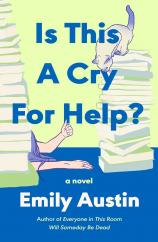
Is This a Cry for Help?
Review
Is This a Cry for Help?



Emily Austin, the author of EVERYONE IN THIS ROOM WILL SOMEDAY BE DEAD and WE COULD BE RATS, returns with IS THIS A CRY FOR HELP?, a striking, startling portrait of queer life and coming of age.
Darcy is many things: wife to Joy, mom to two cats, the kind of woman who deep cleans her house every Saturday morning, and a librarian. Gifted with strong pattern recognition and a good memory, Darcy took quickly to the rules and regulations that come with being a librarian: putting on a customer service voice, operating e-readers, helping readers research common and obscure subjects alike, and so on. But two months ago, she took a medical leave of absence following a horrific panic attack that landed her in the ER and then in 24-hour psychiatric treatment. Now she is back at work, (wo)manning the reference desk and reintegrating into the life she once knew…with an added guest: the constant refrain in her head that says It’s not my fault he died. I’m not the reason he died.
You see, nine years ago, when Darcy was 23, her life fractured into two distinct halves. In the first, she was a coy, dependent girl who was dating Ben, a kind man who made her happy but also made her feel like she had to play a role. Darcy counted calories, wore clothes that left deep indentations in her skin, and screamed when she saw a spider in the bathroom so that Ben could come rescue her, even though she was never particularly scared of arachnids. At night, they cuddled in their bed (after having sex in positions that didn’t emphasize her not-flat belly) and dreamed up the house they would buy one day and the children with whom they would fill it.
"Passages upon passages of...deep, poignant introspection result in the kind of book that makes you feel seen, makes you cry, and makes you wish you could go back in time and hug your younger self.... [IS THIS A CRY FOR HELP? is] a novel that feels nearly uncategorizable but is somehow perfect for everyone."
In the second half of her life, Darcy is a 32-year-old lesbian who has been married to Joy for six months. She no longer counts calories; she wears comfy, loose-fitting clothes; and children are not even remotely interesting to her. When she and Joy make love, they fumble, chuckle and constantly praise each other. Even better, her wife’s career as a book binder perfectly complements her own role in her local library. For a while this new identity seemed to fit her just fine, making her feel whole and unashamed and proud of who she was and who she loved. But then, as she was helping a patron look up an obituary, she saw it: Ben’s obituary. The man with whom she spent the formative years of her young adult life --- who made her feel safe, seen and loved --- is dead. And Darcy has a sneaking suspicion that it’s all her fault.
Grief comes at us in many ways, and guilt is a common passenger. But in Darcy’s case, well, she may have a point. Believed to be (and believing herself to be) straight, she threw a wrench into Ben’s life when she unceremoniously dumped him in favor of a life of homosexuality. In the months that followed, Ben bombarded her with calls, left long, rambling messages about still being in love with her, and (at least according to social media) never dated again and started drinking more. For years, Darcy has repressed all thoughts of Ben, believing that her abandonment of him propelled him into a deep depression. Now that he is dead, she feels certain that it was her that pushed him to the edge. There’s no cause of death in his obituary, and Darcy’s famous pattern recognition has convinced her that he must have taken his own life.
Now the discovery is two months old, Darcy is on a strict regimen of pills, self-care and therapy, and she has returned to the place where she feels the most normal. Libraries, as she explains, are “the last free space,” a democratic institution where citizens can freely educate themselves. But things are changing in the world and in the library system. When Darcy is confronted by an angry “journalist” uninterested in “being indoctrinated by biased, money-grubbing liberal colleges” and touting the “non-mainstream media” as the only unbiased source, it seems that her library’s freedom is under attack.
The reporter, Declan Turner, owns and operates Liberty Lately. After a concerned patron writes him about the porn problem in the library, he sets his sights --- and his readership --- on Hickory Library. Never mind that Darcy and her colleagues run programs like “How to Eat on a Budget”; help immigrants with their resumes; provide stable, comfortable shelter for the unhoused; and lead a yoga and wellness workshop for senior citizens. All that matters is the “communist sex den” that Declan believes has taken hold of his local library. And with him comes the greatest danger public libraries face today: book bans.
As Darcy grapples with her return to work, her struggle to maintain her mental health, and the complex attacks on her branch, she also must revisit her life with Ben, her identity as a lesbian, and all the ways she has repressed, molded and concealed herself in an effort to get it right and be “normal.” As an Emily Austin protagonist, she is wonderfully self-aware, but she is not at her sharpest or best. She struggles with feelings of inadequacy and worries that she cannot perform any of her roles --- wife, librarian, 32-year-old woman --- well, let alone perfectly. Paired with her guilt over Ben’s death, these thoughts send her spiraling on a mission of self-discovery, even as she fights to protect her library and its DEI programs against censorship.
Readers of Austin know that she writes protagonists like no other. Darcy is classic Austin, reminiscent of her breakout character Gilda from EVERYONE IN THIS ROOM WILL SOMEDAY BE DEAD. But the book doesn’t rely on just old molds or approaches; it reads more like the deepening of a talent that has simply never stopped growing. As Austin’s most self-aware character, Darcy absolutely sparkles, even when she’s crying in her car or desperately trying to “win” at therapy. She’s difficult to summarize, so I’ll let her speak for herself here: "I'm not just thirty-three; I'm twenty-seven. I'm eighteen. I'm nine. I was just born. And I have to carry all of those versions of myself, the feelings they have, and the mistakes they've made, everywhere I go." Isn’t that the truth?
Passages upon passages of this deep, poignant introspection result in the kind of book that makes you feel seen, makes you cry, and makes you wish you could go back in time and hug your younger self. Add to that the searingly timely topics of censorship, DEI and book bans, and you have a novel that feels nearly uncategorizable but is somehow perfect for everyone. Grievers, anxiety-havers and library lovers will gobble this up, but readers of Catherine Newman and Rufi Thorpe will find their next favorite author in IS THIS A CRY FOR HELP?
Reviewed by Rebecca Munro on January 23, 2026