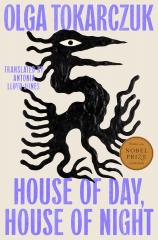
House of Day, House of Night
Review
House of Day, House of Night



HOUSE OF DAY, HOUSE OF NIGHT, another fantastic outing from Nobel Prize-winning author Olga Tokarczuk, is sure to be squeezed onto many “best of the year” lists. Challenging, charming, strange and inventive, it is both about particular people in a particular place and the universal longing for belonging and acceptance. Blending folklore with a postmodern story structure, Tokarczuk has crafted an unforgettable story of fantasy and imagination set in a mundane world full of suffering, pleasure, companionship and memory.
The unnamed narrator of the novel has moved to a small and mostly isolated village in Poland with her partner, R. There she settles into the rhythm of the place, learning its history through the experiences of her new neighbors and the tales they tell. Much of her time is spent with her elderly neighbor, Marta, a wigmaker who is never seen outside her house in the winter. Marta and the narrator drink tea, eat mushrooms, and spend time in companionable (and occasionally awkward) silence.
"Magical and original, thoughtful and thought-provoking, HOUSE OF DAY, HOUSE OF NIGHT upends the traditional boundaries of a novel.... It is a compelling and inventive read, enjoyable and singular."
There is also So-and-So, who wanders in and out of the narrative, and shares the story of Marek Marek, who came to believe that he was a bird. Krysia, another local, begins to hear a voice in her ear in 1969. She is convinced that it belongs to someone named Amos, who is somehow in love with her. She tries to track him down, but her efforts result in humiliation. Other characters like Peter Dieter, Mr. Bronek and Ergo Sum (not to mention the Man with the Chainsaw) have their stories recounted as the narrator weaves together the past and present in this place of shifting borders both national and metaphorical.
HOUSE OF DAY, HOUSE OF NIGHT also tells, in some depth and detail, the interconnected biographies of Kümmernis, a saint, and her hagiographer, a monk named Paschalis. Kümmernis begins life as a sixth daughter, her mother having died while giving birth to her. She grew up to be extremely beautiful and capable of small miracles, and she was promised to her father’s friend in marriage after she had been sent to live in a convent. Her refusal to wed meets with violence from her father and places her on the path to sainthood. Later, her life story is recorded by Paschalis, who understands her familial tensions and cloistered life, but also the oft-confusing importance of gender. Paschalis himself longs to be a woman and spends much of his life searching for a way to be his true self while engaged in the recording of Kummeris’ life as Saint Solicitous.
Tokarczuk moves readers from her narrator’s day-to-day to the fantastical past of the village that is somehow both sleepy and endlessly dramatic. Interspersed between short sections retelling the lives of those mentioned above, as well as tales of border tensions and wars, are dreams remembered and recipes for poisonous foraged mushrooms.
Magical and original, thoughtful and thought-provoking, HOUSE OF DAY, HOUSE OF NIGHT upends the traditional boundaries of a novel. The stories are weird and often dreamy. It is hard to rely on any account, even that of the apparently reliable (but really unknown) narrator. All told, this is a book about liminal spaces, those we walk between and those we imagine. It is a compelling and inventive read, enjoyable and singular.
Kudos to Antonia Lloyd-Jones for a gorgeous translation.
Reviewed by Sarah Rachel Egelman on December 12, 2025


House of Day, House of Night
- Publication Date: December 2, 2025
- Genres: Fiction, Magical Realism, Short Stories
- Hardcover: 336 pages
- Publisher: Riverhead Books
- ISBN-10: 0593716388
- ISBN-13: 9780593716380