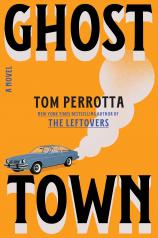
Ghost Town
Review
Ghost Town



In the 1960s, John Cheever and John Updike claimed America’s suburbs as their literary territory. Though his style differs markedly from either of those writers, nine novels into his career, Tom Perrotta continues to mine that same fictional lode with rewarding results. The latest product is GHOST TOWN, an elegiac coming-of-age novel that, for those of a certain vintage, will be thick with memories of the languid days and humid nights of a suburban summer.
Set in 1974 in the fictional northern New Jersey working class town of Creamwood, GHOST TOWN is the story of 13-year-old Jimmy Perrini's life in the aftermath of his mother's death from cancer at the age of 41. Perrotta frames that account as the recollection of an adult Jimmy who has been invited back to his hometown for a ribbon-cutting ceremony for the new municipal building, which is named after his late father Frank, a union welder and volunteer firefighter.
"Perrotta masterfully inhabits Jimmy's consciousness. He tenderly yet honestly portrays the boy's struggle to process his grief over his mother's death, which is made sharper by the seeming inability of most of the adults in his world...to comfort him."
Five decades after his mother's passing, Jimmy is a graduate of the Iowa Writers' Workshop. He has abandoned literary fiction after producing three decreasingly successful novels and a short story collection. Now he writes commercial fiction centered on ghost stories and publishes under the pseudonym Jay Perry. Most recently, he produced four lucrative seasons of an animated children's TV show based on the first of those books. But now he has fallen victim to "the melancholy and debilitating sense during the past few years that my creative life was over."
The young Jimmy spends his days as an unofficial counselor at the town-sponsored youth recreation program camp he has just aged out of. Many nights he cruises the streets of Creamwood in the powder-blue Chevy Vega that he dubs the "Creepmobile." It is erratically driven by unlicensed 16-year-old Eddie Fitzpatrick, who provides him with his first experience of smoking marijuana. When he's not in Eddie's car or navigating the town on his bicycle, he's occasionally in the company of Olivia Jean Riley, the valedictorian of her high school class at the age of 15 and a classmate of his sister, Denise.
Olivia, who has suffered the loss of her own father and a baby brother in an automobile accident, introduces Jimmy to the Ouija board. In those eerie scenes, Perrotta subtly explores the angst of these two children, yearning to find some comfort in their mutual loss and unable yet to articulate the depth of their grief and longing. The death of a parent can create a traumatic absence at any age, but when it occurs in childhood, it leaves a different kind of hole that even a lifetime of experiences and accomplishment can't fill.
In addition to this sensitive portrait of youthful grief, anyone who came of age before the days of fears of child abduction, sports travel teams and the rise of helicopter parents will appreciate Perrotta's vivid re-creation of the vanished free-range lifestyle of Jimmy and his fellow teens. For him, that urge to be at large in Creamwood after dark is exacerbated by his mother's death, because "being alone in the house at night was the only thing worse than being alone in the house in the morning."
And so he departs late one evening, telling his father that he's headed to his friend Greg's when in fact he's off to Olivia's house for another attempt to commune with his mother's spirit. Tingling with anticipation over what he thinks also might be some version of a sexual initiation, he discloses that he's "bringing my toothbrush, just in case." The only piece of parental advice the elder Perrini dispenses is that "you might want to bring some clean underwear."
Though the grownup Jimmy views his childhood angst in this "weird summer" through a sympathetic lens, he doesn't accord that same grace to his native Creamwood. Seven years after the passage of the Fair Housing Act, "a combination of racism and white flight and redlining created segregated suburbs right there in the heart of New Jersey."
When a young Black man named Hector moves into the house next door, occupied by Jimmy's "hippie cousin" Wayne and his wife, Jimmy becomes vaguely aware of this prejudice. But "back then, it was just a simple fact of life, part of the natural order. The sky was blue, the grass was green, and Creamwood was white." When he returns to the town as an adult, he finds a gentrified community, shorn of its industrial base and now home to a diverse population, reflected in restaurants featuring an array of international cuisines.
Throughout, Perrotta masterfully inhabits Jimmy's consciousness. He tenderly yet honestly portrays the boy's struggle to process his grief over his mother's death, which is made sharper by the seeming inability of most of the adults in his world --- beginning with a father who buries himself in work to avoid facing his own sense of loss --- to comfort him. There are no therapists or bereavement counselors, only an offer of help from a narrow-minded teacher and a day trip "down the shore" with a friendly Catholic priest.
As an adult, Jimmy/Jay comes to regard his "entire childhood like a phantom limb, a dull ache where the missing part used to be," bringing him to the point where "his heart went out to the boy he had been." Thanks to the gradually accumulating force of Perrotta's understated storytelling, by the end of this moving novel, we're fully able to share that compassion.
Reviewed by Harvey Freedenberg on April 30, 2026


Ghost Town
- Publication Date: April 28, 2026
- Genres: Fiction
- Hardcover: 288 pages
- Publisher: Scribner
- ISBN-10: 166808063X
- ISBN-13: 9781668080634