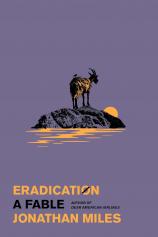
Eradication: A Fable
Review
Eradication: A Fable



From the rant of a disgruntled airline passenger, to a sendup of American consumerism, to a tale of an Afghanistan War veteran whose sudden recovery from paralysis sparks a worldwide frenzy, Jonathan Miles’ first three novels have been noteworthy for their wildly varying subject matter and often comic sensibility. It’s not surprising, then, that none of them provide a hint that his fourth would be the taut and morally freighted ecological thriller ERADICATION: A Fable.
Adi, the novel’s protagonist, is a former private elementary school teacher and musician who’s hired by an unnamed foundation that funds programs in medicine, education, civil society and conservation. His assignment: to travel to a remote, uninhabited island with the goal of single-handedly wiping out its population of up to 4,000 wild goats, an invasive species that’s destroying the native flora and fauna. His interviewer likens the task to “removing a malignant growth,” assuring Adi that his is a noble mission and enticing him with the vision that “you’ll be able to take your children or grandchildren to Santa Flora and say, listen to those birds, look at those trees. I did this. Me. I brought this back from the dead.”
"ERADICATION is a slim novel, but it makes admirable use of that brevity to deliver a powerful and memorable reading experience."
Santa Flora lies off the Pacific coast of the unidentified, post-revolutionary South American country where Adi lives, seven hours distant by boat. To Adi, on his first sighting, “it was all just a uniformly scarpy chunk of land heaved from the sea that, lacking soft slopes or beaches or verdure or really any colors besides khaki and ash and sparse dingy olive, gave the impression of not wanting to be bothered, of a primordial indifference. From every approach its back seemed turned.” But as he’ll discover, it’s a much more complex, and at times lovely, environment, one that will present him with an array of challenges as he navigates its length and breadth seeking out his targets.
Adi is deposited on the island with five weeks of supplies and a rifle he’s never fired before. He’s left to his own devices to formulate a plan for wiping out as much of the island’s goat population as he can in that time. As he reluctantly fumbles his way toward a method for carrying out his distasteful duty, he rescues a bird from a species previously believed to be extinct, shares his humble living space with a rat he names Oliver (as in Twist), and watches as a group of seven nanny goats become an unexpected fan club. All the while, a persistent question nags at him (and us): If his task is so essential and honorable, why is he having so much difficulty executing it?
In portraying his protagonist’s external and internal struggles, Miles is admirably economical. Adi is mourning the loss of his son, Jairo, a tragedy that also precipitated the breakup of his marriage. Miles efficiently parcels out the details of these events in brief doses over the course of the novel. When they’re all finally revealed, their enormity hits home with true force, offering insight into Adi’s damaged psyche and at least a partial explanation for his willingness to assume this lonely task in the first place and his ambivalence about actually carrying it out.
But the ethical ambiguity of Adi’s assignment truly takes shape when he stumbles upon Grejo and Chuky, a pair of fishermen engaged in illegally killing sharks to harvest their fins. In the course of an ominous conversation, a portion of which takes place with a gun pointed at his head, Grejo taunts Adi: “See, somebody in the government says we need more sharks. And somebody else says we need fewer goats. More sharks. Less goats. So they pay you for what you’re doing and for what I’m doing they try to seize my boat and dump me in prison for twenty years.”
At last, Adi no longer can avoid rendering an honest verdict on the legitimacy of an undertaking that’s been described to him as nothing less than “saving one of the Pacific Ocean’s most unique and vibrant systems from very certain destruction” but one that demands the death of innocent creatures to achieve that goal.
The book lands at its moral ground zero and gathers real force in its final 15 or so pages, when events force Adi to abandon his “dithering Hamlet act” in a most startling fashion. In that breathless scene, the story hurtles toward a climax that raises a fresh set of troubling questions. Wisely, Miles resists neatly tying them up, leaving that task to the reader instead. ERADICATION is a slim novel, but it makes admirable use of that brevity to deliver a powerful and memorable reading experience.
Reviewed by Harvey Freedenberg on February 13, 2026


Eradication: A Fable
- Publication Date: February 10, 2026
- Genres: Fiction
- Hardcover: 176 pages
- Publisher: Doubleday
- ISBN-10: 0385551916
- ISBN-13: 9780385551915