Excerpt
Excerpt
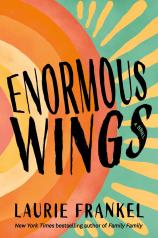
Enormous Wings



1
You know how it ends.
Everyone in the whole world knows how it ends.
Of course that’s true anyway for all of us, no matter what.
Ironically, stories rarely start at the beginning, mostly because the beginning’s so much harder to find.
This story, however, started quite abruptly one June morning when I hit a priest with my car. I didn’t mean to, and it was just a tiny fender bender, and no one got hurt. Also, if you think about it, bending is the entire point with fenders. But it’s true that this fender had been shiny and flawless, like a mirror you would find in a mirror store. Then I ran into it, and all at once it became crumpled and scratched and nonreflective. Like a mirror you would find in hell.
I have learned, after fifty-two years in Texas, that it’s the big white men in big white hats you have to watch out for, but under this hat I spied a clerical collar. Notwithstanding I had just been concocting a metaphor featuring hell, I thought probably he’d go easy on me because yelling at an old woman isn’t very Christian. Mind, neither am I, but I was hoping it wouldn’t come up.
I waited while he picked his way along the shoulder over two empty takeout containers and another that was spilling leftover pad thai onto the road. There were some geese in the median strip, honking at us for stopping or maybe warning us away from their noodles. When the priest arrived by my side finally, what he said was “So is it a special day, or are you always out here driving around like some kind of asshole?”
I was so relieved.
“Oh!” I said. “Flatbush.”
“What?”
“I’m from Brooklyn too.” I laid a hand on my chest. “Flatbush. Born and bred. How about you?”
He looked taken aback. “Bay Ridge. How’d you know?”
“Recognized your accent,” I said. “Also your vocabulary.” Then I added, “Please forgive me for damaging your bumper.”
I thought maybe if I emphasized that the only part of his truck that was harmed was the part put there for that purpose, he might be less upset, but what he said was “Not Catholic.”
“Pardon?” I’d turned seventy-seven the week before, but my hearing was still fine. This just didn’t make sense.
“Don’t let the dog collar fool you. I’m an Episcopal priest.”
“I see,” I said. But I did not.
“So confession is a lesser sacrament. Plus ‘Forgive me for damaging your bumper’ doesn’t really count.”
“I’m Jewish,” I explained.
“Ahh,” he said. “You shouldn’t be driving.”
“Jews are fine drivers!”
“Many of them. Not you. Give me your license.”
“We’re only supposed to exchange insurance information,” I protested. “You’re not a police officer.”
“Higher authority.” Then he took a knife out of his pocket, so I handed over my entire wallet. He deployed a scissor and cut my license into tiny pieces, then let them fall onto the side of the road.
“You shouldn’t litter,” I called as he picked his way back over the takeout containers.
He made a hand gesture I remembered well from my Brooklyn days. It didn’t seem very Christian to me, but then I’m not an expert.
My middle child, Alice, is a lawyer, so I thought maybe we could sue, but after I drove home—unlicensed—and told her this story, she said, “He’s right. You shouldn’t be driving.”
By September, my house was sold, my car was gone—along with my license, my independence, and a state of affairs in which I told my children what to do instead of the other way around—and I stood before the automatic sliding doors of the Vista View Retirement Community, contemplating my new home.
2
“It’s … nice.” max didn’t sound like he meant it. He hadn’t picked Vista View—that would be Alice again—and he’d been sad in a way his sisters hadn’t to lose the house he’d grown up in. If you’re the baby of the family, you’re the baby of the family, even if you’re forty-three. But he sounded like he was trying to mean it, so I tried too.
“It’s … big,” I landed on. In Texas, “big” is almost always a compliment.
We were standing a few feet from the entrance, watching a fake waterfall trickle over fake river rock, trying to work up the resolve to go inside. Upstairs, movers were arranging what remained of my furniture without me, but I couldn’t seem to get past the forecourt.
The building was both of those things, nice and big. It’s just that nice and big aren’t really what you’re looking for in a home, are they? Vista View was polished and bland and inoffensive for floor upon floor, hallway upon hallway, door after door after door. It was like moving back into your college dorm, if your college dorm had been a Hampton Inn. I was used to living alone. I was used to living alone in a rambling hundred-year-old house, whose every inch of warped quarter-round I knew like I knew the three humans I’d raised there. Its walls had been covered in artwork and paint nicks, both from when the kids were little, its floors with more nicks and faded rugs whose intricate patterns I could sketch with my eyes closed. But rugs were not allowed at Vista View—never mind I’d spent fifty years not tripping over them, they were now deemed too great a risk—and there wasn’t room for a lifetime’s worth of beloved novels and throw pillows and my mother’s china.
And I was used to living alone.
“Four hundred people.” My son whistled. Only a few were in evidence, but the brochure assured us they were legion. I had to tip my head all the way back to see the top of the building, and it sprawled away in every direction. “So there must be someone here you’ll like.”
This makes me sound like a misanthrope, which I’m not. My standards have just gotten higher as I’ve aged. Which at this point makes them stratospheric.
“Four hundred old people,” I said. That being the difference between a retirement home and a college dorm. Between a retirement home and a Hampton Inn, for that matter. Old people are fine. Nothing but old people, however, is an unsettling consolidation.
“I love old people.” Max did sound like he meant that. “They’re wise.”
“More like wizened,” I said.
“And anyway, you’re not old. You’re just moving into an apartment. I live in an apartment.”
Yes, it was an apartment, but the shower had a seat in it and a cord you could pull in case of emergencies. Yes, it was located in the independent-living section, but Vista View also had assisted living, memory care, and a nursing wing. And I was too old to navigate a slope as slippery as that one.
“There’s a van into town just because parking’s a pain in the ass.” Max squeezed my arm and kindly didn’t mention my license-in-pieces. “There’s a dining room just because cooking dinner every night is also a pain in the ass.”
“So everyone here is old and lazy,” I said.
“Would you two move?” a voice interrupted behind us. “You’ve been standing in front of the entrance for twenty minutes. You keep tripping the doors and letting out all the air-conditioning.”
We turned around.
“Hi, Dad,” said Max.
“See, here’s an example,” I said, “of old and lazy.”
Among Vista View’s many indignities, this one was going to be hardest to stomach: My ex-husband was a resident already. Roger and I hadn’t lived together in twenty-five years. Now there would be only two floors between us, which hardly seemed sufficient.
“Hi, sweetheart.” Roger slung an arm around Max and kissed him on the cheek. “You drew the short straw?”
Max looked confused but unalarmed. His father talking nonsense had nothing to do with senescence.
“You’re the one who had to take off work to get your mother through move-in day,” Roger clarified, “instead of Darcy and Alice?”
Copyright © 2026 by Laurie Frankel


Enormous Wings
- Genres: Fiction, Women's Fiction
- hardcover: 304 pages
- Publisher: Henry Holt and Co.
- ISBN-10: 1250423775
- ISBN-13: 9781250423771