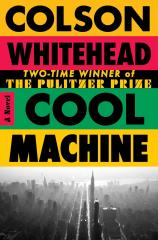
Cool Machine
Review
Cool Machine



There are few authors today who have had the cultural impact on literary and historical fiction in quite the same way as Colson Whitehead. Many name him as one of the greatest living American writers, and his two Pulitzer Prizes are strong proof of this. I consider NICKEL BOYS to be one of the best novels of the last half-century.
Whitehead has returned with the conclusion to his Harlem Trilogy, COOL MACHINE. In the opening installment, HARLEM SHUFFLE, we are introduced to Ray Carney, the furniture salesman/fence as he makes a name for himself in this dangerous yet necessarily shady enterprise set in 1960s Harlem. The middle novel, CROOK MANIFESTO, finds Ray in the 1970s with more danger and rampant vice. This all sets the tone for the finale, COOL MACHINE, which is actually a trio of tales that take place between 1981 and 1986. Ray is older and (hopefully) wiser, but he still seems to find himself in one sticky situation after another during the Reagan era.
"COOL MACHINE is a grand finale to this outstanding trilogy. Those who have been along for the entire ride will realize that they have spent time with a deeply complex and unforgettable character."
The first story, set in 1981, is called “City at Night.” To introduce it, Whitehead uses a great quote taken from the heart of the series: “It’s harder to find a good coffee table than it is to fall in love.” If anyone knows about both, it is the recently named Sterling Furniture Dealer of the Month. Ray had spent years being a reluctant yet ruthless fence. Now, he must prepare himself for the fleeting fame that might come his way.
Do not be fooled for one minute. Ray is not taken in by this pseudo honor, especially when the white corporate type who is interviewing him for the company magazine panders to him about people of color. It is the other part of the story, in his true role as the main fence in Harlem and perhaps all of New York City, where we see him caught between a rock and a hard place financially and considering one last heist at the behest of a dangerous mobster named Uncle Rich.
The second story from 1983, “Here Comes Sue Simmons,” will especially resonate with those who grew up in the tri-state area and followed the local news. Sue Simmons was one of the most famous Black newscasters of her age with a hairstyle that all the ladies of Harlem wanted to copy. In this piece, her persona is more of a metaphor for a cautionary tale involving Ray and yet another heist. This time, he teams up with his old friend and partner-in-crime, Pepper. They somehow find themselves mixed up with a suitcase full of cash, a rare African mask, and a violent assassin on the trail of both.
The final story is set in 1986 and is probably my favorite. “No Radio” provides Ray with a chance at catharsis by making up for the death of his cousin, Freddie, two decades ago. Ray may not have been able to save Freddie, but he is determined to set things straight by rescuing his son. When Robert goes missing, and word on the streets of Harlem is that the Mafia may be behind it, Ray reaches out once again to Pepper to help him with this major redemption arc and hopefully bring Robert back safe and sound.
The language is infectious. Whitehead knows and writes about the streets of NYC in much the same way that George Pelecanos knows and writes about Washington, DC. COOL MACHINE is a grand finale to this outstanding trilogy. Those who have been along for the entire ride will realize that they have spent time with a deeply complex and unforgettable character.
Reviewed by Ray Palen on July 24, 2026


Cool Machine
- Publication Date: July 21, 2026
- Genres: Fiction, Historical Fiction
- Hardcover: 368 pages
- Publisher: Doubleday
- ISBN-10: 0385550502
- ISBN-13: 9780385550505