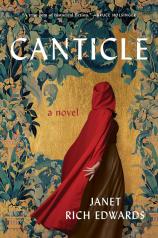
Canticle
Review
Canticle



A young woman wrestles with questions of faith and purpose in Janet Rich Edwards’ brilliantly rendered debut novel.
Set in the waning years of the 13th century, CANTICLE focuses on a teenage mystic named Aleys, the “powerfully odd” daughter of a wool merchant from a small town outside of Bruges. Aleys knows she is different from most people around her, including her rascally older brothers and dramatic younger sister. She’s fascinated by the strange beauty of the natural world, pausing to rescue caterpillars and contemplate the dust motes dancing in the air. And she’s drawn to the vivid, often violent, lives of the saints, which her mother shares with her children. Aleys’ mother, like virtually all women, is illiterate, which means she spins her stories from memory. But she has a rare tool to help bring each tale to life: a precious psalter, lavishly illustrated “in colors so vivid they seem to vibrate.”
"...[a] brilliantly rendered debut novel.... Edwards skillfully brings the medieval world to life in all its complexity. Her characters inhabit a rich and vibrant world that is undergoing significant social and political change."
The lives of saints like Ursula and Perpetua make an indelible impression on the strange and lonely Aleys. “It would be marvelous to be a martyr,” she thinks, noting that “the saints get all the adventures. All the friends.” The psalter also gives Aleys her first sense of the power of the written word. Yet learning to read is an impossible dream, until her mother dies in childbirth and her father makes an unusual decision. He decides to teach Aleys her letters so that she can help manage his floundering business. Her father sees literacy as a useful tool, but for Aleys, it is something far more consequential. It’s a gift that frees her from a conventional life and sets her on an unexpected path to turning her childhood dreams into reality. However, Aleys learns that being revered as a saint comes with complications and danger she has not anticipated.
Aleys’ journey plays out over several years. Not long after her mother dies, she flees her father’s loving house to escape an arranged marriage. She turns first to a Franciscan friar, pleading to be admitted to the radical order whose members have taken vows of poverty. Friar Lukas is drawn to the girl’s ardent faith but is unsure what to do with a young woman. He leaves her in the care of the Beguines, a lay community of women living and working independently from men. At first, Aleys chafes at life with the “passionless” Beguines, believing she is destined for better, more holy things. Gradually, she discovers that she has a home among this group of sisters, who replace the family she has left behind.
Then an apparent miracle upends Aleys’ life yet again, setting in motion forces beyond her control. Lukas becomes ever more fanatically devoted to the young woman he believes is channeling the Holy Spirit, while his brother, the Bishop, schemes to use her to advance his own political position. Meanwhile, Aleys struggles to understand the messages she seems to be receiving from God in his “unutterable vastness” and what he expects from her as his servant.
In CANTICLE, Edwards skillfully brings the medieval world to life in all its complexity. Her characters inhabit a rich and vibrant world that is undergoing significant social and political change. Mendicant orders like the Franciscans and the Dominicans, who make a show of their “gaudy poverty,” are grudgingly accepted by a suspicious church, while other “heretical” movements, such as the Cathars and Waldensians, are quickly and viciously suppressed.
Movements to translate the Bible into the languages of the common people are popping up around Europe, including Bruges, much to the dismay of church leaders, who jealously guard their control over God’s word. Merchants are growing in power and influence, and groups like the Beguines are challenging commonly held ideas about the role women play in society. Add in a dose of holy visions and hard-to-explain healings, and you have all the ingredients you need for a conflagration.
In her zeal to prove herself worthy of God’s love, Aleys finds herself in the middle of this firestorm. Her responses to her impossible situation form the emotional core of the novel, as Edwards movingly explores the intricacies and contradictions of faith. In the end, Aleys may get what she wished for as a young girl who dreamed of becoming a saint. But it comes at a cost, as she is “woven into the braid of those who sought the truth and spoke of the journey. She walks with them and knows she will join them, lionesses all, at Mary’s side.”
Reviewed by Megan Elliott on December 20, 2025


Canticle
- Publication Date: December 2, 2025
- Genres: Fiction, Historical Fiction
- Hardcover: 368 pages
- Publisher: Spiegel & Grau
- ISBN-10: 1966302053
- ISBN-13: 9781966302056