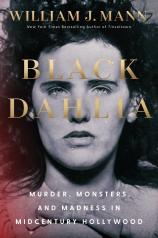
Black Dahlia: Murder, Monsters, and Madness in Midcentury Hollywood
Review
Black Dahlia: Murder, Monsters, and Madness in Midcentury Hollywood



The horrific murder of 22-year-old Elizabeth Short in 1947, one of the nation’s most fascinating and disturbing unsolved crimes, has grown into the stuff of legend. She came to be known as the Black Dahlia and a symbol of the supposed postwar crisis of morality. But in BLACK DAHLIA, William J. Mann unpacks the myths and realities, the evidence and the headlines surrounding this case in search of not the murderer, but the victim.
It is unclear when Short earned her unfortunate nickname, but it certainly was not given to her by anyone who really knew her. It is possible, even likely, that the sobriquet was offered only by the media after her death. In many news reports, she was described as a femme fatale --- dressed in sheer black clothing, prowling the streets of Los Angeles, spending time with one man after another. In reality, Short was a young woman adrift. She had left her mother and sisters back in Medford, Massachusetts, seeking opportunities, adventure and the warm weather in California.
"BLACK DAHLIA is a propulsive and heartbreaking read.... [T]he book...captures the United States in a time of upheaval, transformation, confusion and possibility. It’s a terrific addition to the true crime genre."
Short’s plans in California were uncertain, but what is known is that she ended up relying on the support of strangers. Meals were often paid for by men she met at restaurants, and women she quickly became friends with offered her places to stay. She was often without her own belongings for various reasons and didn’t seem to earn a paycheck. She told a few different versions of her own biography, including tales about engagements, marriages, children, boyfriends and more. Mann’s account of Short is compelling and interesting apart from her death and the thwarted investigation.
But, of course, what people have long been interested in is Short’s murder, not her life. This concerns Mann, who does a great job introducing her to readers as a living and complicated young woman. If you are not familiar with the details of her death, he will fill you in. In addition, Mann examines the years-long case to find her killer with all its false leads, bogus confessions and media falsehoods that impacted the quest for justice. The context and cultural norms and challenges of midcentury America, especially for women and veterans, are also important in the story of the Black Dahlia, and Mann does excellent work here.
BLACK DAHLIA is a propulsive and heartbreaking read. Short was an enigmatic young woman --- maybe hapless, perhaps calculating, but far from the hypersexual harlot she has always been portrayed as. Mann doesn’t shy away from her faults and bad decisions, but he never revictimizes her by blaming her for the terrible fate that befell her. The book is well researched and written, sometimes shocking, and always crafted with Short's humanity at the forefront.
Despite its subtitle, “Murder, Monsters, and Madness in Midcentury Hollywood,” the book is indeed about Elizabeth Short and captures the United States in a time of upheaval, transformation, confusion and possibility. It’s a terrific addition to the true crime genre.
Reviewed by Sarah Rachel Egelman on February 6, 2026


Black Dahlia: Murder, Monsters, and Madness in Midcentury Hollywood
- Publication Date: January 27, 2026
- Genres: Nonfiction, True Crime
- Hardcover: 464 pages
- Publisher: Simon & Schuster
- ISBN-10: 1668075903
- ISBN-13: 9781668075906