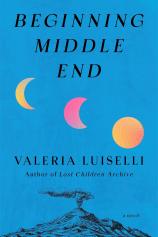
Beginning Middle End
Review
Beginning Middle End



“I had been looking for something like a beginning,” writes Valeria Luiselli's first-person narrator on the opening page of BEGINNING MIDDLE END. “All I had to do, or so I thought, was to answer a simple question: How do I reinvent it, the story, our lives?”
She goes on to explain that, in the wake of a challenging book project and the end of her marriage, she and her 12-year-old daughter (who also has been separated --- due to the unspecified circumstances of the divorce --- from her stepfather and his son, her stepbrother) are having to understand anew what it means to be a family, with just the two of them. So they embark on a bit of an adventure. The mother enrolls the daughter in homeschooling for the remainder of the school year and has the daughter accompany her on a European tour to promote her most recent book.
"BEGINNING MIDDLE END is an unexpected, emotionally resonant, intellectually challenging and richly rewarding novel."
At first, their journey is aimless, but eventually they set their sights on Sicily, a location with importance to their family history. It’s where the narrator's grandmother (known as Nanna) once lived, disguising herself as a man to work on an archaeological site before traveling as a refugee to Latin America and making a home in Mexico. That's where the narrator's mother still lives, and part of the background tension in the novel (along with the narrator's anxiety about being able to write a book and the daughter missing her brother) involves the narrator's worries about her aging mother, who she fears is losing her memory the way Nanna did in later life.
Once the duo settles in for an extended stay at the Catania home of one of the narrator's recent lovers --- a pianist who's away on tour --- they establish routines, one of which involves reading volumes of Loeb Classics that the pianist himself seems to view more as interior design than reading material. Upon reading the Aeneid, the narrator finds a new kinship with the title character: “Aeneas leaves the destroyed Troy, holding the hand of his young son and carrying his elderly father on his shoulders. They are the image of difficult middle age, I think.”
This image is apt in more ways than one. Not only does it reflect their family situation, it also seems to presage later events in the novel. While in Catania, the daughter grows increasingly anxious about the eruption of Mount Etna, though it turns out that they eventually have much more to fear from the wildfires. Its flames are amplified by the winds, the names of which give the book’s four main parts their titles.
The two set off once again, this time for a different part of the island, in search not only of safety from the fire but also for the archaeological site where Nanna once worked and near where she lived. Here their journey starts to bear similarities to the Greek myth of Proteus, whose likeness is captured in a mosaic tile that Nanna took from the site and whose fate grows increasingly symbolic to the daughter in particular.
Along the way, the two characters consider the ways in which time, memory and story interweave with one another --- both the larger story of the world and the very specific stories that are the narrator's livelihood. She grows concerned about not only her mother's memory, but also her daughter's memories, which she fears are growing corrupted by the fictional anecdotes that she pulled from her daughter's life but altered for her novels. In her daughter's mind, however, they become the truth of her own life, substituting for the actual events: “the stream of her memory and the stream of my imagination are flowing into one another, in such a way that we will not know how to tell things apart one day.”
This is just one of many reflections on the nature of fiction and the means of storytelling that will be fascinating not only to writers, but to all readers who enjoy thinking deeply about how fiction works and why. In reflecting on the differences among archaeology, mythology, geology and fiction, she reflects, “In fiction, things are remembered, put together again, woven, recompensed, reinvented. And I suppose fiction is everything that happens in the middle. Everything we didn't see. It is everything we thought was not worth telling, yet, in hindsight, constitutes all there ever was.”
Without giving away too much, near the end of the novel, things take a turn, and once again we start to think about mothers and daughters in a different way. Some things that were unexplained earlier become clear, and the story is brought to life not only through words but also through pictures and postcards. Luiselli, who has long had an interest in soundscapes, also includes a link to a “sonic version” of the novel, which blends the audiobook with sounds captured on site in Sicily. Since I suspect my appreciation for the book will only grow deeper upon rereading, I might explore it in this new way the next time around.
BEGINNING MIDDLE END is an unexpected, emotionally resonant, intellectually challenging and richly rewarding novel.
Reviewed by Norah Piehl on July 31, 2026


Beginning Middle End
- Publication Date: July 28, 2026
- Genres: Fiction
- Hardcover: 368 pages
- Publisher: Knopf
- ISBN-10: N/A
- ISBN-13: 9798217208319