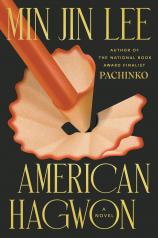
American Hagwon
Review
American Hagwon



Like PACHINKO, Min Jin Lee’s previous bestseller, AMERICAN HAGWON spans decades and features a large cast of characters. The action revolves around John and Helen Koh, and their three children: Bo, DH and Mido. John and Helen came from humble beginnings but have cemented their family in their Christian faith, hard work and education. These qualities have taken them from a corporate posting in New Jersey, where the kids were born, to Sydney, Australia, then back to Seoul.
The novel opens in 1992, with “excessively” quiet Mido and her difficulties in her new Korean school. She is a fine student but socially isolated. That all gradually changes when she is befriended by Yun, an outgoing and vivacious classmate. Yun encourages Mido to join her at the Eagle Academy, one of many hagwons (after-school study programs) in hyper-competitive Seoul.
"The narrative seamlessly travels between the omniscient and close third-person points of view. This rich detail provides an immersive setting and illuminates the lives and choices of a Korean family that readers will not only relate to but care about."
Lee’s detailed prose carries us through the decades as John faces a shocking betrayal by his mentor and friend, Shin, who has come into the clutches of a wily and seductive young woman named Danbi. “There was little she hadn’t done, and there was nothing she wouldn’t do.” The family must relocate back to Sydney. Then, when the 1997 financial crisis hits Korea and John’s company lets him go, they immigrate to southern California to start over. Bo and DH continue their college education, but Mido elects to live at home and continue to teach at the American hagwon founded by Yun’s boyfriend, Lion.
Lion, a Princeton-educated son of professional parents, started Exodus Academy to fund his part-time musicianship. But soon he becomes dedicated to helping students love learning for learning’s sake, trying to dampen the relentless pressure on them to strive for acceptance to an Ivy League college. “He believed that education should be transformational, not transactional.”
This is only a fraction of the characters and landscape in this epic novel. We feel for the Koh family because we know what they are facing, down to the number of dollars Helen can make selling luxury goods to well-off Koreans at the mall. “What she had not realized as a child was that every day you’re alive costs money.” In California, John is reduced to being a fry cook at Shrimp Castle. “As a fifty-two-year-old immigrant with a college degree that didn’t matter here, John was making more than he could wearing a suit.” Yet his dignity is never in question, and the whole family attends church every Sunday. In this world of irreproachable humans, the vanity and cleverness of Danbi (yes, she comes to America, too) is a welcome counterpoint. As her sexual and financial exploits compound, we anticipate her downfall with relish.
Throughout this long novel, Lee deftly showcases human nature (both good and bad). Here’s Bo, now a TA in a psychology masters program, reflecting afterwards on a confrontation with a student: “She was a young person with her own rigid thoughts, trapped in her own rented room without windows and doors.” The narrative seamlessly travels between the omniscient and close third-person points of view. This rich detail provides an immersive setting and illuminates the lives and choices of a Korean family that readers will not only relate to but care about.
Reviewed by Eileen Zimmerman Nicol on September 30, 2026


American Hagwon
- Publication Date: September 29, 2026
- Genres: Fiction
- Hardcover: 656 pages
- Publisher: Cardinal
- ISBN-10: 1538752034
- ISBN-13: 9781538752036