Absence
Review
Absence



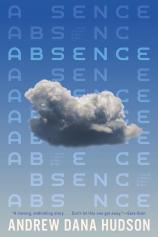
When I first looked at the cover of Andrew Dana Hudson’s ABSENCE, several possible topics regarding the one-word title came to mind. I wondered what kind of absence he was talking about. Maybe it's about a messed-up kid who skips school, or someone who manages never to be there when scary or difficult situations arise. But I could have taken a hundred guesses, and none would be anywhere near Hudson's perspective on or exploration of the subject.
The plots, themes, narration and dialogue all deal with the horror and mystery of how every person on earth would deal with the reality that strikes those in the novel. Individuals or groups of people suddenly disappear without any warning, reason, logic or explanation. The event becomes known as popping. Two people are talking or driving together, or making love. Suddenly only one is there; the other is temporarily replaced by a vacuum, which itself disappears almost immediately. A popping sound is always heard when the victim goes away.
When popping had begun in a few locations around the world, people generally denied it was happening or simply ignored the phenomenon. But then the pops increased dramatically and quickly, and nobody could figure out what was happening. It soon became quite clear that the entire human race was on its way to extinction. The world was ending, and there was absolutely nothing anyone could do about it.
The U.S. government tried desperately to at least ease the suffering of survivors. It created the Bureau of Depopulation Affairs, and the entire nickname of the organization and its raison d'être became Depop. “Pop” now had two meanings, both of which were ugly and depressing: it referred to the “act” of disappearing, and it also was the major element of the word “Depop,” meaning the gradual erosion of the world’s population. In any case, the government decided to send checks to the closest survivors of those who had popped, calling the new policy the Final Deal.
"The novel...drew me in both intellectually and emotionally. I seriously began to question myself. How would I react to Depop? I still don't know, but I've thought about it a lot. Happily, for me, the ending was profoundly satisfying and brilliantly conceived."
So we arrive at the basic plots of the novel. The protagonist is Harvey Ellis, a fairly smart, thoughtful, sensitive and tortured youngish man. He has lost his parents and his beloved fiancée, Kayla, to Depop. He has seen his loved ones all happily go to church together, and it is there that tragedy strikes in the form of a cluster pop.
Harvey eventually decides to work at the Kansas City Bureau as an investigator. His job is to determine if individuals who are in some way connected to an incident of Depop are honest or deceptive. Some run away because they just want to leave their current life for some reason, including their possible desire to escape punishment for a crime they have committed. Harvey must track them down, as well as those who have fraudulently claimed that their spouse, relative or friend has popped. They are the ones who want to get the Final Deal checks.
As Harvey proceeds with those individual investigations, he interviews the person in question to determine if the claim is valid or just a greedy hoax. He brings along with him a machine he has invented and tells the interviewee that it can determine if the pop has taken place when and where the claimant says. When he turns the machine on, he indicates that it shows no sign of a recent pop. The hoaxer then gets very nervous and eventually confesses that he or she made up the story, leading to his or her arrest. Harvey calls his fake device the Ulbay Itshay Radiation Detector, and it works almost every time.
After about 10 years of being very successful at his job, he is called into his boss's office and offered something new --- a very different kind of mission that is far more dangerous and mysterious than any he has been on so far. In this case, he will be assigned to interview and investigate a young woman from the small Kansas town of Dawnville. She claims that she is a Return --- that she had popped but now has returned to this life on earth. Some had made the same claim before but had been quickly proven to be phonies. A true Return would be among the most powerful and beloved people who ever lived, serving as proof that a loved one who has popped can come back to our world and into our lives.
Harvey accepts the assignment. But he can't be allowed to travel by himself. If he pops while on the mission, there must be a witness. He chooses his partner, Shonda Erins, a young Black woman who is strong, wise, skeptical by nature and very beautiful.
When they arrive in Dawnville, they find their target, Gabriela Reyes, in a holding cell in the town's jailhouse. The sheriff explains that she had shown up the day before in a very confused state. She didn't seem to know who she was or why she was there. But by the next day, everything had come back to her. She had been to the places people go when they pop, and then she returned to her life on earth. The townspeople learn that she claims to be the first person who popped in the town. If she is telling the truth, they despise her.
Before her disappearance, the town had considered itself an official Safe zone. No one, they proclaimed, had ever popped there. People from all over the Midwest had moved there, and the town had flourished. If someone suddenly disappeared, they made excuses. But when Gabriela popped, everyone assumed that it was real. And they hated her for ruining their town's reputation. And now, here she is again.
After she is introduced to the town, the investigators and the readers, Gabriela is the novel's central force. She claims very stubbornly, almost religiously, that she is the teenager who popped 10 years ago. When Harvey and Shonda investigate her to try to catch her in a lie or a mistake, she responds with devastating details about her travels to and through other difficult and harsh destinations and universes until she finally reached the city of Strangertown. Everyone who has lived there has been determined to build a beautiful and productive community, and they have accomplished many of their goals. Strangertown seems to be the Depop version of something much like the Christian concept of heaven, but not quite as near perfection.
Gabriela also explains that popping is not a one-time phenomenon. With practice, people can learn to pop from location to location until they reach their hoped-for destination --- usually Strangertown. But after living, striving, contributing and thriving there, she has decided to attempt to conquer the conveyance, the path back to her earthly home. She wants to teach human beings the realities of popping; the need to work, build and grow together in order to save humanity; and to use Depop to gain the ability to pop on command so that everyone can use the techniques she has learned --- not only to save human lives, but also to send more people to Strangertown to make that community even stronger and more wonderful for eternity.
Harvey is impressed with Gabriela's presentation and thinks she could be the real deal. But Shonda believes she's a phony. For the duration of their two-week mission, they argue, fall in and out of love, and live through the terrors of dealing with the people of Dawnville. So many of them can’t stand Gabriela, despise the two federal agents, abhor the government, or hate anyone who has ruined their precious town. More and more pops have been attacking the town, and violence turns into madness. Gabriela, Harvey and Shonda barely escape with their lives.
By the end of the mission, Harvey has met not only angry, despairing and stubborn folks, but also a couple of groups of people who have maintained a sense of hope and consistent decency. Meanwhile, nothing has happened to change either Harvey's or Shonda's mind about Gabriela's story.
The Bureau accepts Shonda’s conclusions, rejecting all of Harvey's ideas and hopes. After some more time at the bureau, Harvey retires and decides to investigate the case again, this time on his own. He feels that he has lost a round but not the fight as he is determined to prove that Gabriela's story is true (or at least find real proof one way or the other).
I shall not proceed lest I spoil the ending. About three-quarters of the way through the book, I began to wonder how Hudson might be able to end the whole thing. Would it be sad or happy? Impossible! What kind of compromise could he possibly create? Was Harvey or Shonda right? Or would we be left hanging? The novel also drew me in both intellectually and emotionally. I seriously began to question myself. How would I react to Depop? I still don't know, but I've thought about it a lot. Happily, for me, the ending was profoundly satisfying and brilliantly conceived.
Anyone who loves thought-provoking novels should read ABSENCE. But you must do so before you pop.
Reviewed by Jack Kramer on July 24, 2026


Absence
- Publication Date: May 5, 2026
- Genres: Fiction, Mystery, Science Fiction, Suspense, Thriller
- Hardcover: 448 pages
- Publisher: Soho Press
- ISBN-10: 1641297581
- ISBN-13: 9781641297585