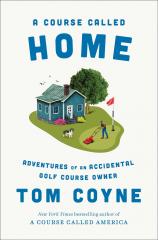
A Course Called Home: Adventures of an Accidental Golf Course Owner
Review
A Course Called Home: Adventures of an Accidental Golf Course Owner



Many people have a vision of golf that’s shaped by what they see when they watch CBS's reverential coverage of The Masters each spring and luxuriate in a vision of the azaleas, dogwoods, and meticulously manicured fairways and greens of the ultra private Augusta National Golf Club. But the world in which most golfers reside couldn’t bear less resemblance to the pristine beauty and privilege of that iconic course.
Instead, average golfers will feel more at home in the tiny corner of the golfing universe that Tom Coyne, editor of The Golfer's Journal, describes in A COURSE CALLED HOME. Coyne's memoir is the story of the role that he and a motley crew of helpers --- some famous and others who never would be known publicly outside the pages of this book --- played in salvaging a failing nine-hole public course in New York's Catskill Mountains. It's a heartwarming tale of determination, teamwork, and the leaps one sometimes has to take on the road to realizing a dream.
"...a heartwarming tale of determination, teamwork, and the leaps one sometimes has to take on the road to realizing a dream.... You don’t have to be a golfer or golf fan to fall in love with this charming book."
As he eloquently has described in books about golf in Ireland and Scotland, and another tracing his golfing trek across the United States, Coyne has been a frequent traveler to many of the world’s finest courses. In early 2023, he responded to an email summons from Shaun Smith, greenskeeper of the Sullivan County Golf & Country Club, in tiny Liberty, New York, to visit the club. Located three hours by car from Coyne's Philadelphia home, in the area once known as the Borscht Belt and formerly noted for classic golf courses at famous resorts like Grossinger's, it billed itself as “The Oldest Golf Course in the Catskills.” If it survived, it would celebrate its 100th anniversary in 2025.
On that first visit, Coyne encountered portions of the property and equipment in a state of decrepitude that beggared the imagination. And yet, with the keen eye of a golf connoisseur and now himself a partner in a course design company, he could see that under a heavy blanket of snow glittered a diamond waiting for knowledgeable and loving hands to polish it. “It was unpretentious, indigenous, unreasonable golf,” he writes, “the sort you can't shape but can only hope to find, and having found it in what might be its final days was as tragic as this view was humbling.”
After that sobering inspection, and with no prior experience operating a golf course, Coyne agreed with the owners to a “kick-the-tires” year, during which he would manage the course while formulating a plan either to purchase it or pass and allow it to be sold and almost certainly plowed under for development. The heart of the memoir recounts, with Coyne's consummate storytelling skill, all the highs and lows he and his team experienced in nursing the course out of the golfing ICU and back to life.
While the book hardly would serve as a manual for an aspiring golf course entrepreneur, Coyne revels in the gritty details of daily public course life --- like mowing fairways in the morning dew or roping off a bunker to protect newly laid turtle eggs --- and the humble task of managing people it entails. His priority was raising money to help nudge the course toward solvency. In the face of increased membership, green and cart fees, he had to win over the stalwarts of the Sullivan County Men's League, who were accustomed to paying $20 for nine holes of golf and a cart on Monday nights. He mined his extensive contacts in the golf world to attract visiting members willing to pony up $400 annually to support a course most of them never would visit.
Partially inspired by the course's unique connection to the early days of aviation, Coyne settled on a whimsical logo that served as the foundation for a merchandising effort. And by the end of the first season, he had devised a plan that not only would preserve all the things that made the club special, but would position it to thrive, reimagined, well into a second century.
But as much as A COURSE CALLED HOME is a golf story, it's also an inspiring tale of the people who bonded so improbably to bring the club to life. Without spoiling the pleasure of discovery, Bill Murray, Jason Kelce and Mike Madden, son of the legendary football analyst, are big pieces of that story. But so are Shaun Smith, like Coyne a recovering alcoholic, who got a second chance when he was sent to Sullivan County for rehab, and found his way to employment at the course, and John, the “former Brooklyn truck-driving, Mafia nephew pro shop manager” Coyne describes in one indelible scene offering a golf lesson to two minivans full of yarmulke-wearing men from one of the nearby communities of ultra-Orthodox Jews.
Forget six-figure initiation fees and gated entrances. Coyne and his cohorts put their money, but more importantly their hearts, into preserving this course as the kind of place golf's Scottish founders might have loved: “a simple spot to play a simple game.”
You don’t have to be a golfer or golf fan to fall in love with this charming book. Asked in an interview with “CBS Sunday Morning” if he would do it all over again, Coyne replied, “Yes, absolutely, one hundred percent, for the people it’s put in my life.” Happily for anyone who reads A COURSE CALLED HOME, they’ll have the pleasure of briefly welcoming those same people into their lives as well.
Reviewed by Harvey Freedenberg on May 29, 2026


A Course Called Home: Adventures of an Accidental Golf Course Owner
- Publication Date: May 5, 2026
- Genres: Memoir, Nonfiction, Sports
- Hardcover: 304 pages
- Publisher: Avid Reader Press/Simon & Schuster
- ISBN-10: 1668030551
- ISBN-13: 9781668030554