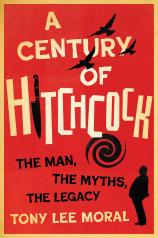
A Century of Hitchcock: The Man, the Myths, the Legacy
Review
A Century of Hitchcock: The Man, the Myths, the Legacy



A CENTURY OF HITCHCOCK, the most recent homage to legendary director Alfred Hitchcock, begins and ends with promise. Tony Lee Moral, who has written several books on Hitchcock, discusses his subject’s genius, frequently using words like “unprecedented” and “innovation.” The early chapters note the pains he went through for as much control over his productions as possible, given that he worked for a stretch with studio honcho David O. Selznick.
The middle part, however, seems more like a hit job on author Donald Spoto, whose own numerous books on Hitchcock portray him in a different, darker light. While acknowledging Hitch’s genius, Spoto makes many claims regarding questionable behavior when it came to the director’s relationships with several of his female actors. Some in Hitchcock’s orbit say there was never any malice intended, just attempts at practical jokes that did or did not hit the mark, depending on who’s telling the story. Moral especially questions the reliability of claims made by Tippi Hedren, a heretofore unknown actress who starred in the classic The Birds and the more controversial Marnie and who accounts for a great deal of the material in the book.
"Your final verdict will depend on what you are looking for. If you want gossip, you will find plenty of it in A CENTURY OF HITCHCOCK. If you would like more of a film studies examination of a master of his craft, I would suggest looking elsewhere."
Moral writes, “Some film historians and fans have argued that Hitchcock’s behavior must be viewed in the context of the time. Hollywood in the 1960s was notorious for its exploitation of actresses, with male executives wielding tremendous power over their female stars. They argue that Hitchcock’s intense directorial methods, though harsh, were not unique and were driven by artistic perfectionism rather than personal malice.” To his credit, Moral explicitly states that historical context “doesn’t excuse any alleged abusive behavior.”
He continues to take Spoto to task, claiming that the writer berated Hitchcock out of spite because his own affection for and admiration of the director was unrequited, making this “competitor” appear small and petty. Other authors have written about Hitchcock’s questionable behavior towards women when it comes to overseeing many aspects of their lives: what they wore, where they went, what they ate, etc. Moral points out that some of the people involved have changed their stories over the years (calling their original comments and/or memory into question), while others, supposedly in the know, have contradicted such anecdotes.
It turns into many chapters of “they said/they said.” In “The Dark Side of Biography” --- a play on the title of Spoto’s THE DARK SIDE OF GENIUS --- Moral criticizes Spoto’s methods, accusing him of deliberately misrepresenting some of his subjects’ interviews. “Spoto was not an impartial investigator,” says Moral, “but was guiding the narrative to build a case to fit his hypothesis.”
Moral finds plenty of people who are willing to counter Spoto. At one point, Spoto was accused of casting aspersions that could not be defended since Hitchcock was no longer alive to defend himself. Ironically, the same thing might be said about Moral’s treatment of Spoto, who died in 2023.
“Hitchcock will always be a giant of cinema,” Moral concludes. “But his reputation will be influenced by cultural shifts and the biographers who tell his story. The Spoto and Hedren case is a perfect example of how Hollywood history is shaped not just by facts but by storytelling. Hitchcock’s reputation has been rewritten by the narratives we choose to tell, which may not necessarily be the objective truth. These narratives are shaped by time, personal grievances, and cultural trends.”
I am in no way defending Spoto. I reviewed his book, SPELLBOUND BY BEAUTY: Alfred Hitchcock and His Leading Ladies, in 2009 and found it to be just another in the popular trend of dirt-dishing. I just find Moral’s use of this platform to castigate a fellow writer somewhat, well, amoral. It does touch on Hitchcock’s place in cinematic history but spends too much time on other topics.
Your final verdict will depend on what you are looking for. If you want gossip, you will find plenty of it in A CENTURY OF HITCHCOCK. If you would like more of a film studies examination of a master of his craft, I would suggest looking elsewhere.
Reviewed by Ron Kaplan (www.RonKaplansBaseballBookshelf.com) on June 18, 2026


A Century of Hitchcock: The Man, the Myths, the Legacy
- Publication Date: June 9, 2026
- Genres: Biography, Nonfiction
- Hardcover: 304 pages
- Publisher: The University Press of Kentucky
- ISBN-10: 1985904446
- ISBN-13: 9781985904446