Interview: January 15, 2026
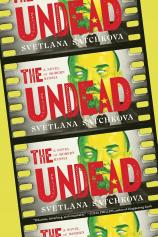
In THE UNDEAD, a gripping tale of contemporary Russia, a young filmmaker and her friends run afoul of a government that ruthlessly oppresses artists who dare to satirize the regime. In this interview conducted by former publicity executive Michael Barson, Svetlana Satchkova talks about her decision to write the novel in English and the impact it has had on her approach to fiction; explains the differences between life in Moscow and New York; and names the three authors who she believes have done the most effective job of writing stories that accurately depict the state of life in Russia.
Question: You’ve had three novels published in Russian previously, but THE UNDEAD is your first to appear in English. Were you aware while writing it that it would be so published? And if so, did writing in English affect the approach you took versus your earlier novels?
Svetlana Satchkova: I left Russia in 2016, and I may never be able to return, even for a visit. Under current laws, what I’ve already said in print about the war in Ukraine could be punishable by up to 20 years in prison. Maybe that would change if Putin’s regime collapsed and was replaced by a democratic one, but I wouldn’t count on it.
In any case, my home is now in the United States. After a few years here, I realized that my audience is here as well. I wrote THE UNDEAD in English, and that choice of language changed how I’ve approached my fiction. I’m still writing about Russia, but I now have to explain Russia to anglophone readers, for whom many things are unfamiliar --- from the nuances of political reality to everyday details, like what the Moscow subway looks like. (Spoiler: many central stations resemble Versailles, with marble, gilded moldings, crystal chandeliers and mosaics. You won’t believe it until you see it.)
At the same time, I try not to overexplain. A novel can’t turn into Wikipedia.
Q: Your protagonist, Maya, is an Indie filmmaker in Russia. Living in New York as you now do, are you constantly tempted to keep up with new film releases?
SS: The truth is, I don’t have much free time. So at some point I had to make a choice --- sacrificing watching films in favor of reading. I’ve seen maybe 20 films in 2025, and most of them weren’t even new.
Q: As one who has written two books about the classic Red Scare period in America, I am fascinated at how the last 10 or 15 years have managed to reinsert Russia --- and its looming threat --- into the forefront of American popular culture. You must have a unique perspective on that rebirth yourself.
SS: My take on this isn’t unique --- many people would agree with me. Putin is, at his core, a very Soviet person. He grieves the dissolution of the USSR and wants to return to a time when he was a young KGB officer and the world was simple and comprehensible. He wants Russia to be a superpower again, just like in the old times. So Russia has returned to the political stage as a villain, and popular culture has responded accordingly.
Q: Living in Brooklyn as you now do, what is the biggest adjustment you have had to make in lifestyle compared to living in Russia prior to 2016? And as a novelist, in what ways (if any) do you find it easier living here?
SS: In Moscow, I had a career as a magazine editor and media manager, and I led a very cushy life, to say the least. I traveled all over the world for film festivals and premieres, interviewed A-list stars, stayed in the best hotels, ate at the best restaurants, and went to fabulous parties. In New York, my husband and I have a rent-stabilized apartment. We travel very little, rarely eat out, and shop at Costco and Trader Joe’s (which I love, by the way). I can’t afford to go to salons to have my hair cut or have anything done to my face.
That contrast is part of what my novel is about: the choice people in Russia often face between living well while staying silent about the regime’s atrocities, sometimes even collaborating with it, and leaving all that behind for an honest life with no material prospects.
But I really have nothing to complain about. I’m living the life of a writer in New York City. What more could I want? Most importantly, I can write about what I want to write about, without fearing for my life or the lives of my loved ones, and without making compromises that rot my soul.
Q: Which authors do you think have done the best job of creating characters and stories that accurately depict the state of life in Russia?
SS: I can’t say I’m a fan of contemporary literature about Russia. The three writers who’ve had the most profound impact on me, and who best depict the current or perhaps eternal state of life in Russia, are all dead and have been for close to or more than a hundred years:
Nikolai Gogol (who was Ukrainian, by the way, but wrote in Russian), Mikhail Saltykov-Shchedrin and Fyodor Sologub. They used satire as a form of social critique, exposing cruelty, hypocrisy, stupidity and moral decay. All three are still extremely funny today, at least if you read them in Russian. Gogol’s most famous work is DEAD SOULS; you can probably guess how the title of my novel came to me.
Q: So as a 21st-century novelist, how have you forged your own path in writing about today’s Russia?
SS: Some readers of THE UNDEAD seem to think that I write in the same absurdist vein, but that’s not quite true. There is certainly humor in my fiction, but this novel is based almost entirely on real events, even when they seem completely made up, like the story about the dog. (People will have to read the book to find out what it is.) While I was working on the novel, my editor left comments in the Word document a few times saying, “This is too implausible,” and I replied with proof links.
Life itself is absurd. But in Russia, this everyday absurdity is layered with something else. An authoritarian state adds its own convoluted grotesqueness, defying logic altogether.