Interview: April 2012
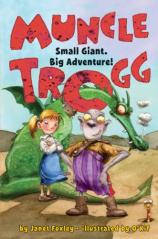
Janet Foxley’s debut novel, MUNCLE TROGG, tells the story of a giant who doesn’t fit in with the other giants because he is too small. But soon it will be up to him to save the giants’ home, Mount Grumble. In this interview, conducted by Kidsreads.com’s Donna Volkennant, Foxley shares her inspiration for writing the book and why she chose giants as her main characters. She also talks about her unique Internet presence, gives advice to aspiring writers, and provides a glimpse into the next Muncle Trogg adventure.
Kidsreads.com: MUNCLE TROGG is a fairy tale about a community of giants living on Mount Grumble, hidden from human Smallings. What was the inspiration for your debut novel?
Janet Foxley: I enjoy making up my own worlds and creating every aspect of their inhabitants' way of life. But I didn't want the story to be so strange that it was unapproachable, so I decided to focus on people who would already be familiar to readers from traditional fairy tales. And out of all the fairy tale characters, I thought giants offered the most scope for fun. Once I'd decided on giants, it was immediately obvious to me that I needed to write about a giant who was too small.
KRC: Muncle, Gritt, Flubb, Sir Biblos, Titan Bulge, and the other characters in MUNCLE TROGG are creative and unique --- and their names are so fitting. How did you come up with such unusual characters and character names?
JF: The characters are really the same bunch of people you might find anywhere. The only difference is that with humans the majority are reasonably pleasant and clever, whereas with giants the majority are brutish and dim. The names largely reflect their characteristics. Gritt is hard and King Thortless --- well, it's obvious why he needs the help of a Wise Man, isn't it? Baby Flubb is flabby, Titan Bulge is fat and gets his first name from the Titans, the race of giants in Greek mythology. Biblos's most precious possession is the Book, so I simply called him by the Greek word for book.
Muncle's first name comes from Latin and Greek. He is a "little man" --- Latin "hoMUNCULus."I took the middle of the word and just changed the spelling to make it look like an English word. And his last name is Trogg because he is a "troglodyte" --- Greek for someone who lives in a hole in the ground.
You will gather from all this that I love language and am fascinated by the history and sound of words!
KRC: Why did you decide to tell the story from the point of view of one of the Giants rather than one of the Smallings?
JF: This has partly to do with my love of making up peoples and societies. I like to really get inside them, not see them with an outsider's eye. But I could also see that there was a lot of scope for humor if everything was the wrong way round, if it was the giants who were afraid of the humans, and if the giants' behavior and tastes and ideas were the norm, and the humans were the ones who were seen as odd.
KRC: The illustrations are delightful and complement the storyline perfectly. What can you tell us about the collaboration process with illustrator O'Kif?
JF: This is something that often surprises readers: Except in the case of very famous and influential writers, authors don't get to collaborate with their illustrators at all. It is the publisher who decides what sort of pictures will suit the book and who will do them.
I love O'Kif's illustrations.They remind me of the pictures that were in my favorite books when I was a child. He has read the book very carefully and shown the scenes exactly as I described them. The expressions on the characters' faces are wonderful. I particularly like Muncle's despair on page 119 and Puglug's rage on page 165. He couldn't have brought my characters to life better if we had collaborated!
KRC: You've written a creative and an entertaining story, yet you did work in some sensitive topics, such as bullying and being excluded for being different. In addition to being entertained, what do you hope young readers will take away after reading the book?
JF: Muncle succeeds by being himself, unlike Gritt, who gets into trouble by trying to join the in crowd. I hope that readers will learn that it's best to be themselves, even if that means being "different"; that the "different" person may actually be cooler than the in-crowd; that we all have a talent for something, we just have to find it; that brainy kids aren't nerds to be teased but essential members of society.
There are also wider issues that can make for discussion topics in school: ethnic stereotyping (the giants' view of Smallings), for example, and the treatment of animals (dragon wing-clipping).
KRC: MUNCLE TROGG features giants, dragons and a dungeon, yet it also contains a healthy dose of humor. How important is the use of humor when writing for young readers?
JF: I think a touch of humor is useful in any book, but especially so in children's books. In MUNCLE TROGG, the humor arises almost organically from the contrast between the giants' way of life and the one the reader is used to. The idea of eating earthworms does turn off a few fastidious girls, but it attracts a lot of reluctant boy readers!
KRC: Your website is lots of fun! The "Turn Yourself into a Giant!" exercise is especially entertaining. How has your presence on the Internet helped you connect with young readers?
JF: My readers are mostly too young to use the Internet themselves, so I mainly reach them through their parents and teachers. I do get some fan mail through my contact page, and teachers also use it to arrange school visits. Some teachers make a point of putting my website up on the classroom smart-board before my visit so the children already know a bit about me before they bombard me with questions.
KRC: How has winning the London Times/Chicken House Children's Fiction competition affected your writing career?
JF: It has made my career. Publication was the prize for winning the competition, enabling me to bypass the soul-destroying process of receiving a stream of rejections from every agent and publisher I approached. I had been writing for 35 years before I won the competition, and then within a year I went from being unpublished to being published, or about to be published, in 22 countries. It has been a surreal journey.
KRC: You are a painter as well as a writer. How does being a visual artist complement your writing?
JF: I enjoy messing about with experimental painting techniques, and occasionally I produce something worth putting in a frame, but painting is really only a hobby --- a refreshing break from the intensive thinking process that is writing, in the same way that gardening and sewing are. Doing something practical and physical is excellent for resting the brain.
KRC: What can you tell us about plans to make MUNCLE TROGGinto an animated feature?
JF: Very little! I have seen a plot outline and understand that a script is being written at the moment. It looks like it might be quite different from the book, very American and very funny.
KRC: What advice do you have for young readers who want to become writers?
JF: Read, read, read. Read a story once for pleasure, and then read it again to see why it works, what you like about it and what you don't. That way you'll learn what makes a good book. And work hard at school so you can get a good day job, because most writers don't earn enough from writing to live off!
KRC: Are you currently working on another Muncle Trogg adventure? If so, what can you tell us about it?
JF: The next book, MUNCLE TROGG AND THE FLYING DONKEY, will be published in America next Spring. The story starts just after the end of MUNCLE TROGG and tells us what happens next. I have just started to write a third adventure, which doesn't have a title yet, but which again will be a continuation of the previous book.