Interview: December 4, 2025
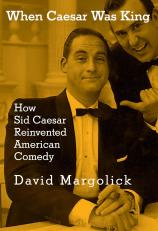
WHEN CAESAR WAS KING is the first definitive biography of Sid Caesar, the founding father of television comedy and an icon to generations of Americans. In this interview conducted by former publicity executive Michael Barson, longtime New York Times and Vanity Fair writer David Margolick talks about his research for the book and the surprises he unearthed about Caesar’s rise to television stardom and subsequent fall; the frustrating unavailability of full episodes of Caesar’s iconic variety program, “Your Show of Shows”; and Caesar’s volatile relationship with Mel Brooks and what might have been had he pivoted to a film career as Brooks did.
Question: Your book covers the full arc of Sid Caesar’s rise to television stardom to his precipitous fall during the ’50s. In the course of doing your research, what was the single most surprising fact you unearthed about his volatile career?
David Margolick: Everything I learned about Caesar was really a surprise, because I (like just about anyone my age; I was born in 1952) knew so little about him. I think most striking was just how popular he'd been, especially among elite viewers, and how precipitously he fell. As Mel Brooks put it, he was just "used up," and it happened so fast! Also surprising was how much of a watershed in the history of television Caesar's fall was seen to be, even at the time. Amazingly, people were still shocked that TV would favor profits over quality. Imagine that!
Q: Like so many savants throughout the history of entertainment media, Sid Caesar never really seemed to fit in --- neither with his fellow actors nor with his corporate bosses. Do you feel that Caesar was simply a man out of his own time? Would he have flourished better in our own day and age with his unique sensibility?
DM: Sid Caesar was one of a kind, unfathomable even to his closest co-workers, and would never have fit in, then or now. I think he actually lucked out in his timing. In the desperate, frontier world of early television, more allowances were made for someone like Caesar. He helped fill all those empty hours, and got the ratings, attention and respect, so they put up with the rest of him, at least for a while.
Q: It’s frustrating that it’s so difficult to view the bulk of “Your Show of Shows” episodes because of its preservation having been limited to kinescope, unlike contemporary TV classics like “I Love Lucy” and “The Honeymooners.” Is there anything that can be done to widen its availability now?
DM: I doubt it. Caesar made various attempts to cut up the original shows and repackage them into bite-sized pieces, but they never caught on. They don't really lend themselves to such a format. It's true that the kinescopes aren't as crisp and clear as filmed sitcoms like "I Love Lucy," but that's the problem. Like the best early comics in Hollywood, the amazing things Caesar did transcended the technology of the time. It's that his best stuff is too rare and rarefied. While the best of Caesar is glorious, lots of it is not. Given the insatiability of live TV, repetition and mediocrity were inevitable.
You could put together some interesting collections for theatrical release (as Julian Schlossberg did in the early 1970s with Ten from Your Show of Shows), documentaries or television specials. They could be built around Caesar's wonderful but unappreciated film spoofs, for instance, or his German Professor sketches, which are a mother lode of the early and entirely unseen Mel Brooks.
Such compilations also could be showcases for the more ambitious sketches from "Caesar's Hour," the largely overlooked but equally distinguished show that followed "Your Show of Shows." (That was the show where Caesar had his legendary writers' room, with Brooks, Neil Simon and Larry Gelbart all working for him at once.) But I'm afraid that Sid Caesar is destined to remain a cult figure, which was what he was becoming as television spread to the hinterlands in the mid- to late 1950s. When he was knocked off weekly TV, it was by Lawrence Welk. Him, of course, they still show!
Q: Mel Brooks is revealed to be one of the few who could navigate the bumpy road of friendship with Sid Caesar over a long period of time. His suggestion (unaccepted) that Caesar transition to a career in film is painful when one considers the trailblazing film work Brooks went on to do himself over the next 60 years. Is this an “if only” that haunts you as well?
DM: Well, Brooks had his ups and downs with Caesar. People (including Brooks) forget that when "Your Show of Shows" ended, Brooks actually left Caesar. So tightly were they interwoven that he needed to get away from him. And it's unclear to me how Brooks would have deployed Caesar in whatever movies he wrote for him. Brooks on his own was far more solicitous of Caesar than Caesar's other former colleagues, throwing him roles from time to time when he was scratching for work, but those parts were very small. Brooks clearly felt that on some level, Caesar was either too hobbled or burned out to do more (Caesar wasn't really acting in It's a Mad, Mad, Mad, Mad World, for instance; he was genuinely unhinged), too imperial for conventional acting gigs, or just too difficult to work with.
Q: Sid Caesar’s national popularity carried an early expiration date, for all the reasons your book illuminates so vividly. Who would you suggest had the most similar career arc in the field of comedy over the past 60 years?
DM: I'm not enough of a student of the subsequent history of comedy to give you a good answer. I'm sure there've been other comics since Sid Caesar who've been undone by alcoholism, pressure, fame, or their own sensitive or precarious psyches. The arc is familiar, but the scope is so much smaller.
But I doubt there really was ever anyone like Sid Caesar, whose rise and fall was so dramatic and, thanks to television, so out there for everyone to see. The landscape has grown much more cluttered, and the public so much more jaded, since then. So if there have been subsequent Sid Caesars --- which I very much doubt --- they've come and gone much less conspicuously.