City of Widows
Review
City of Widows



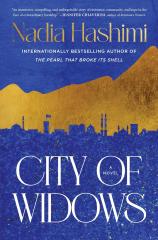
The chaotic American withdrawal from Afghanistan in 2021 serves as the backdrop for Nadia Hashimi’s gripping new novel, CITY OF WIDOWS. Told largely from the perspective of Marjan, a woman living in Kabul with her young daughter, Hawa, this hopeful yet sobering book highlights the complex experiences of Afghan women, whose hard-won freedoms are in jeopardy as the Afghan government collapses and the Taliban swiftly moves in to take control of the country.
We meet Marjan in the final days of the United States’ 20-year occupation after she and Hawa have taken refuge in a community of widows who have carved out a fragile space for themselves on the edges of the capital city. A self-described “outcast,” Marjan is uneasy even in this relatively safe space. She has spent years on the run, and when the group’s leader asks her to share her story, she is at a loss. “She has written, erased, and rewritten her story so many times that she has worn through the paper and vanished her own history.”
"The chaotic American withdrawal from Afghanistan in 2021 serves as the backdrop for Nadia Hashimi’s gripping new novel... In addition to capturing the richness of Afghan women’s lives, Hashimi draws on the country’s rich literary and musical traditions..."
But in CITY OF WIDOWS, Marjan finds her voice, as her story is gradually revealed in parallel timelines that finally converge at the end of August 2021, as she fights to find a way to get herself and her daughter on one of the final flights out of Kabul. Readers will doubtless remember the images of desperate Afghans crowding the airport as they tried desperately to leave the country. Hashimi brings a frantic immediacy to those scenes, as Marjan and Hawa return repeatedly to the airport, where they endure punishing conditions and narrowly survive an attack by a suicide bomber.
Like so many people hoping to flee the country, Marjan knows that there is a target on her back. She is a soldier with the Afghan Female Tactical Platoon, a real-life all-female military unit that assisted the Americans on special missions. Cultural norms meant that women could not communicate with male soldiers, so members of the FTP deployed to remote locations alongside their American counterparts assisted with questioning women about Taliban targets. After a difficult life, Marjan’s service with the FTP gave her purpose and confidence, but the ultra-conservative Taliban will not look kindly on her collaboration with the Americans.
However, Marjan is not just afraid of Taliban reprisal. Her bigger fear relates to Abdul Khaliq, the warlord she was forced to marry at the age of 13, becoming his fourth wife. Marjan --- whose birth name is Rahima --- fled her husband’s home as a teen after their first child died. Hawa was born after Marjan’s escape, and she believes her father is dead. Meanwhile, her mother has spent the intervening decade looking over her shoulder while also carving out a life for herself in a country where women have few rights, both legally and culturally.
CITY OF WIDOWS offers a fascinating look into the multifaceted lives of Afghan women. Marjan recalls her childhood, when she was a bacha posh, a girl allowed to dress and behave as a boy. That unique position --- one she was granted because her parents did not have a son --- makes her something of a shapeshifter, and she relies on her ability to adopt other identities when she flees her husband and again as she works to escape Kabul. While Marjan opts to conceal her femininity, other women in the book, like her vibrant friend Soraya, embrace it.
Whether they are running a shelter for victims of domestic violence, attending university, hosting a news program, or studying music (as Hawa does), the women Marjan encounters over the course of her journey have found their own ways of living in a society where females lack the freedoms that many American women now take for granted.
In addition to capturing the richness of Afghan women’s lives, Hashimi draws on the country’s rich literary and musical traditions, particularly in scenes involving Hawa, who has chosen to play the rubab, a stringed, lute-like instrument. Hawa’s love of music stands in stark contrast to the Taliban’s strict opposition to music and song and is a reminder of all she stands to lose as they take power.
This sense of loss pervades CITY OF WIDOWS, and the crushing reminder of all that’s been taken from her over the years has left Marjan skittish and wary. But she comes to realize that if she wants a different life for herself and her daughter, she must learn to let others in, sharing her story and forging connections that will allow her to write a new beginning.
Reviewed by Megan Elliott on July 31, 2026


City of Widows
- Publication Date: July 28, 2026
- Genres: Fiction, Women's Fiction
- Hardcover: 432 pages
- Publisher: William Morrow
- ISBN-10: 0063423545
- ISBN-13: 9780063423541